

A character turns toward camera. A fabric catches light. A city moves beyond the window. These are small events, but they decide whether an image feels like cinema or like a generated artifact. AI animation software now gives independent creators access to motion once reserved for teams with large budgets, long schedules, and specialized pipelines. The access is real. The artistry is still earned.
For filmmakers, the question is not whether artificial intelligence can make something move. It can. The question is whether that motion holds a shot together: whether it reveals character, creates pressure, establishes place, or lets an impossible image become emotionally legible.
Want to bring your cinematic ideas to life? Create stunning AI videos with AICINEO and start turning your imagination into moving pictures today.
AI Animation Software Is a New Department
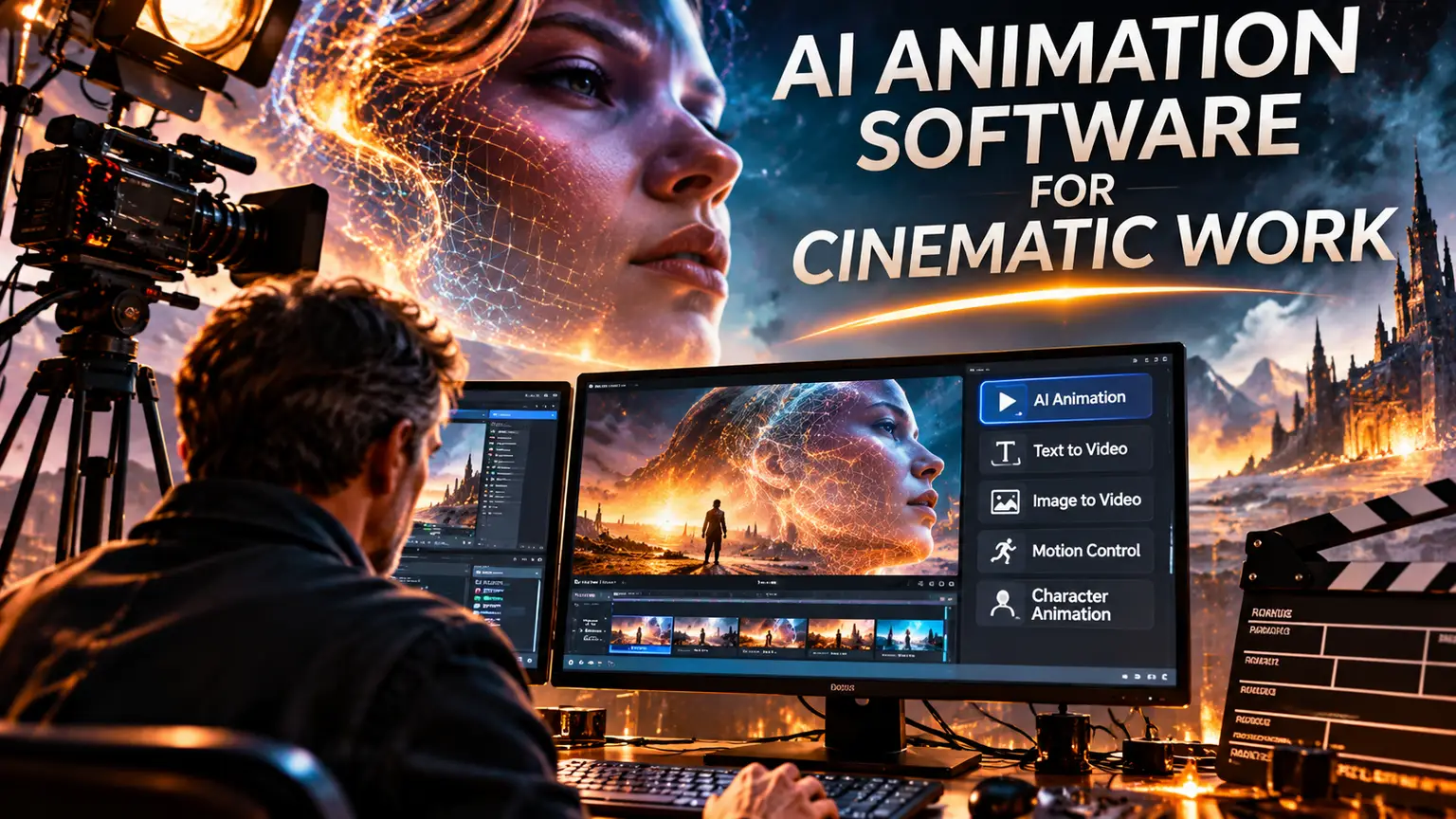
The phrase can make the category sound like a single kind of tool. It is not. AI animation software now spans image-to-video generation, text-to-video systems, motion transfer, character performance, lip sync, interpolation, camera movement, rotoscoping, and stylized 3D workflows. Some tools begin with a prompt. Others begin with a drawing, a storyboard frame, an actor's performance, or a carefully composed still.
That distinction matters because every starting point gives the filmmaker a different kind of control. Text-led generation is useful when the scene itself is still being discovered. It can suggest worlds, transitions, and physical logic that would be expensive to build conventionally. Image-led animation is often stronger when the production already has a visual language. A reference frame can carry costume, color, lens feeling, production design, and composition into the moving shot.
Performance-driven systems occupy another territory. They can translate facial movement, body motion, or voice into an animated figure. Their value is not simply speed. They allow a director to preserve the irregularity of a live performance while placing it inside a drawn, synthetic, surreal, or otherwise unreachable world.
None of these categories replaces the others. A short film may use generative motion for an establishing shot, tracked animation for a lead character, and conventional editing to make both belong to the same emotional reality.
The Shot Comes Before the Tool
A cinematic workflow begins with intent. Before opening a model, define the shot in film terms: subject, action, framing, duration, camera behavior, light, and the change that occurs by the end. “A woman walks through a futuristic hallway” is a premise. “Locked medium close-up as she crosses a pulsing corridor, realizes she is being watched, and stops one beat too late” is a shot.
That level of direction changes the output. It also reveals when a generated sequence is not doing its job. A visually impressive clip may still fail because the camera drifts without purpose, the character loses identity between frames, or the action never lands on a usable edit point.
The strongest creators treat generation as a set of takes. They make variations, isolate the useful two seconds, and build continuity in the edit. This is closer to directing than pressing a button. A generated clip is raw footage with unusual properties: abundant, unstable, and full of accidental discoveries.
A practical sequence often starts with a reference image or a small run of boards. The filmmaker then tests movement at a short duration, evaluates identity and spatial consistency, and only extends the shot when the visual logic is holding. Working this way reduces wasted renders and prevents a common trap: building a scene around a beautiful first result that cannot be repeated or cut with anything else.
Motion Has to Mean Something
Movement is one of cinema’s most persuasive tools. A slow push-in can turn a neutral face into a confession. A handheld tremor can make an environment feel unsafe. A sudden stillness can be more dramatic than spectacle.
AI-generated motion can be hypnotic because it is fluid, unpredictable, and often slightly unreal. That quality is useful when the story needs dream logic, transformation, memory, or unease. It is less useful when the scene requires clear geography, precise physical action, or sustained character acting. The trade-off is not a flaw in the medium. It is a directorial choice.
If a sequence depends on a hand placing a glass on a table, a character navigating a room, or two performers maintaining eye contact across multiple cuts, use the method that gives you enough control. That may mean combining AI output with keyframing, compositing, motion capture, 3D blocking, or live-action plates. Cinema has always been hybrid. AI simply adds another material to the set.
Where the Software Changes Production
The most consequential shift is not that a solo artist can generate a moving image. It is that visual development and production can now overlap. A frame made during early concept work can become the seed for a scene. A test animation can reveal the mood of an entire film. A discarded variation can become a transition, a dream fragment, or the opening image of a new sequence.
This compresses the distance between imagining and seeing. It does not compress judgment. In fact, judgment becomes more visible. When images are easy to produce, selection becomes a major creative act. Which version has tension? Which imperfection feels alive rather than broken? Which shot belongs to this film rather than any film?
That is why curation matters as much as generation. An AI cinema project needs a coherent visual grammar: recurring shapes, a disciplined color world, consistent camera language, and a reason for its transformations. Without those decisions, abundance becomes noise.
Sound also carries more weight than many creators expect. A generated image can tolerate moments of visual instability when the sound design gives it physical presence. Footsteps, room tone, fabric, mechanical vibration, breath, and carefully placed silence establish reality faster than another round of visual prompting. Animation becomes cinema when image, duration, cut, and sound begin to argue with and support one another.
What to Look for in AI Animation Software
The best tool depends on the film, not the feature list. Still, four qualities deserve attention: controllability, consistency, speed, and rights clarity.
Controllability is the ability to direct composition, motion, reference images, camera behavior, and revision. Consistency is whether characters, environments, and objects remain recognizable across a sequence. Speed matters because iteration is the actual production process, but raw generation speed is less valuable than a workflow that lets you find, compare, and revise strong takes quickly. Rights clarity matters because a film is meant to travel - through festivals, screenings, client work, distribution, and public culture. Know what the platform permits before making it part of the production foundation.
Creators should also evaluate outputs at the scale where audiences will see them. A clip that feels convincing on a phone may collapse on a large display, especially in faces, fine textures, edge detail, and fast action. Test the image in context, with sound and adjacent shots. A frame is not a film.
The New Craft Is Editorial
AI animation will not make every filmmaker an animator in the traditional sense. It does create a wider class of image-makers who must think like directors, editors, production designers, and performance coaches at once. The technical barrier is changing. The demand for taste is not.
This is good news for artists with a point of view. A distinctive film does not need to demonstrate every capability of the software. It needs to make choices. It can be spare. It can hold on an image. It can let an imperfect morph become the emotional event rather than hiding it.
At AICINEO, that is the frame worth protecting: AI cinema is not a demo category. It is a developing film language. The software will keep changing, sometimes monthly. A precise eye, a clear dramatic instinct, and the willingness to reject the merely impressive will remain durable.
Make the next shot for the feeling it must leave behind. Then choose the system, process, and amount of machine intervention that can carry that feeling to the screen.