

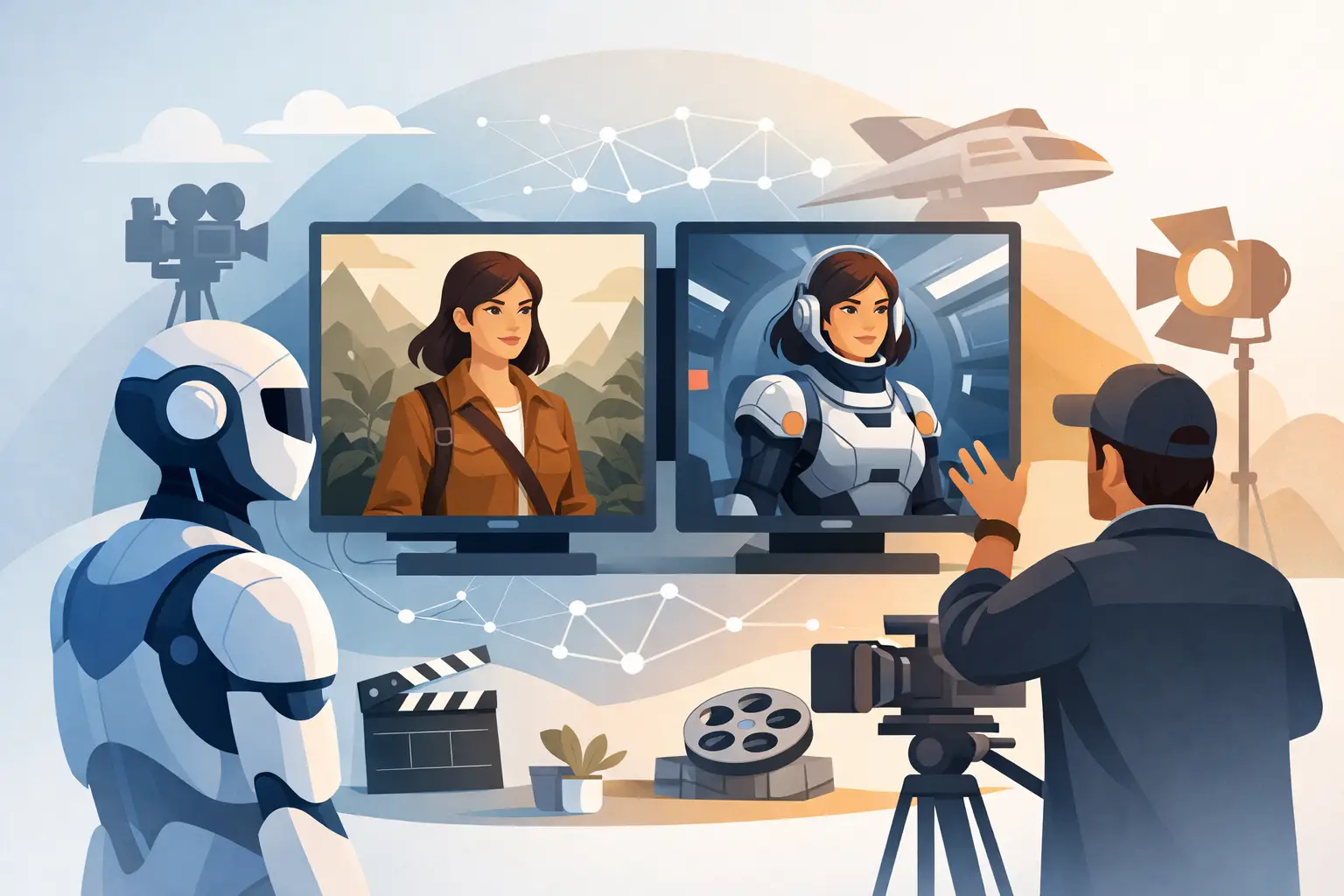
A character changes costume between scenes. Their face shifts by a few years. The light catches a different eye color. Their hands no longer belong to the person who spoke in the previous shot. The audience may not name the problem, but they feel it immediately.
AI character consistency is not a minor technical cleanup. It is one of the conditions that turns generated footage into cinema. When a viewer believes the same person has crossed a room, survived a night, made a choice, and returned in the next scene, story begins to hold.
For AI filmmakers, consistency is often framed as a prompt problem. It is larger than that. It is a direction problem, a production-design problem, an editing problem, and, ultimately, a performance problem.
Why AI character consistency carries the story
Cinema asks viewers to accept fragments as continuous life. A close-up, a wide shot, an over-the-shoulder angle, and a reaction shot may be filmed hours apart. Editing makes them feel like one moment. Traditional production has departments, casting, wardrobe, makeup, and continuity supervision to protect that illusion.
AI cinema compresses those departments into a new creative workflow. A creator may generate a character portrait, animate a motion pass, construct an environment, alter a camera angle, and rebuild a shot several times before the sequence works. That freedom is powerful. It also means every new generation can quietly rewrite the cast.
The risk is not only a changed face. A character can remain visually similar yet lose identity through altered posture, age, body proportions, costume logic, or emotional energy. A fighter who carries herself with controlled stillness in one scene should not become casually weightless in the next unless the film gives that transformation meaning.
Consistency does not mean sameness. A character should change under pressure. Their hair can become wet, their clothing can tear, their expression can harden, and their silhouette can evolve. The question is whether those changes feel authored. Continuity gives transformation somewhere to land.
Build the character before you build the shots
The strongest approach begins before motion generation. Treat the lead character as a designed cinematic asset, not a description that gets rewritten in every prompt.
Create a character bible with a clear visual hierarchy. Start with the details that must survive every shot: facial structure, age range, body type, skin tone, hair shape, signature clothing elements, and any defining mark or object. Then define the details that may vary, such as jacket condition, jewelry, makeup intensity, or a secondary costume layer.
This distinction matters because generative systems respond differently to different kinds of visual information. If every detail is equally emphasized, the result can become overdescribed and unstable. A few unmistakable anchors usually travel further than a paragraph of adjectives.
For a noir protagonist, the anchors might be a narrow face, close-cropped silver hair, a scar at the left brow, a dark green wool coat, and a deliberate, unsmiling gaze. The coat can collect rain. The scar can fall into shadow. The expression can break. But the character should still read as the same person at a glance.
Reference images are the practical foundation. Build a focused reference set rather than relying on one heroic portrait. Include a neutral close-up, three-quarter view, profile, full-body frame, key costume details, and expressions that matter to the film. If action is central, include references that establish stance and physicality. The goal is not to create a museum archive. It is to establish a visual source of truth.
Design for recognition, not decoration
Distinctiveness helps, but visual noise does not. Complex patterned fabrics, excessive accessories, changing hairstyles, and highly reflective materials can create unnecessary drift from shot to shot. They may look striking in a single image while becoming difficult to reproduce through an entire sequence.
This is a trade-off, not a rule against ambitious design. An extravagant character can work if their silhouette and core features remain legible. The practical question is whether the design serves the film's visual language or merely makes one frame more impressive.
A useful test is to reduce the character to silhouette, palette, and posture. If they remain recognizable, the design has a chance to endure across scenes.
Treat each shot as part of a continuity system
A single strong clip proves almost nothing. The real test arrives when the character must exist in a sequence.
Before generating multiple angles, decide what the scene is doing. Where is the character standing? What are they wearing at this exact point in the story? What happened seconds before the shot? Which direction are they moving? What is their emotional temperature? These choices provide constraints that make generation more coherent and editing more possible.
Work from an anchor shot. This is the frame that establishes the character, costume, setting, lighting, and scene mood. Once it is convincing, use it as the visual parent for nearby shots. Build the medium shot, profile, reaction, and insert around that center instead of inventing each angle independently.
Prompt language should repeat the non-negotiable traits with disciplined consistency. Keep character identity separate from shot direction. One section of the prompt can hold the character anchors; another can define lens feeling, framing, action, light, and environment. This makes iteration easier because the filmmaker can alter the camera without accidentally recasting the role.
Still, reference and prompts are not guarantees. Review generated shots in sequence, not as isolated thumbnails. A shot that looks excellent alone may fail beside the previous frame because the jawline is wrong, the coat is a different material, or the character's height has changed relative to the environment.
Motion reveals what still images can hide
A face can match in a portrait and fail the second it turns. Motion exposes continuity issues in anatomy, gait, gesture, and performance rhythm.
This is why physical direction belongs in the character bible. Define how the character occupies space. Do they lead with the chin or keep their head lowered? Are their movements sharp, guarded, restless, ceremonial? Do they move fast while their face stays composed? These choices create a repeatable screen presence.
For dialogue scenes, restraint often helps. Extreme facial motion can produce visual instability and may distract from the line itself. A smaller turn of the head, a controlled glance, or a hand tightening around an object can carry more conviction than an elaborate animated reaction.
Camera strategy matters too. If an exact face match is difficult in a pivotal moment, do not force every emotional beat into an exposed frontal close-up. Use profile, shadow, reflection, a cutaway, a shoulder frame, or a reaction from another character. This is not hiding a limitation. It is filmmaking. Cinema has always used framing to control attention and preserve mystery.
Edit for belief, not for proof
Trying to prove that every frame was generated perfectly can weaken a film. The audience does not need a forensic demonstration. They need to believe the scene.
Editing can protect character continuity through rhythm and selection. Cut on movement when possible. Use a match in posture, eyeline, or gesture to bridge two shots. Let sound continue across a visual cut. Keep lighting transitions motivated by location and time. These decisions give the viewer a coherent path through material that may have been created in separate passes.
Color treatment can also unify variations. It cannot repair a different person, but it can bring adjacent shots into the same world by aligning contrast, grain, saturation, and shadow behavior. The same applies to production sound, voice performance, and music. Identity is audiovisual. A familiar voice, breathing pattern, or recurring sonic detail can reinforce a character when the image is under pressure.
There is a limit. Editing should not become a permanent substitute for a stable character design. If every cut is engineered to conceal drift, the film will become visually timid. Return to the source references, simplify the setup, or regenerate the shot when the mismatch changes who the character appears to be.
When inconsistency can become the point
Not every AI film needs conventional continuity. A character who shifts faces may be the premise. A dream sequence may mutate its cast. An unstable digital avatar may become more compelling when its identity flickers between human, synthetic, and symbolic forms.
But intentional instability requires a readable baseline. The audience must understand that the change is expressive rather than accidental. Establish the character clearly first. Then break the image with purpose, timing, and consequence.
This is where AI cinema can move beyond imitation. Generative tools make identity unusually elastic. Filmmakers can use that elasticity to portray memory, surveillance, grief, simulation, transformation, or fractured selfhood in ways live-action production rarely permits. The effect becomes powerful when it enters as a decision, not a defect.
A continuity pass belongs in every AI film
Before picture lock, watch the film once with story in mind and once with identity in mind. On the second pass, ignore whether a shot is beautiful. Ask whether every character remains themselves from cut to cut.
Look for the small fractures: a disappearing ring that has narrative importance, a hairstyle that jumps between scene coverage, a different shoulder width, a voice that loses its texture, a costume that returns too clean after an action scene. Then separate issues into two groups. Some can be corrected through color, sound, reframing, or a better cut. Others require a new generation because they alter the person on screen.
AICINEO sees AI cinema as a medium with its own grammar, not a novelty filter placed over filmmaking. Character continuity is part of that grammar. It is where generative possibility meets cinematic discipline.
The goal is not to make AI disappear. The goal is to give viewers a character worth following long enough that they stop watching the technology and start watching the film.