

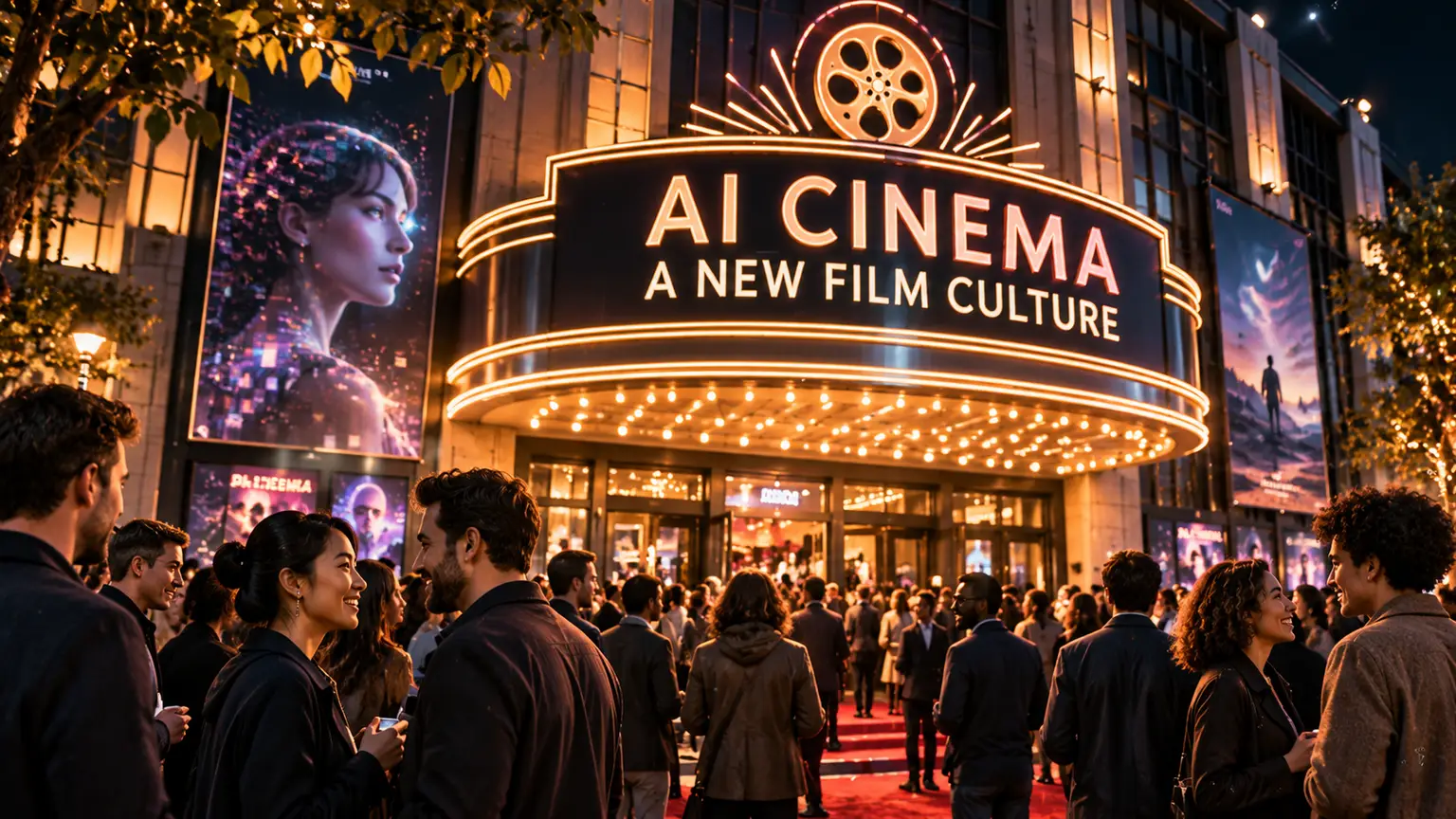
A frame appears: a city made of wet chrome, a face that has never existed, a camera move that would have required a crane, a crew, and a closed street. The question is no longer whether AI cinema can produce an image. It can. The question is whether that image carries intention.
That is the line separating a technical demonstration from a film culture. AI cinema is not defined by a prompt, a model, or a spectacular visual anomaly. It is defined by the decisions surrounding those tools: what the filmmaker chooses to show, withhold, repeat, cut, score, and leave unresolved.
The medium is arriving fast. Its standards should arrive with it.
https://www.aicineo.com/
AI Cinema Needs Its Own Screen
For years, artificial intelligence has been discussed as software - a faster route to concept art, a shortcut in post-production, a production aid. Those uses matter, but they do not describe the whole territory. Cinema has always absorbed new machines and turned them into language. Lightweight cameras changed documentary. Digital editing reshaped rhythm. Computer-generated imagery expanded the possible scale of a world.
Generative systems introduce a different shift. They can participate in the construction of the image itself. A director can work from an impossible location, transform a visual reference into a sequence, test an atmosphere before a set exists, or build an animated performance through iteration. The process may be less linear, but the cinematic choices remain recognizable: composition, duration, continuity, point of view, sound, pace, and emotional pressure.
Calling every AI-assisted clip a film would flatten the medium. Calling it all a gimmick would miss the moment. Serious work sits between those extremes. It recognizes the technology as a new material while holding it to the old and difficult demands of cinema: make us look, make us feel, make us remember.
A dedicated cultural frame matters because moving images need context. A five-second experiment can thrive in a feed. A short film needs an audience prepared to stay with its rhythm. A collection needs curatorial judgment. A movement needs places where artists can be seen beside one another rather than scattered across product announcements and algorithmic noise.
The Tool Is Not the Author
AI changes authorship, but it does not erase it. It makes authorship more visible in some places and more complicated in others.
A filmmaker may not draw every texture or animate every gesture by hand. Yet that filmmaker can still direct the outcome through references, selection, sequencing, revision, sound design, editing, and a clear sense of what does not belong. In generative production, rejection is often as expressive as creation. Knowing which hundred images are wrong is part of knowing what one image should be.
This does not mean every use of AI carries equal creative weight. There is a real difference between accepting a first result and shaping a work across dozens of deliberate decisions. There is also a difference between using a model as a visual sketchbook and presenting generated material as if no human labor, source material, or system influenced it.
The industry needs better language than either extreme offers. “Made by AI” can obscure the work of writers, performers, editors, designers, and directors. “Made without AI” can obscure the systems already embedded in modern production pipelines. The useful question is more specific: how did AI participate, and where did human judgment determine the film?
That clarity is not a burden. It is part of the craft. Credits, process notes, and candid discussion can give audiences a more intelligent way to encounter the work. Transparency also protects the artists whose voices, likenesses, styles, and labor should not become invisible raw material.
What AI Cinema Changes on Set
The traditional set is built around scarce resources. Time is expensive. Locations are limited. Weather cannot be negotiated with. A shot that exists in a director’s mind may remain there because the budget cannot carry it.
AI cinema changes the economics of imagination. A small team can explore worlds, historical settings, creatures, transformations, and camera language that once belonged only to productions with extensive resources. That does not make filmmaking easy. It changes where the difficulty lives.
The challenge moves upstream into development and downstream into refinement. A creator needs a strong visual thesis before generating hundreds of possible directions. They need to protect character consistency, spatial logic, performance, and narrative progression after the first impressive image. They need editing discipline when every shot can become more elaborate than the last.
This is why filmmakers with taste will matter more, not less. Access to image generation broadens the field. Taste creates distinction inside it.
The strongest AI films will not merely announce their technical method. They will use it where it is dramatically necessary. An unstable dreamscape may benefit from synthetic transformation. A speculative documentary may use generated reconstruction to make an absent world perceptible. An animated fable may find its own texture in the artifacts, mutations, and unexpected motion of the process.
But some stories will demand physical locations, human performances, practical effects, or traditional animation. The future is not a replacement schedule. It is a larger production vocabulary. The right method depends on the story, the ethics of the material, and the feeling the filmmaker wants to preserve.
The New Craft Is Editorial
Early generative video often asks the viewer to admire possibility. A serious film asks the viewer to follow meaning.
That requires editorial intelligence. It is not enough for a sequence to look expensive, strange, or technically improbable. What does the shot reveal? Why does it arrive now? What does the cut do to our understanding of the character or the world? Does the sound deepen the image, resist it, or expose its artificiality?
Editing is where AI cinema can become cinema rather than a stream of visual events. A cut creates cause and effect. Duration creates tension. Repetition turns an image into a motif. Silence can expose the loneliness beneath a flawless synthetic surface.
Sound deserves special attention. Generated visuals can be seductive enough to overpower everything around them, but film is not a gallery wall. Sound gives moving images weight, place, and consequence. A restrained score, an imperfect room tone, a voice with texture, or a sharply placed absence of sound can make an unreal image feel emotionally precise.
The same applies to writing. Generative tools can accelerate ideation, but they cannot replace a point of view. Audiences recognize when a film has no inner necessity. They may not use that phrase, but they feel it in the first minute: the work is showing possibilities because it has nothing to say.
Curation Is Part of the Medium
When production becomes more accessible, selection becomes more valuable. There will be more films, more fragments, more striking first frames, and more work competing for the same attention. The answer is not to celebrate volume. It is to develop standards.
AICINEO exists within that need: a destination where AI-made and AI-assisted motion-picture work can be encountered as cinema, not as a side feature of a software release. That distinction shapes the audience experience. It asks viewers to consider form, authorship, and ambition. It asks creators to make work that can stand in a program, not merely perform in a feed.
Curating AI cinema means looking beyond the novelty of generation. Does the film have a coherent visual world? Does it take an artistic risk? Does it use the medium in a way that feels necessary rather than ornamental? Does it respect the people and materials implicated in its creation? Can it survive a second viewing after the surprise has faded?
These are not gatekeeping questions. They are invitations to take the work seriously.
A Culture Worth Building
Every new film language passes through an awkward period. The images are exciting, the vocabulary is unsettled, and the public argument often becomes louder than the work. AI cinema is in that period now.
Its future should not be handed over to model demos, content farms, or empty panic. It belongs to directors who can find an image no one else would choose, artists who can make technological instability feel human, and audiences willing to reward intention over speed.
Make the experiment. Then make the cut that gives it purpose. The next era of cinema will be shaped not by the machine that produces the most images, but by the people who know which image deserves to stay.