

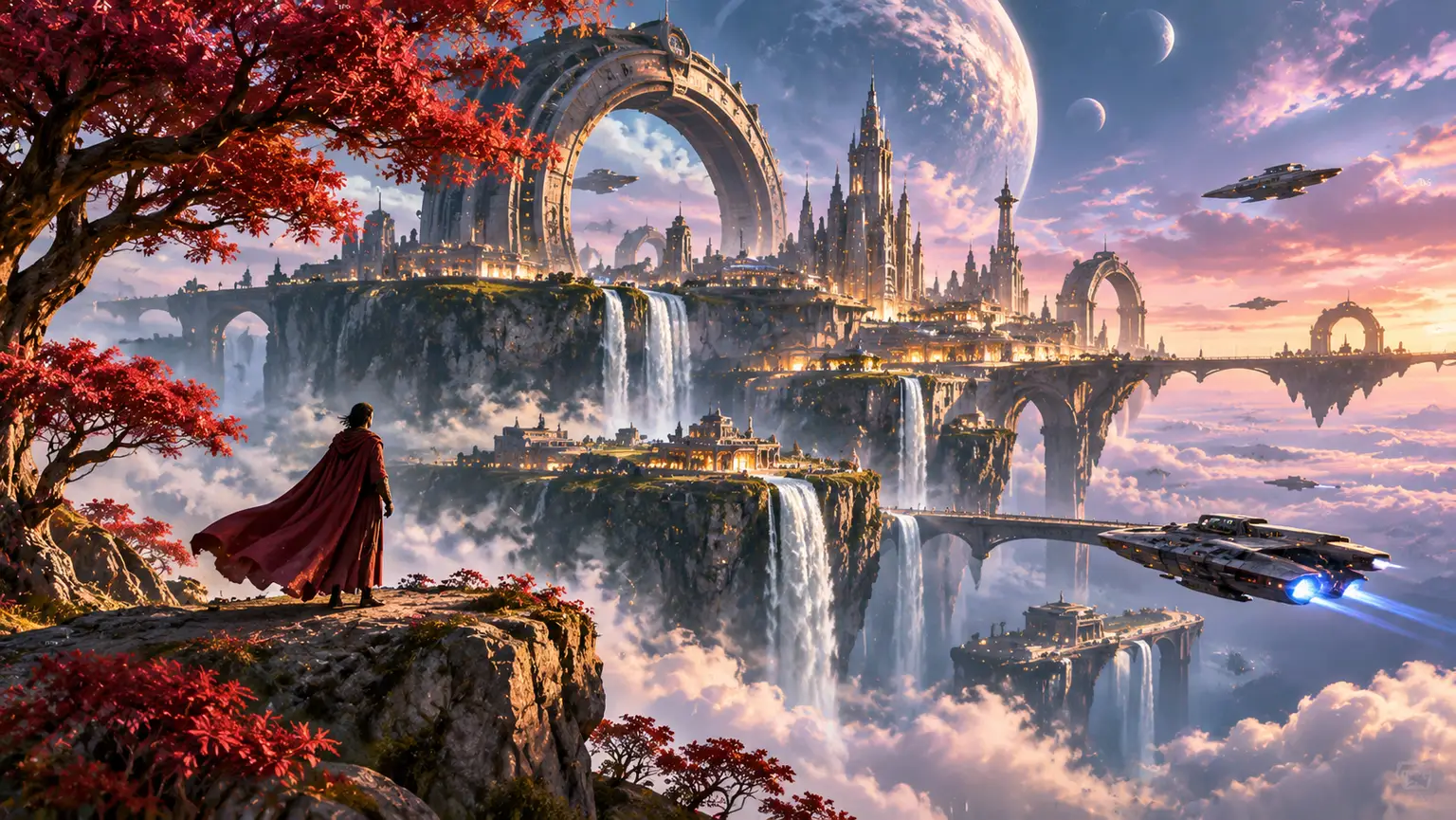
A city becomes believable when it has rules the camera can feel. Its light arrives from somewhere. Its architecture carries a history. Its people move as if they belong there. This AI cinematic worldbuilding guide is built around that standard: not generating attractive frames, but constructing a place that can survive a close-up, a cut, and a full sequence.
AI cinema makes worldbuilding available at a new scale. A lone filmmaker can test ancient floodplains, orbital shrines, impossible suburbs, or alternate 1990s cityscapes before a conventional production could finish a concept package. But abundance creates its own problem. If every shot invents a new world, there is no world at all. There is only visual drift.
https://aicineo.com/
Start With the World’s Pressure
A cinematic world does not begin with a mood board. It begins with pressure: the force that has shaped every room, costume, street, and ritual inside it.
Ask one direct question: what has this place had to survive? A desert republic built around water theft will organize its homes, trade, clothing, and politics differently than a coastal city recovering from an automated evacuation. A luxury space station governed by private memory storage will not look like a generic chrome future. Its design should reveal who has access, who is watched, and what is being concealed.
Write the answer in a few sentences before generating anything. Include the world’s central resource, dominant fear, social hierarchy, and visible contradiction. Keep it dramatic rather than encyclopedic. You are not writing lore for its own sake. You are defining the conditions that produce images.
For example, “a vertical city powered by an artificial sunrise” gives you a visual system. Upper levels may have pale, regulated light and immaculate surfaces. Lower levels may trade in scavenged heat, reflective fabric, and illegal darkness. The premise immediately suggests lensing, color, sound, and character behavior.
Build a World Bible for the Camera
The most useful AI worldbuilding document is short enough to use during production. Make a living world bible of one to three pages, then revise it as the film finds itself.
Define the visual constants
Choose a limited set of constants that should recur across frames. This might include materials, weather, light sources, architectural geometry, and a restrained color logic. A world can be lush or minimal, but it needs repetition. Repetition is how the viewer learns the place without being told.
Be specific. “Futuristic” is not a constant. “Oxidized copper, wet basalt, amber utility light, narrow vertical apertures, and low fog” is usable direction. These choices can travel from environment generation into wardrobe, props, title design, and grade.
Also define what does not belong. Exclusions protect a film from default model aesthetics. If your world rejects glossy white interiors, visible screens, cyberpunk neon, or contemporary streetwear, write that down. Negative direction is often as valuable as positive direction.
Define the human constants
Worldbuilding fails when environments receive all the attention and people look imported from another project. Decide how characters inhabit the place. Are they hurried, ceremonial, exhausted, controlled? What do they carry? Which gestures are ordinary? What does status look like at a distance?
A character’s silhouette is a worldbuilding tool. A dockworker in a flooded industrial settlement might wear buoyant shoulder pieces, waterproof paper tags, and boots adapted for ladder work. None of these details need explanation. In the right frame, they make the setting feel lived in.
Define the cinematic constants
Your camera is part of the world. A handheld, intimate camera creates a different reality from slow architectural tracking shots. Decide whether the film observes from a human body, a surveillance system, a dream state, or an impossible aerial perspective.
Set a few production rules: preferred focal-length feeling, degree of camera movement, depth of field, contrast range, and image texture. AI tools can generate nearly any visual language. That freedom is why restraint matters. The audience reads coherence through repeated cinematic decisions, not through the novelty of individual shots.
Generate Systems, Not Isolated Images
The common trap is to prompt for a spectacular establishing shot, then attempt to reverse-engineer the rest of the movie from it. Work in systems instead.
Begin by generating a location family: wide exterior, street-level approach, interior threshold, working space, private room, and overlooked back area. The goal is not six perfect images. The goal is to discover what persists when the camera moves through the same place.
Then create time variants. How does the location look at first light, midday, rain, emergency power, or after an event? A world gains authority when conditions change but its identity remains intact. This is especially useful in AI video, where temporal variation can be directed as a story function rather than an excuse for visual change.
Use a reference board with selected, approved frames only. Do not let it become an archive of every interesting output. A reference board is an editorial instrument. It tells collaborators, and your future self, what the film has committed to.
When prompting, repeat the core terms that define the world, but leave room for discovery. Over-specifying every image can produce sterile consistency. Under-specifying produces drift. The right balance depends on the project: a tightly controlled speculative drama may need stricter visual rules, while a surreal short can permit purposeful instability.
Make Continuity a Creative Department
In live-action filmmaking, continuity is often invisible labor. In AI cinema, it must be designed into the process from the start.
Track recurring characters, costumes, props, locations, weather, and damage states. A simple shot log can prevent major breaks: the coat changes color, a doorway shifts shape, the same vehicle loses its defining feature, or a character enters a room from the wrong side of the building. These errors pull viewers out of a film faster than most creators expect.
Continuity does not mean every pixel must match. Cinema has always used compression, suggestion, and selective detail. What matters is that the audience can recognize the same person, the same object, and the same spatial logic from shot to shot.
Give major props a story role. A handheld light, a transit token, a mask, a child's recorder, or a damaged service robot can become an anchor across scenes. Recurrent objects do more than solve continuity. They carry emotion and make a generated world feel authored.
Design Sound Before the Picture Is Finished
A beautiful silent environment often feels like concept art. Sound turns it into cinema.
Build a sonic identity early. Decide what machines hum, what materials respond underfoot, what distant activity suggests the city beyond the frame, and where silence is unnerving. A world powered by tides should not sound like a generic spaceship. A subterranean archive should have a different acoustic personality from its public corridors.
Sound also creates scale without generating more visual information. A distant procession, pressure doors cycling three floors away, insects striking a window, or an announcement distorted by old speakers can establish a larger civilization around a close shot. It is a practical advantage for small teams and a major storytelling advantage for everyone.
Treat dialogue with the same discipline. Accent, pacing, vocabulary, and vocal texture should arise from the world’s social conditions. If the images suggest a centuries-old culture but every character speaks in interchangeable contemporary shorthand, the illusion thins.
Let the Story Test the World
A world is only cinematic when something can go wrong inside it. Once the visual system is established, put it under narrative stress.
Send a character somewhere they should not be. Force a private object into a public space. Cut the power, change the weather, expose a hierarchy, or introduce a visitor who cannot read the local rules. These actions reveal the world better than another panoramic image.
This is where AI cinema moves beyond demonstration. The point is not to prove that a tool can render a future city. The point is to make an audience feel what it costs to live there.
Before locking a sequence, watch it without explaining the premise to anyone. Can a viewer identify the place, its mood, its rules, and the shift taking place? If not, simplify. Remove the detail that only decorates. Strengthen the detail that carries story.
AICINEO treats AI cinema as a medium, not a visual trick. Worldbuilding is part of that distinction. Build places with consequence, then let the frame reveal only what the film needs. The audience will sense the world continuing beyond the cut.