

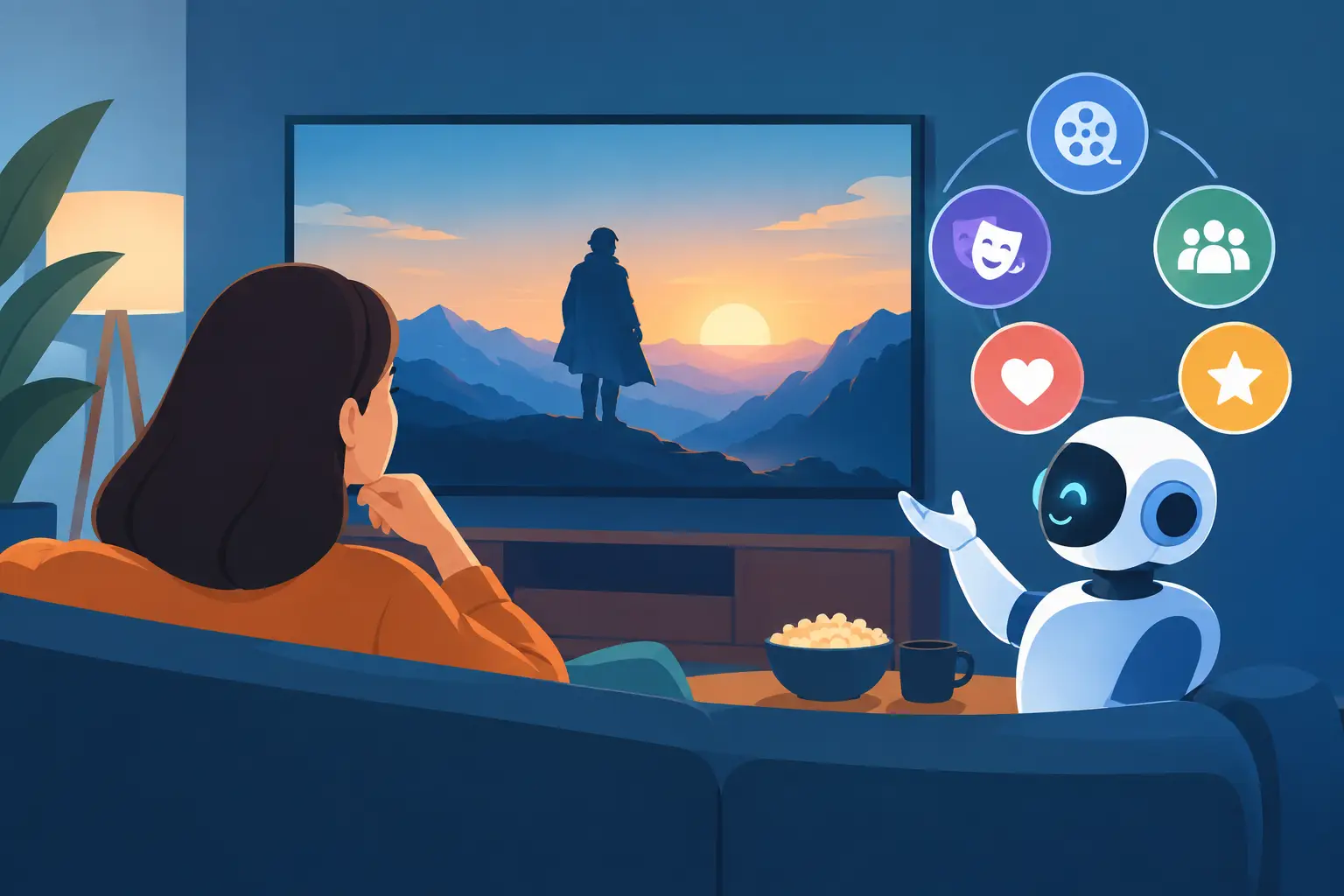
The first question after an AI film ends should not be, “Which tool made that?” It should be, “What stayed with me?” This AI film audience guide begins there, with the image, the rhythm, the performance, and the feeling that survives after the screen goes dark.
AI cinema is not one look, one workflow, or one claim of authorship. It is a growing field of motion-picture work in which generative systems can shape development, design, animation, voice, scene construction, post-production, or the entire visual language. Some films announce those methods. Others let the work speak first. The audience has room for both.
Watching this medium well means bringing more than technical curiosity. It means developing taste for a form that is still defining its grammar.
AI Film Audience Guide: Start With the Film
A machine-made image can be instantly arresting. It can also be instantly forgettable. The distinction is not whether a frame looks expensive, strange, or impossible. It is whether the image has a reason to exist inside the film.
Ask what the film wants from its visual world. Does the shifting architecture express a character’s unstable memory? Does an artificial voice create productive distance? Does a sequence of transformations build tension, comedy, awe, or dread? When generative techniques serve the film’s internal logic, they become cinema rather than demonstration.
This is especially useful when a work is visually dense. AI can produce a torrent of detail, but detail is not direction. Strong films know when to hold a shot, when to cut away, and when to leave space for the viewer to connect the emotional dots. A remarkable frame is only the beginning. Cinema needs duration.
The same standard applies to stories that are intentionally fragmented. Not every AI film needs conventional plot, dialogue, or naturalistic character arcs. A visual poem, a music-driven short, or an experimental dream sequence can be complete on its own terms. The question is not whether it follows a familiar structure. The question is whether its choices feel deliberate.
Watch Craft, Not Just Novelty
The novelty phase is useful. It gets people to look. It should not become the only way people look.
When viewing AI cinema, notice the familiar disciplines that remain visible beneath unfamiliar production methods: composition, blocking, editing, sound design, color, pacing, performance direction, and tonal control. A filmmaker may generate environments or animate a concept frame by frame, yet still face the oldest cinematic decisions. Where does the eye go? What does the cut reveal? What does the soundtrack make the image mean?
Sound deserves particular attention. Audiences often focus on visual artifacts because they are easiest to spot. But weak sound can flatten even extraordinary imagery. A carefully built sonic world can make a surreal image feel physical, intimate, or dangerous. Silence can do the same. Listen for whether the film’s soundscape creates a world you can enter rather than simply decorating what you see.
Look, too, at consistency. In a short film, visual instability can be expressive. A face that shifts from shot to shot may support a story about mutation, identity, or unreliable perception. In another film, that same instability may break the emotional connection because the character is meant to feel grounded. There is no universal rule. Context decides whether an imperfection becomes texture or distraction.
The Human Hand Is Still Present
The phrase “AI-generated” can imply that human judgment disappeared. It did not. Someone selected references, shaped prompts, rejected outputs, edited sequences, designed sound, revised the script, directed performers, or decided that an accident belonged in the final cut.
That does not mean every project involves the same degree of authorship or labor. It means audiences should resist simple assumptions. A film made with a small team and generative tools may contain intense artistic control. A large production using AI in a narrow post-production task may remain conventional in every other respect.
The useful question is not, “Was this made by AI or by people?” The useful question is, “What creative decisions can I feel?” In the strongest work, the answer is everywhere.
Learn the Difference Between Spectacle and Vision
AI cinema has a natural advantage in spectacle. It can move from a flooded cathedral to a microscopic city to a face assembled from smoke with little concern for physical production limits. That freedom is real, and it deserves celebration.
But unlimited imagery can create a new limitation: nothing carries weight if everything is extraordinary. Vision is the ability to choose. A filmmaker with vision sets boundaries, returns to motifs, and lets a few meaningful ideas organize the flood of possibilities.
Consider whether the film has an image system. Perhaps circles recur in the sets, costumes, and camera movement. Perhaps a particular shade of red appears only at moments of betrayal. Perhaps the world changes its material quality as a character loses certainty. These patterns give viewers something to follow, even when the film is abstract.
The most compelling AI films do not merely show what could not have been filmed before. They make us see something that could not have been imagined in the same way.
Give Short Works Your Full Attention
Many AI films currently arrive as shorts, micro-shorts, visual experiments, trailers for imagined worlds, or episodic fragments. That is not a lesser category. Short form has always been a place where cinema tests new language.
It does require a different viewing posture. A two-minute film may be asking for a second viewing, not because it is opaque by default, but because its details move quickly. Watch once for impact. Watch again for construction. On the second pass, notice transitions, recurring objects, shifts in sound, and the exact point where the emotional temperature changes.
Avoid treating every brief work as social content that must deliver an immediate explanation. Some will. Others are built to leave a residue: an unsettled image, a strange joke, a fragment of a world larger than the frame. Those are valid outcomes when they are intentional.
A platform such as AICINEO gives these works a dedicated frame. That frame matters. It asks viewers to meet AI cinema as cinema, with attention and standards, rather than as an isolated feed of technical tricks.
Ask Better Questions About Ethics
Audience literacy also includes ethical literacy. Generative filmmaking raises legitimate questions about consent, training data, labor, attribution, likeness, misinformation, and the use of styles associated with living artists. These questions are not outside the art. They shape how the art is made, distributed, and received.
Still, ethics should not become a shortcut for refusing to look closely. A responsible audience can hold two ideas at once: a film may be formally powerful, and its methods may deserve scrutiny. Praise does not erase concern. Concern does not require shallow criticism.
When a work uses a recognizable person’s likeness, claims documentary truth, recreates a real event, or borrows heavily from a living artist’s signature style, the stakes rise. Viewers should expect clarity about what they are seeing and how it was presented. Context is part of the experience.
For fictional, openly experimental work, the conversation may be different. The key is not to impose one moral test on every project. It is to ask whether the filmmakers have treated audiences, collaborators, and source material with care.
Become an Active Audience
New cinematic movements need more than creators. They need viewers who can recognize promise, articulate criticism, and reward work that takes genuine risks.
Share the films that give you something specific to say. “This is cool” may help a clip travel, but “the sound design turns a familiar dream image into grief” helps build a culture of attention. Name the craft you notice. Name the questions you still have. That feedback gives emerging filmmakers a more useful signal than empty applause or reflexive dismissal.
Be open to unevenness. New tools often produce work that is visually ahead of its storytelling, or conceptually sharp but technically rough. That is part of a medium learning in public. Openness does not mean lowering standards. It means judging a film for its ambition, execution, and potential rather than demanding that every experiment arrive fully formed.
The audience for AI cinema is not waiting at the end of the process. It is helping define the process now. Watch slowly when a film asks you to. Question the work when it earns questions. And when an image changes the way you thought cinema could move, stay with it long enough to find out why.