

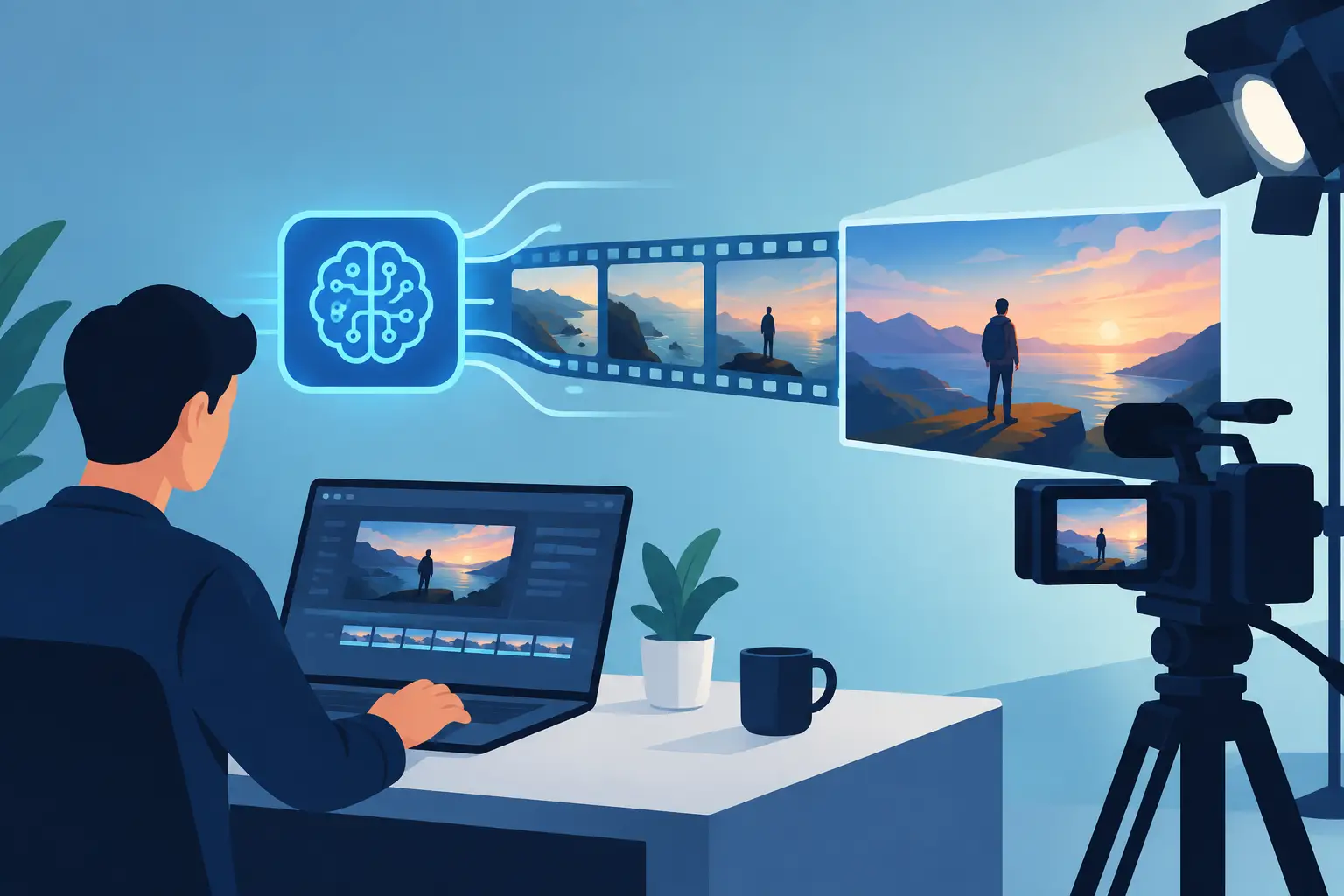
A shot appears before the location exists. A character changes age, scale, costume, or species without sending a production back to wardrobe. A director can test ten visual worlds before lunch. AI filmmaking platforms have made these conditions possible, but possibility is not the same thing as cinema.
The meaningful question is no longer whether artificial intelligence can generate moving images. It can. The question is whether a platform helps an artist turn generated material into a film with intention, rhythm, atmosphere, and a point of view. That distinction will shape the medium far more than any single model release.
What AI Filmmaking Platforms Actually Do
AI filmmaking platforms bring parts of the production process into a new kind of creative environment. Depending on the platform, a creator may develop concept images, generate shots, animate characters, extend locations, create voices, alter performances, build sound, or edit a sequence from text and reference material.
That range can sound like a replacement for a crew. It is not. A platform is closer to a volatile studio: fast, visually abundant, and capable of surprising results, but demanding in its own way. It introduces new controls and removes familiar ones. A filmmaker may gain access to impossible production design while losing the certainty of a precisely repeatable take.
The strongest systems are not defined by how much they generate. They are defined by how well they support decisions. Can the creator preserve character identity across scenes? Can a camera move be directed rather than merely requested? Can an image be revised without destroying what already works? Can the final work be shaped into a coherent sequence rather than a stack of impressive clips?
Those questions separate filmmaking infrastructure from a prompt factory.
The Platform Is Not the Film
A beautiful AI-generated shot has the same problem as a beautiful photograph pinned to a wall: it does not automatically create momentum. Cinema depends on relation. One image changes the meaning of the image before it. Sound creates expectation. A cut withholds information. A performance gives the audience a reason to stay.
This is where many first experiments with AI video fall short. They treat generation as the finished act. The result may be polished, strange, or technically astonishing, yet feel weightless because nothing has been selected, developed, or placed in tension.
AI cinema begins after the first output. The director has to decide what the work is looking at, what it refuses to explain, and where its visual logic holds. A dreamlike world can be compelling. So can instability. But inconsistency should serve the film's emotional design, not reveal that the maker has moved on to another prompt.
For creators, the shift is liberating and demanding. The role becomes less about commanding a machine to produce a finished scene and more about directing an evolving field of options. Taste becomes production value. Editorial judgment becomes a form of authorship visible in every frame.
Where the Best Platforms Earn Their Place
The most useful AI filmmaking platforms help creators move from exploration to control. Early ideation needs speed. Production needs continuity. Post-production needs precision. A platform that excels at only one phase may still be valuable, but it will not carry every project.
Visual development needs memory
A film requires a world that can hold together. Creators need to return to a character, palette, location, lens language, or costume silhouette without rebuilding the entire premise each time. Reference images and style controls are useful only when they protect the specific details that make a project recognizable.
This matters especially for short films, music videos, and episodic work. A single extraordinary image can establish a mood. A series of images must establish a universe.
Motion needs direction
Motion is where still-image thinking meets the demands of cinema. A platform may create spectacle with fluid camera movement or large-scale transformation, but the filmmaker still needs to ask whether the motion has dramatic purpose. Is the camera advancing a feeling, revealing information, or simply advertising its own ability?
Useful controls include shot duration, framing, camera behavior, subject movement, and the ability to iterate on a shot without starting over. Absolute control is not always necessary. Some artists want the system's unpredictability. But they should be able to choose where uncertainty enters the process.
Sound and editing need equal status
Audiences forgive imperfect visuals more readily than weak rhythm. A scene becomes cinematic when image, dialogue, music, ambience, and silence begin to negotiate with each other. Platforms that treat sound as an afterthought encourage work that looks complete but feels unfinished.
The same is true of editing. Generation produces material. Editing produces time. Even a one-minute AI film may require dozens of decisions about pace, repetition, reaction, interruption, and absence. The final cut is where a visual experiment becomes an experience for someone else.
The Trade-Off: Speed Can Flatten the Work
AI production gives independent filmmakers access to scale that once required large budgets, specialist teams, or years of technical training. That is a real creative expansion. It can bring speculative worlds, impossible transformations, and unconventional forms into reach for artists working alone or in small groups.
But speed creates a new pressure: the pressure to publish before a work has found its shape. When images arrive instantly, revision can look like failure. In practice, revision is often where the film becomes itself.
There are also questions of source material, consent, labor, and attribution. A serious platform cannot treat these as footnotes. Creators need clarity about what they are using, what rights they hold, whose likenesses or voices are involved, and how their work can be distributed. The cultural credibility of AI cinema will depend partly on whether its production practices can withstand scrutiny.
Then there is sameness. When thousands of creators rely on the same default aesthetics, a medium can quickly develop a recognizable but narrow visual accent. The answer is not to reject shared tools. It is to use them against their defaults. Bring references that are personal. Build constraints. Rewrite the prompt. Cut the most obvious shot. Let a film become stranger, quieter, harsher, or more specific than the platform initially suggests.
AI Cinema Needs Places to Be Seen
A platform for making films is only one side of the movement. Films also need an audience that understands how to watch them. AI-made work should not be treated as a technical demo reel, nor should it be judged by a novelty standard that conventional cinema never faces.
The audience should be able to encounter AI cinema as cinema: work with authorship, craft, risk, genre, flaws, and ambition. That requires curation. It requires context. It requires a destination where a short experimental film can sit beside a narrative work, animation, music-driven visual storytelling, or a piece that invents a form not yet named.
AICINEO occupies that cultural space by framing the medium as a distinct screen culture, not a feature buried inside a software category. That frame matters. It gives creators a reason to make work for more than the feed, and viewers a reason to return for more than the surprise of the first frame.
Choosing a Platform Around the Project
There is no single best platform because there is no single kind of film. A fashion film may prioritize image control and stylized transformation. A dialogue-driven short may require credible performances, consistent characters, and strong voice tools. An abstract visual piece may benefit from instability and discovery. A producer working with a client may value predictable revisions over surprise.
Start with the film's nonnegotiables. Is it a face, a location, a mood, a sequence of actions, a voice, or a particular relationship between image and sound? Test a platform against those demands with a small scene, not a vague prompt. Make three versions. Try to revise the strongest one. Then try to cut it with surrounding material. The friction you encounter will tell you more than a gallery of promotional examples.
The next era of filmmaking will not be defined by the platforms that generate the most footage. It will be defined by the artists and audiences who insist that footage become cinema.