

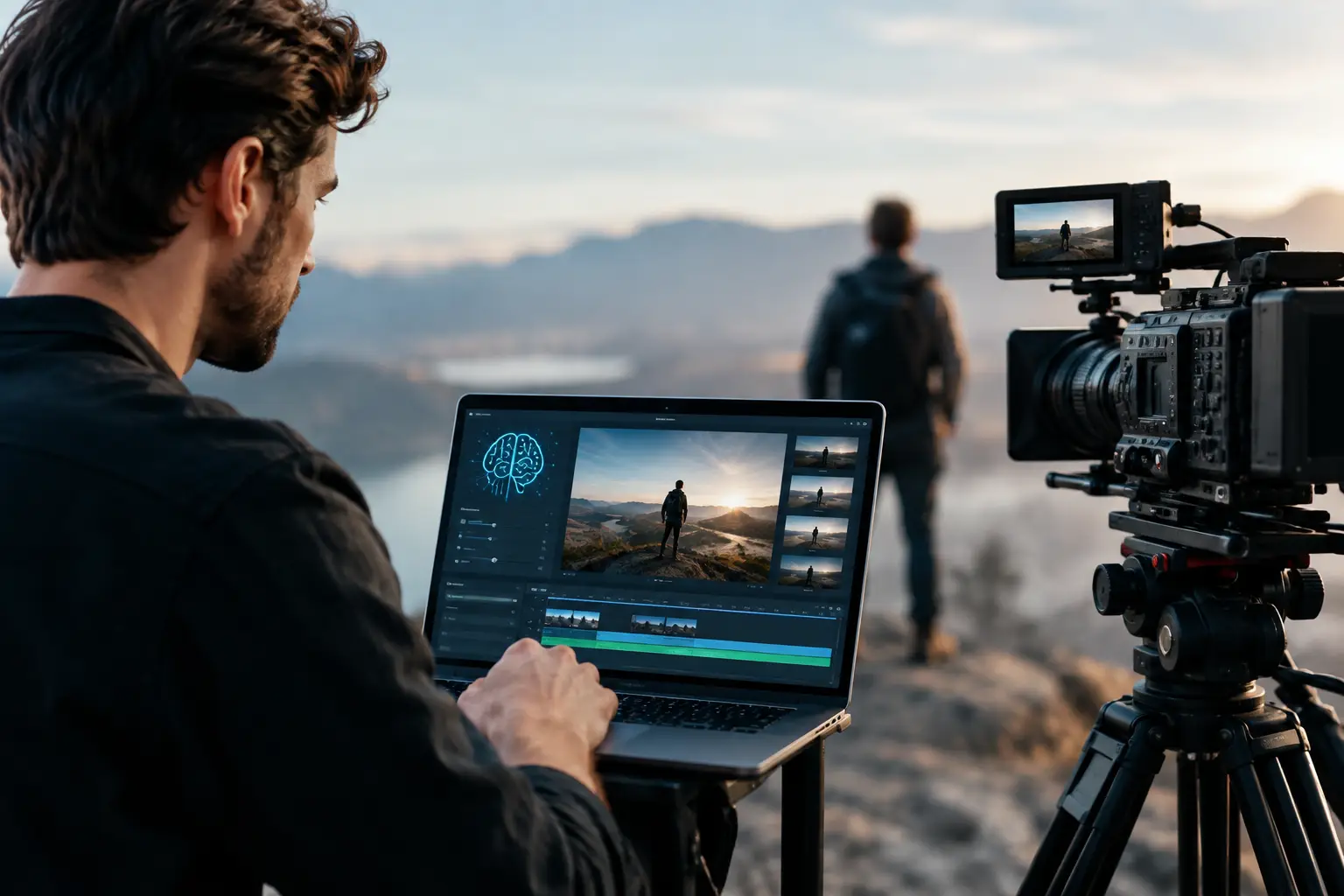
Featured image concept: A photorealistic cinematic production studio at blue hour, with a filmmaker reviewing a dramatic AI-generated scene on a widescreen monitor. Soft practical lights, shallow depth of field, film-grain texture, and a modern editorial workspace.
A short film no longer has to stop at the idea stage because there is no camera package, location budget, crew, or composer. The most useful AI filmmaking trends are not replacing creative direction. They are removing the production barriers between a strong concept and a finished screen experience.
For filmmakers, screenwriters, musicians, and creators, that shift changes the question. It is no longer, “Can I afford to make this?” It is, “What kind of film can I make if I can develop every part of the process in one creative flow?”
AI Filmmaking Trends Moving From Experiments to Workflows
The early wave of AI video was built around spectacle: a beautiful five-second shot, a surreal transformation, a visual idea made for a social feed. That work still has a place. But the stronger trend is continuity. Creators want consistent characters, intentional shot sequences, a recognizable visual language, clean pacing, and sound that gives the image emotional weight.
That makes AI filmmaking less about generating isolated clips and more about production design. A filmmaker may begin with a logline, develop a screenplay, identify emotional turning points, create a shot plan, generate sequences, build a score, and edit the final cut. Each stage informs the next one.
The result is not automatically a great film. AI can generate options quickly, but it cannot decide why a scene belongs in the story. It cannot feel when a pause should last one beat longer. Those decisions remain the work of the director, editor, writer, and composer. The technology is becoming more capable. Taste is becoming more valuable.
Screenplays Are Becoming Production Blueprints
Scriptwriting tools are increasingly useful when they help creators move beyond a blank page. They can support premise exploration, scene variations, dialogue passes, character notes, and formatting. The real advantage is speed during development, when ideas are still flexible and inexpensive to change.
The best approach is not to ask for a complete feature screenplay and accept the first result. Start with your point of view. Define the protagonist, the central conflict, the ending, and the tone. Then use AI to pressure-test scenes, create alternate beats, or reveal structural gaps.
A clear screenplay also creates better video prompts later. If a scene establishes who is present, what changes, where it happens, and how it should feel, the visual generation stage has a stronger foundation. A vague prompt can create a striking image. A well-written scene can create a sequence with purpose.
AI Filmmaking Trends Favoring Shot Design Over One-Prompt Videos
The most cinematic projects are increasingly built shot by shot. Instead of prompting for “a dramatic sci-fi trailer,” creators are thinking like directors: an establishing shot to set the world, a close-up to reveal doubt, an insert to carry meaning, then a wider frame for the turn in the scene.
This method gives you control over rhythm and coverage. It also makes revisions less painful. If one shot misses the mood, you can replace that shot without rebuilding the entire sequence.
Visual consistency remains one of the central creative challenges. Character appearance, wardrobe, location design, lighting, and camera language can drift between generations. The practical answer is to create a simple visual bible before generating footage. Define recurring details: the character’s silhouette, color palette, lens feel, time of day, textures, and the world’s level of realism.
Keep a record of prompts that work. Reuse the same descriptive anchors across scenes, then change only what the story requires. A noir detective in rain-lit streets needs more than “cinematic.” Specify the wet pavement reflections, restrained color, hard side light, wardrobe, framing, and emotional state. Precision does not limit imagination. It gives it a frame.
Sound Is Becoming a Storytelling Layer, Not an Afterthought
A silent visual can look expensive and still feel unfinished. That is why original music, ambience, and sound design are becoming central to AI cinema workflows.
Creators are using AI music tools to sketch themes early, not only to fill the final timeline. A quiet piano motif can shape how a scene is edited. A pulsing electronic track can reveal that a montage needs faster cuts. Sound helps determine pace before the film is locked.
Original scoring also gives smaller projects a distinct identity. Stock music can be useful, especially for fast content, but it may carry a familiar emotional shape that makes a film feel generic. Creating a soundtrack around your story lets the music follow the same mood, transitions, and character arc as the images.
Use restraint. A score does not need to play under every second of dialogue. Silence, room tone, distant traffic, a breath, or a single environmental sound can make a moment more believable than an oversized music cue.
Editing Is Where AI Footage Becomes a Film
Generation creates material. Editing creates meaning.
This is one trend worth treating seriously: the creators getting the best results are not publishing raw generations. They are reviewing takes, selecting only the shots that serve the story, tightening scenes, matching motion, balancing sound, and cutting away before an image loses its impact.
AI-assisted editing can accelerate routine work such as trimming clips, organizing assets, generating captions, or testing different pacing. But the final edit should still be guided by intention. Ask what the audience needs to know, feel, and anticipate in every sequence. If a shot is beautiful but repeats information, remove it.
Short-form creators may favor immediate visual impact and rapid scene changes. Narrative filmmakers may need a slower setup, a held reaction, or a recurring image that pays off later. Neither approach is universally better. The platform, genre, audience, and story determine the cut.
Smaller Teams Can Think Bigger, With Better Discipline
AI filmmaking is lowering the cost of experimentation, particularly for proof-of-concepts, music videos, atmospheric short films, pitch trailers, and visual storytelling for online audiences. A solo creator can test a world that would once have required a large preproduction budget.
That freedom works best with boundaries. Set a runtime. Decide on a small cast. Limit locations. Choose one visual style rather than chasing every possible effect. Constraints protect a project from becoming a collection of impressive but disconnected moments.
It is also wise to consider rights, consent, and audience trust from the start. Do not use a real person’s likeness or voice without permission. Keep records of the assets and references used in your work. If disclosure is appropriate for the platform or project, be direct about AI’s role. Professional creative practice is part of the medium’s future.
Build the Complete Film, Then Put It in Front of People
The next meaningful trend is not simply more generation. It is connected creation and distribution. When writing, video, music, editing, and publishing live closer together, creators can spend less time moving files between disconnected tools and more time refining the film.
AICINEO is built for that end-to-end process: write the script, create cinematic video, score the moment, edit the cut, and share the finished work. Try it free when you are ready to turn your next scene, trailer, music video, or short film into something people can actually watch.
The creators who stand out will not be those who generate the most footage. They will be the ones who make choices, protect a point of view, and carry an idea all the way to the final frame.