

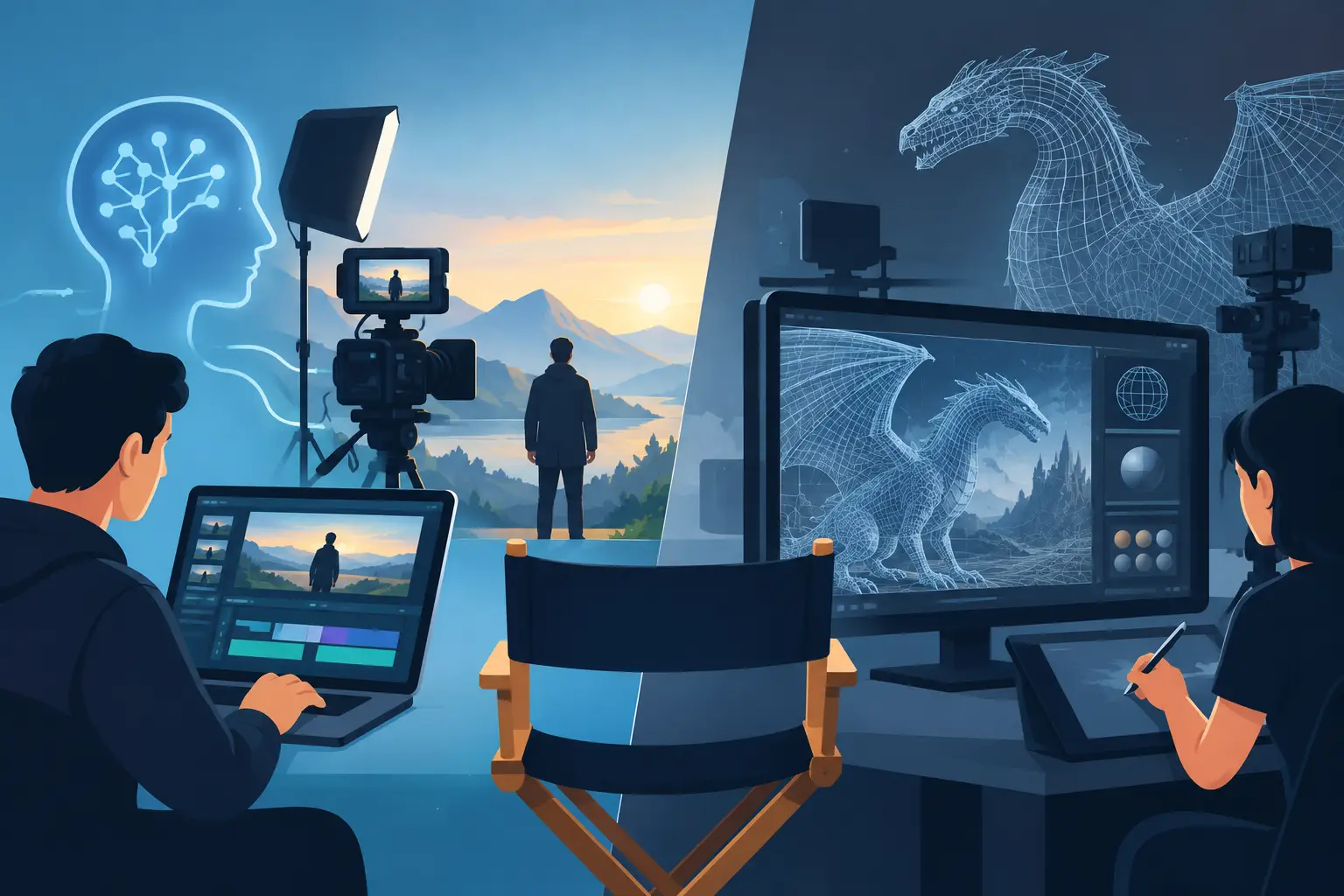
A city materializes in fog. A creature crosses the frame. A camera drifts through an impossible interior. For decades, images like these meant a pipeline: concept art, asset modeling, texture work, rigging, animation, lighting, rendering, compositing, and revision. AI filmmaking versus CGI production changes that equation. It does not remove craft. It relocates it.
The question is not whether generative tools can make images that resemble visual effects. They can. The more useful question is what each production model asks of an artist, what kind of control it delivers, and which stories it makes possible.
AI Filmmaking Versus CGI Production: The Real Difference
Traditional CGI is constructed. Artists build or acquire assets, define materials, place lights, animate bodies, simulate physics, and render shots from a virtual scene. The process is labor-intensive because it is explicit. A director can ask where an object sits, how far a lens is from it, how a character’s hand turns, and how sunlight hits a wall at a particular frame. The answer lives in editable scene data.
AI filmmaking is directed through a different relationship. A creator works with references, prompts, image inputs, video inputs, masks, motion controls, iterative selection, editing, sound, and sometimes custom models. Rather than specifying every component of a scene, the filmmaker establishes conditions and evaluates outcomes. The work often moves faster from intuition to image, but it also requires judgment at every turn.
That distinction matters. CGI is generally deterministic: change a parameter, rerender, and the system follows the scene. Generative video is probabilistic: repeat a process and variation enters the frame. One method rewards precise construction. The other rewards visual direction, editorial instinct, and the ability to recognize the right accident.
Neither is automatically more cinematic. Cinema has always been a negotiation between intention and contingency. Film grain, weather, performance, practical effects, lens behavior, and location all introduce forces a director cannot fully command. AI adds a new kind of contingency, one shaped by models, data, interfaces, and prompts.
CGI Owns Continuity. AI Changes Access.
For productions built around recurring characters, complex action, branded product geometry, or long sequences of spatially coherent effects, CGI remains the stronger foundation. A studio needs a digital creature to retain its anatomy from shot to shot. A vehicle needs to be mechanically accurate. A game cinematic may require the same environment to support dozens of camera angles and revisions. Structured 3D pipelines were made for this.
CGI also carries a mature production language. Departments know where responsibility sits. A supervisor can identify a problem in layout, lighting, animation, or compositing. Files can move across large teams. Assets can be revised months later. This is not glamorous, but it is essential when schedules, legal approvals, and client requirements are involved.
AI changes the economics of the first image. An independent filmmaker who could never commission a full environment build can now test a world, a costume language, a creature design, or a surreal transition in hours. A small team can explore visual territory that previously belonged to large effects houses and well-funded commercials.
That access is not a minor efficiency gain. It changes who gets to develop cinematic ideas before asking permission. A director can make a proof of concept with atmosphere instead of a pitch deck with references. An artist can produce a short whose visual ambition is larger than its budget. A writer can discover the tone of an unrealized film by cutting moving images rather than describing them.
But access is not the same as control. The most convincing AI films do not treat generation as the finished act. They use it as material. The image must still be selected, shaped, paced, reframed, scored, and placed in relation to other images. A beautiful shot without dramatic purpose is still only a beautiful shot.
The New Craft Is Direction Under Uncertainty
CGI artists often solve problems by breaking them into technical tasks. The director needs a wider establishing shot. The environment team expands the set. The character needs a more convincing reaction. Animation revises the performance. The final image is built from accountable decisions.
AI filmmakers solve many problems through iterations of language and reference. They may begin with a storyboard, generate keyframes, use those frames to guide motion, isolate areas for correction, then cut around imperfections. A sequence might emerge through dozens of versions, each one moving closer to a feeling rather than a fully preplanned scene file.
This can look casual from the outside. It is not. The work demands an eye for composition, production design, rhythm, continuity, color, and the emotional logic of a cut. It also demands restraint. Generative tools can make every frame strange. A film needs to know when strangeness serves the story and when it merely announces the tool.
The strongest practitioners are becoming hybrid directors. They understand visual grammar and editorial structure, but they also understand how to steer models without expecting them to behave like conventional software. They know when to use a generated shot, when to combine it with practical footage, and when a controlled CGI element is the more honest solution.
Where AI Breaks Down
AI video can produce visual inconsistency, unstable anatomy, ambiguous geography, and motion that feels convincing for a moment but fails under close scrutiny. A character may change identity across a cut. A prop may mutate. A room may not hold together when the camera turns. Dialogue performance and intricate physical interaction remain difficult in many workflows.
These limitations are not reasons to dismiss the medium. They are production realities. A filmmaker can write around them, stylize around them, or use them deliberately. Dream logic, memory, fantasy, montage, archival fiction, music films, speculative documentaries, and compressed poetic narratives can turn instability into form.
The trouble begins when a project needs the rules of conventional realism but relies on tools that cannot yet consistently support those rules. If the central pleasure of a scene is an actor’s precise performance, a complex fight, or a character navigating a clearly mapped space, generative video may create more repair work than it saves.
CGI has limits of its own. It can be slow, expensive, and creatively overmanaged. A polished asset pipeline can make images technically impeccable while draining away the initial spark. The cost of revision often pressures teams toward familiar choices. AI’s volatility can be frustrating, but it can also preserve discovery.
The Best Productions Will Be Hybrid
The future is unlikely to be AI or CGI. It is a wider production vocabulary.
A film may use AI for early visual development, generated transitions, background worlds, dream imagery, or a short sequence that needs impossible scale. It may use CGI for hero objects, camera-critical environments, continuity-sensitive characters, and shots that demand exact revision. Live action may provide performance, physical texture, and a stable human center. Compositing and editorial will bind the methods into one visual language.
The deciding factor should be the shot’s job. Does it need repeatability? Does it need a consistent asset that will return throughout the film? Does it need to be made quickly in order to test an idea? Does imperfection add to the feeling, or does it break the illusion? These are directing questions before they are software questions.
That framing also protects filmmakers from false binaries. AI cinema is not an attack on animation, visual effects, or the people who built those disciplines. It is a new medium entering the same creative field. Its value will be measured by the films it enables, not by the number of tasks it automates.
A New Cinema Needs Standards
As AI filmmaking becomes more visible, audiences will become more discerning. The novelty of generated imagery will fade quickly. What remains is authorship: a point of view that can be felt across the frame, the edit, the sound, and the story.
That means creators should be clear about their methods where it matters, especially in professional collaborations and work involving recognizable people, copyrighted material, or sensitive documentary claims. Consent, provenance, and attribution are part of the craft’s credibility. A new medium earns cultural weight by taking its responsibilities seriously.
It also means platforms and programmers have a role beyond showcasing technical spectacle. They can identify work with formal ambition, create context for audiences, and treat AI-made films as films. AICINEO exists in that space: not as a software demo reel, but as a home for a developing cinematic language.
The next memorable AI film may not be the one with the most photorealistic frame. It may be the one that understands exactly what its images can do that no traditional pipeline would have made possible. Start there: with the image only you can direct, then choose the method that lets it live.