

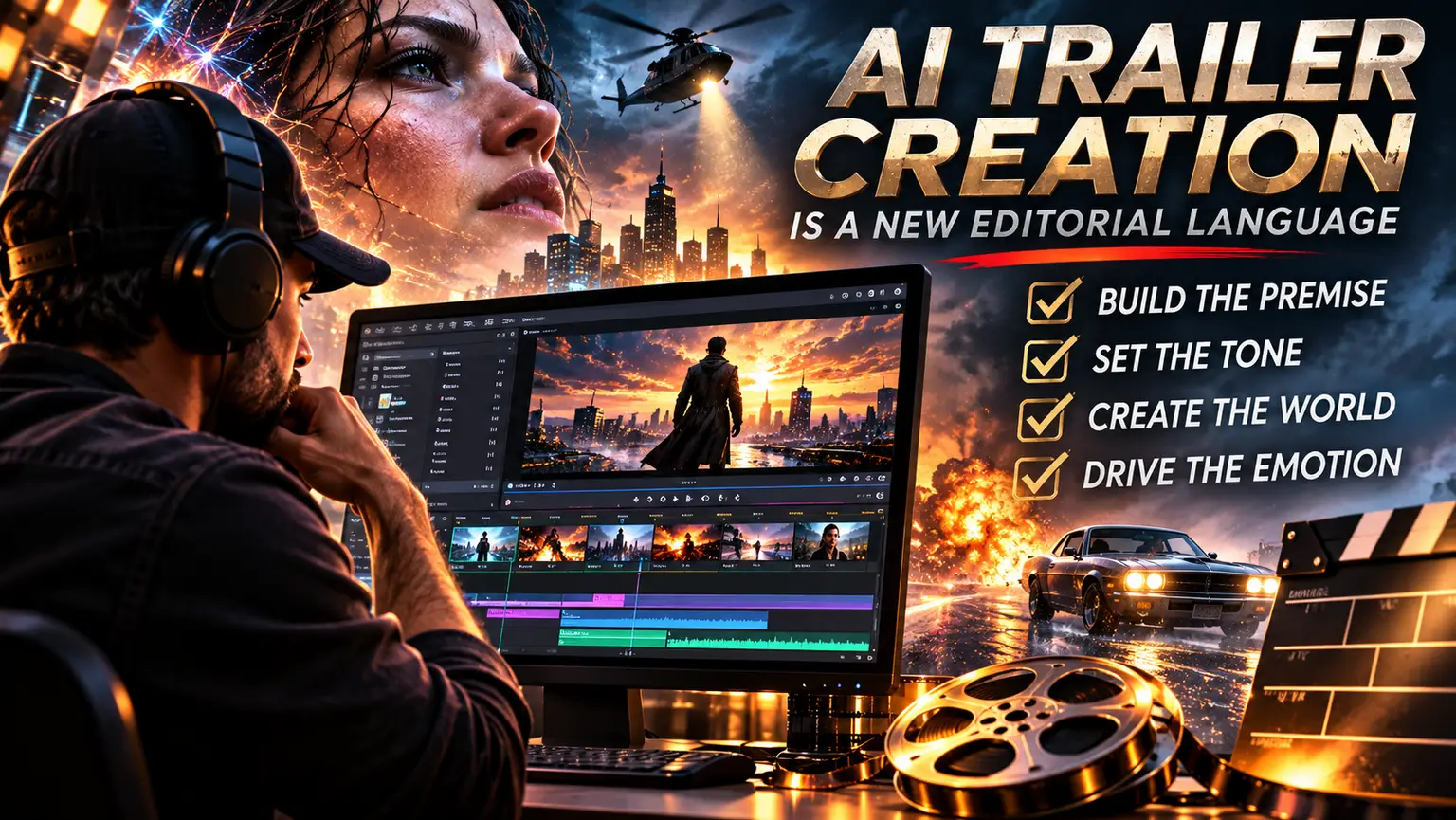
A trailer is not a shortened film. It is a controlled collision of image, sound, pace, and unanswered questions. It gives an audience a feeling of the world before it explains the world. AI trailer creation changes how quickly that collision can be built, but it does not remove the need for judgment. If anything, it makes judgment more visible.
A creator can now generate a rain-soaked city, an impossible creature, a period ballroom, or a spacecraft corridor in hours rather than months. That speed is real. So is the risk: a trailer can become a sequence of impressive shots with no dramatic gravity. Cinema begins when the images know what they are asking us to feel.
https://aicineo.com/create-ai-video?utm_source=chatgpt.com
AI Trailer Creation Starts With the Promise
The strongest trailers begin with a promise, not a prompt. Before a visual system is asked for a frame, define the central tension in one sentence. A disgraced navigator receives a transmission from the future. A daughter discovers her father has been rewritten as a synthetic memory. A small town watches its dead return through television static.
That sentence sets the trailer's emotional contract. It tells you whether the piece should feel intimate, mythic, violent, uncanny, romantic, or absurd. It also prevents a common AI-film mistake: generating a collection of beautiful material before deciding what the material is for.
A useful trailer premise has pressure in it. Something is wanted, threatened, hidden, or about to break. The audience does not need the full plot. They need a reason to lean forward.
For AI cinema, this early decision is especially valuable because generation offers abundance. A clear premise gives abundance a boundary. It helps determine which locations matter, what visual motifs should repeat, and how far the imagery can depart from realism without losing the viewer.
Build a Trailer World, Not Just Individual Shots
AI-generated footage is often judged frame by frame. A trailer is judged as a world. Consistency does not mean every shot has identical lighting or exact character continuity. It means the images appear to belong to the same emotional climate.
Start with a small visual bible. Define the era, palette, camera behavior, texture, architecture, wardrobe logic, and level of visual distortion. A near-future thriller might use sodium-vapor streets, surveillance glare, compressed shadows, and lenses that feel slightly too close. A fantasy romance may need soft daylight, handcrafted surfaces, and movement that feels remembered rather than recorded.
Then choose a limited set of recurring anchors. A red signal flare. A child in a silver coat. An elevator that never reaches the same floor. A face seen only through reflective surfaces. Repetition creates recognition, and recognition creates the sense that a larger film exists beyond the trailer.
This is where AI tools can become genuinely cinematic rather than merely efficient. They let creators test worlds that would normally remain in sketchbooks or pitch decks. But the tool should serve a production design decision. If every scene has a different style because each prompt chases a new surprise, the trailer loses authority.
Continuity Is an Editorial Choice
Perfect continuity is not always the goal. Dream logic, collage, and visual instability can be the point. A horror trailer may benefit from a protagonist whose face subtly changes between cuts. A surreal science-fiction film may want a city that rearranges itself.
The question is whether the instability has meaning. If it reflects the story's reality, it becomes language. If it happens because the creator accepted the first usable generation, it reads as drift.
Cut for Escalation, Not Explanation
Most weak trailers explain too much or escalate too little. They introduce the setting, then the protagonist, then the conflict, then the theme, in neat sequence. The result may be clear, but clarity alone is not suspense.
A more effective structure often moves in three motions: invitation, fracture, acceleration. First, establish an image or line that makes the world feel specific. Then break its apparent order. Finally, build rhythm until the audience is left with a charged final image, line, or silence.
The invitation might be a slow aerial view of a floating suburb. The fracture could be a child saying, “My mother came back wrong.” Acceleration does not require louder music and faster cuts alone. It can arrive through increasingly impossible images, fragments of confrontation, or a sudden shift from spectacle to stillness.
AI trailer creation makes it tempting to fill every second. Resist that instinct. A clean pause can make an artificial world feel more human. Let a character look at something. Hold on an empty room after a line lands. Allow one shot to become an image the viewer carries away.
The trailer is also allowed to misdirect. It should be truthful to the film's tone, but it does not owe the audience a plot diagram. Suggesting an unseen story is often more powerful than summarizing a completed one.
Sound Gives Synthetic Images Consequence
Generated visuals can appear weightless until sound gives them impact. A footstep, a malfunctioning radio, a breath held too long, or the low mechanical pulse beneath a quiet scene can create the physical stakes that images alone may not provide.
This is not an argument for constant score. Sound design works best when it creates contrast. If every shot is accompanied by a hit, nothing hits. Begin with a sparse sonic identity, then introduce disruption with intention. A familiar nursery melody can become unsettling when it breaks apart. A voiceover can feel intimate when it is nearly swallowed by room tone.
Voice is another area where restraint matters. Synthetic voices can be useful for temp narration, fictional broadcasts, alien characters, and deliberately mediated performances. Yet an emotionally central line may need a human performer, or a carefully directed hybrid approach, to carry subtext. The issue is not whether a voice was generated. The issue is whether it sounds like someone has something at stake.
Music should be edited as narrative, not decoration. Mark the moment where the trailer changes temperature. Let the score earn its expansion. Then consider ending without a final musical resolution. Silence after a last image can leave more space for anticipation than one more crescendo.
The Best Use of AI Is Iteration With Taste
AI can produce ten variations where a conventional workflow may have supported one. That changes the editorial process. It allows a filmmaker to test alternate locations, character entrances, movement styles, and tonal directions before committing to a final cut.
But more options can weaken a creator's point of view. The answer is not endless generation. It is a disciplined selection process. Build a reference board, generate toward a defined idea, save only the material that reinforces it, and cut early. Once a rough trailer exists, its weaknesses become concrete: the opening may be too abstract, the antagonist may be absent, the middle may have no turn, or the final button may be predictable.
At that stage, generate with surgical intent. Do not ask for “more cinematic shots.” Ask for the image the edit is missing: a hand hovering over a damaged control panel, a wide shot that reveals the scale of isolation, a close-up that can carry a moment of recognition. Precision protects the film from visual excess.
This is also the practical value of AI trailer creation for independent artists. It can make the proof of concept visible. A director can show a world, rhythm, and tonal ambition before financing the full work. A musician can test a visual universe around an unreleased track. A studio can explore a campaign language before a production pipeline is locked.
The trade-off is that the trailer may set expectations the eventual film cannot meet. Treat it as a promise, not a substitute. If the trailer's visual scale is impossible to sustain, build the larger project around the same emotional intelligence rather than trying to duplicate every spectacle shot.
A Trailer Needs a Point of View
The emerging language of AI cinema will not be defined by who can generate the most elaborate image. It will be defined by who can make an audience feel that an image had to exist.
That standard applies whether the trailer is built from live-action footage, generated scenes, animation, compositing, or all of them at once. Process matters. Authorship matters. So does disclosure when audiences, collaborators, or platforms need clarity about how work was made. But the screen still asks its oldest question: why this story, from this perspective, now?
AICINEO sees AI cinema as a medium with its own room to grow. Trailers are part of that growth. They are not just promotional artifacts. They are early acts of world-building, where a filmmaker declares the atmosphere, scale, and emotional voltage of a new work.
Before you generate the next shot, return to the feeling you want to leave behind. If you can name it precisely, you can cut toward it. If the final frame makes someone stop scrolling and imagine the film that follows, the trailer has already done its work.