

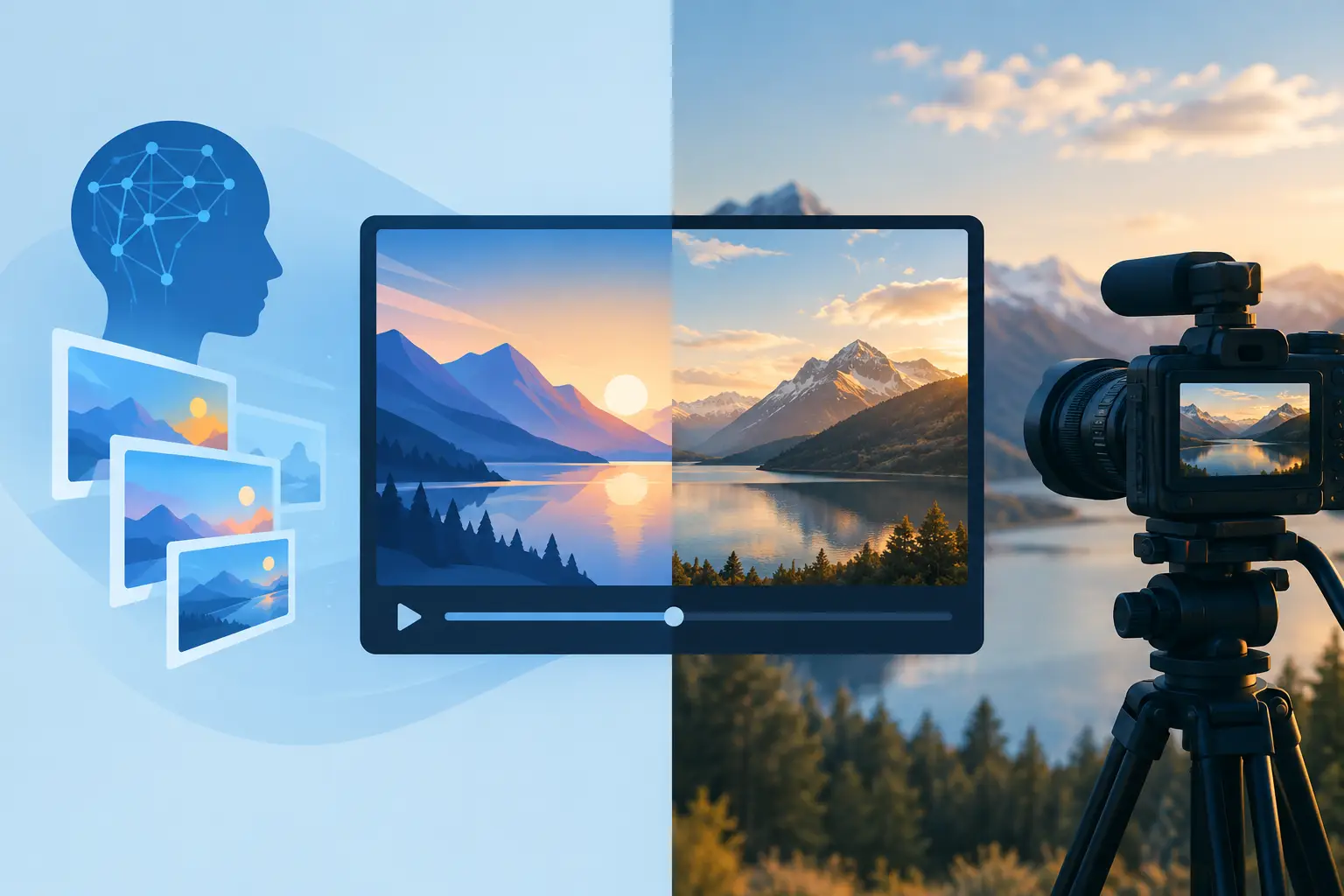
A city at blue hour. Rain on glass. A lone figure framed in a hotel window. For years, that image meant a stock-library search, a licensing fee, and the familiar risk that another brand had already used the same shot. AI video versus stock footage is not simply a production decision. It is a decision about authorship, visual identity, and what kind of world a film is allowed to build.
For filmmakers, agencies, and independent creators, both formats have a place. Stock footage remains one of the fastest ways to establish reality. AI video introduces another possibility: imagery designed around the internal logic of a specific story. The difference becomes visible when a film needs more than coverage. It needs a point of view.
AI Video Versus Stock Footage: The Core Difference
Stock footage documents or stages an image that already exists. A creator selects from a catalog, then edits that material into a new context. Its strength is immediate access to recognizable places, people, actions, textures, and events. Need a commuter train, an aerial of Chicago, a laboratory, or a close-up of hands typing? There is likely a usable shot waiting.
AI video begins with direction rather than selection. The filmmaker defines a subject, lens behavior, lighting, production design, movement, mood, and transformation. The resulting clip may still require iterations, compositing, sound design, and editorial discipline. But its starting point is not the archive. It is the imagined frame.
That distinction changes the creative conversation. Stock asks, “What is available?” AI asks, “What should exist?”
Neither question is inherently better. A documentary about wildfire recovery may need verifiable, location-specific footage. A speculative music film about memory dissolving through architecture may need images no camera could reasonably capture. The medium should follow the claim the film is making.
When Stock Footage Still Wins
Stock has a practical advantage that should not be dismissed for the sake of novelty. It is often fast, predictable, and easy to evaluate before purchase. A producer can see the exact frame, resolution, model release status, and licensing terms before it enters the edit.
It also carries photographic evidence. A real coastline, a real crowd, or a real factory floor contains accidental detail that gives an image weight. For journalism, corporate communications, educational video, travel content, and historical context, that connection to the physical world can be essential.
Stock works especially well when the footage serves as connective tissue rather than the film’s visual signature. An establishing shot can establish. A cutaway can carry an edit. Not every moment needs to invent a universe.
There is also the matter of production reliability. Generative video can produce inconsistency in anatomy, motion, geography, text, and object continuity. It may take several attempts to create a five-second shot that holds up under scrutiny. Stock footage rarely asks for that kind of technical negotiation.
The trade-off is familiarity. A clip can be technically polished and still feel anonymous. Viewers may not consciously recognize its source, but they recognize the visual language of generic media: the perfect smile, the frictionless office, the drone shot that means “innovation.” Stock can give a project production value while quietly flattening its personality.
Where AI Video Changes the Frame
AI video is most potent when the image itself carries meaning. It gives creators a way to design scenes that would be impossible, prohibitively expensive, unsafe, or simply too strange for conventional production.
A director can move from an abandoned shopping mall into a flooded Baroque theater without treating the transition as a visual-effects spectacle. A fashion filmmaker can create a garment that grows like coral. An animator can test character atmosphere, camera language, and world-building before a physical shoot begins. These are not only cost savings. They are new creative choices.
The strongest AI-generated work does not use unreality as decoration. It uses it as grammar. Distorted scale can express power. Impossible weather can express grief. A camera that glides through a painting can turn memory into space. When these choices are connected to theme, AI video feels less like a prompt result and more like cinema.
This is why AI video can be particularly valuable for independent filmmakers. It compresses the distance between visual ambition and available resources. A creator without access to a studio backlot can still develop a coherent world. That does not eliminate craft. It relocates it into art direction, reference selection, iteration, editing, and taste.
Originality Is Not Automatic
The case for AI video should not become a case for visual excess. Generative tools can create images that are impressive at first glance yet forgettable by the next cut. They are capable of producing vastness, but vastness is not a story.
AI video also has its own version of stock sameness. Default prompt language, overused cinematic keywords, hyper-glossy surfaces, and familiar surreal motifs can create a new generic look. If every scene is “cinematic,” none of them are.
Originality comes from decisions that repeat with intention: a restricted palette, a camera that behaves in a distinct way, a recurring visual metaphor, a rhythm of cuts, a refusal to show what another film would show. The tool does not provide this coherence. The filmmaker does.
For that reason, a hybrid workflow is often the more sophisticated answer. Real footage can anchor an invented sequence. Stock can establish a recognizable location before AI bends that location into dream logic. AI can fill the visual gaps that would otherwise force a project into compromise. The final work gains tension between the documented and the imagined.
Cost Is More Than the License Fee
At first glance, AI video appears cheaper than stock. In many cases, it is. There may be no travel, crew, set build, permits, or talent costs for an imagined scene. For a small team, that changes what is possible.
But low-cost generation is not the same as low-cost finishing. A usable AI shot may require extensive prompting, reruns, cleanup, upscaling, frame interpolation, compositing, color work, and sound design. If the scene involves a recurring character or a precise product detail, continuity can become a serious production challenge.
Stock costs are more visible. Licensing is usually priced upfront, and the editorial effort is familiar. AI costs can be more variable because the work happens in the search for the right result. A short prompt may look effortless in a social post; a sequence that sustains a film’s visual standard rarely is.
The useful question is not, “Which is cheaper?” It is, “Where should the budget buy certainty, and where should it buy possibility?” Stock buys certainty. AI buys possibility. A production needs both at different moments.
Rights, Trust, and Audience Context
Rights deserve the same creative attention as framing. Stock footage is generally offered under defined licenses, but creators still need to understand territory, duration, usage, exclusivity, and restrictions around recognizable people or properties. “Licensed” is not a universal answer.
AI video introduces a different set of questions. What were the tool’s terms at the time of generation? What training-data policies shape the platform? Does the output contain recognizable brands, public figures, or styles that create avoidable risk? Can the team document its process if a client or distributor asks?
Audience trust matters too. If a film presents an invented event as factual footage, it can mislead viewers. If the work is clearly fictional, experimental, or stylized, AI can expand the language of the piece without making a false claim about reality. Context is the line.
For creators building a long-term practice, transparency is not a burden. It is part of authorship. Credit collaborators. Be clear when synthetic imagery changes the factual status of a scene. Treat generated material with the same seriousness given to archival footage, VFX, and performance.
Choose the Image That Serves the Film
Use stock footage when the project needs verifiable reality, speed, familiar production certainty, or a brief visual bridge. Use AI video when the project needs a specific world, a visual metaphor, a scene that cannot be captured, or a signature image that belongs only to the film.
The more useful distinction is not synthetic versus real. It is intentional versus interchangeable. A stock clip can be deeply intentional when it carries historical truth or documentary texture. An AI shot can be interchangeable when it is generated only to look expensive.
AI Cinema is growing because filmmakers are treating these tools as materials, not shortcuts. The work worth watching will not be defined by whether an image came from a camera, a library, or a model. It will be defined by whether the image had to exist exactly that way.
Before the next search or prompt, write one sentence about what the shot must make the audience feel. Let that sentence choose the medium.