

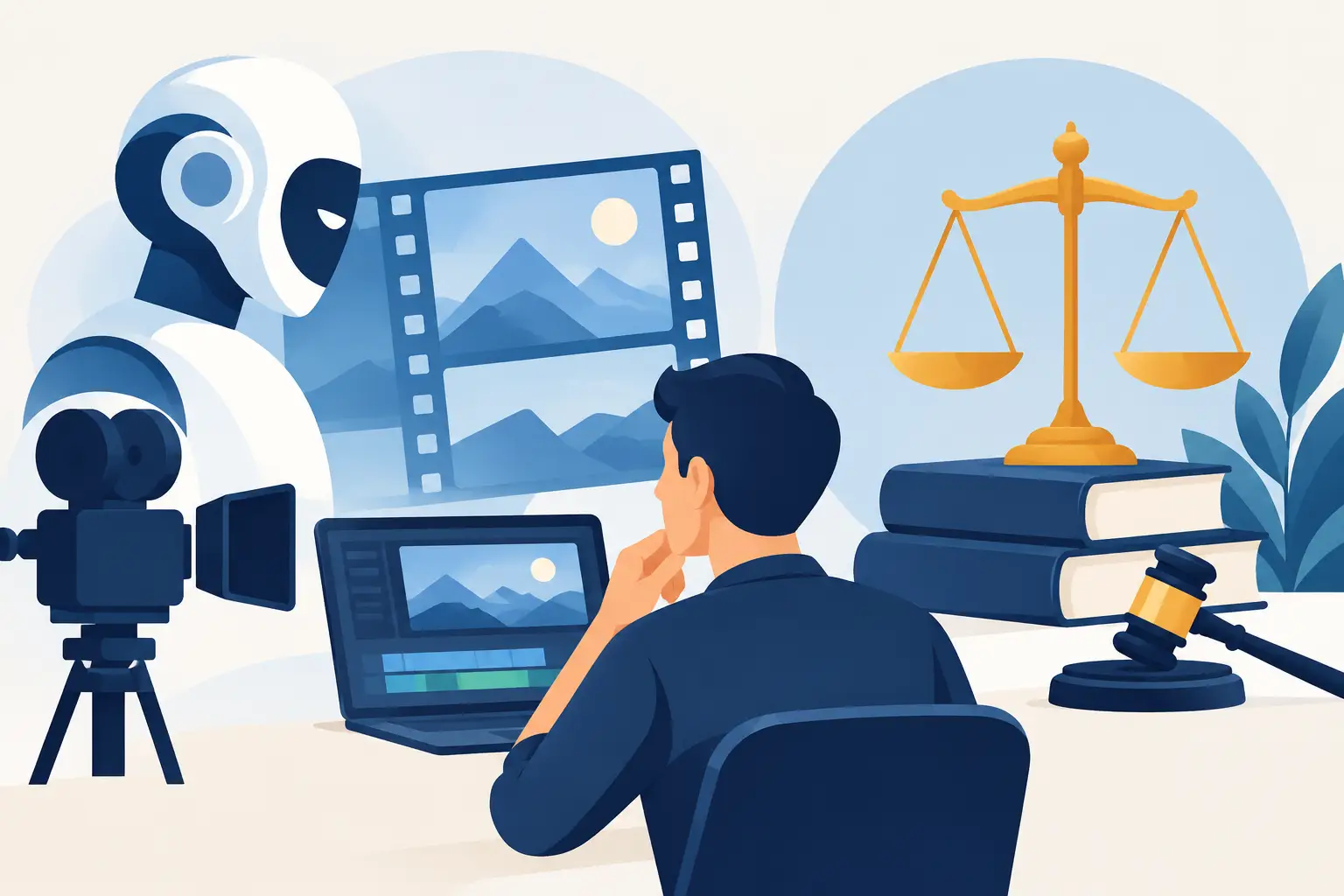
A synthetic close-up can be generated in seconds. Clearing the rights behind it can take far longer. The question, "are AI films legal?" has no single answer because an AI film is not one legal act. It is a chain of inputs, performances, prompts, edits, assets, agreements, and distribution decisions.
For filmmakers, the useful question is more precise: do you have the rights to make, use, claim, and release this particular work? AI cinema is legally possible. It is also a medium where casual assumptions can become expensive.
https://www.copyright.gov/ai/
Are AI Films Legal?
Yes, AI films can be legal. A film made with generative tools is not automatically infringing, unprotectable, or barred from release. The legal outcome depends on what went into the project, what the model produced, how people and recognizable material appear in it, and what rights your contracts actually grant.
A creator who uses original scripts, properly licensed references, authorized performances, and meaningful human direction occupies a very different position from someone who asks a model to recreate a living actor in a famous franchise scene. Both may be called AI films. Legally, they are not comparable.
The current U.S. framework is also moving in real time. Courts, regulators, platforms, unions, and studios are still defining boundaries around training data, voice replication, digital replicas, and authorship. That uncertainty does not mean creators should freeze. It means the production process needs a rights strategy before the final export.
Copyright begins with the source material
The cleanest AI film starts with material you control. That includes an original screenplay, visual development created by your team, licensed music, commissioned performances, and footage you have the right to transform or reference.
Copyright protects expression, not broad ideas. A filmmaker can make a neon detective story, a haunted spacecraft drama, or a surreal fashion film without asking permission from every work in those genres. But directly reproducing protected characters, scripts, compositions, images, or distinctive scenes introduces risk. Prompts do not erase that risk simply because the image arrives through a model rather than a camera.
Reference images deserve special care. Uploading a photographer's image, a studio still, a comic panel, or a frame from another film may violate the terms of the tool or exceed your right to use that material. Even if an output looks transformed, the input itself can create a problem. Keep a record of what was uploaded and why you were allowed to use it.
Training data is a separate question. Litigation and public debate continue over whether AI training on copyrighted works can qualify as fair use under particular facts. There is no universal rule that all training is lawful, and there is no universal rule that every output from a trained model is infringing. For a filmmaker choosing a tool, the practical issue is its terms, indemnity language, enterprise controls, and the provider's position on training and output rights.
Human authorship still matters
In the United States, copyright protection generally requires human authorship. The U.S. Copyright Office has made clear that purely AI-generated material is not protected in the same way as a human-created film. But an AI-assisted work can still contain copyrightable human expression.
That distinction matters. If a director writes the story, chooses the shots, refines generated images, directs human performances, designs sound, structures the edit, and shapes the final sequence, those human contributions may be protectable. The more the film reflects deliberate creative judgment, the stronger the case for authorship in the human-made elements.
This is not a reason to turn every workflow into paperwork theater. It is a reason to preserve the creative record. Save script versions, prompt iterations, edit timelines, source files, notes, and documentation of human revisions. If you register a work, be prepared to identify and disclaim material generated entirely by AI where required. Accuracy is part of the asset.
A useful principle: treat the model as a production instrument, not as the sole author of the movie. Cinema has always been assembled through tools. AI changes the speed and the texture of assembly, but authorship still lives in choices.
Making AI Films Legal to Release
Release raises questions that do not end with copyright. A beautiful image may be clear of a copyright claim and still create exposure through a person's face, voice, name, or reputation.
Consent is not optional when a person is recognizable
If your film uses a real actor's likeness, face scan, body performance, voice, or identity, get written permission that specifically covers the intended AI uses. A standard release written for conventional footage may not clearly authorize digital replication, synthetic dialogue, model training, alteration, or future uses across media.
This is especially critical when working with performers. A performer may agree to appear in a short film but not agree to have their face placed in unrelated scenes or their voice used to say lines they never delivered. The difference is creative, ethical, and contractual.
Using a celebrity's likeness or a recognizable public figure carries additional risk. Rights of publicity vary by state, and the analysis can change based on commercial use, expressive use, advertising, parody, and deception. A disclaimer may help viewers understand a work, but it is not a universal permission slip.
Voice deserves its own attention. A synthetic voice that evokes a well-known person can trigger claims even without using their name or a literal recording. The safest approach is simple: use voices you created, licensed, or recorded with clear consent for synthetic treatment.
Music, fonts, stock, and the invisible layers
Many AI film clearances fail in ordinary places. A score generated from an unlicensed song reference, a stock image used outside its license, a typeface without commercial rights, or a sound effect library restricted from machine-learning use can complicate a release.
Read licenses at the asset level. Some stock and music licenses permit commercial use but restrict redistribution. Some AI tools allow you to use outputs commercially on paid plans but reserve rights to train on your inputs. Others prohibit certain uses, including deceptive impersonation, adult content, or high-risk applications. Your workflow is only as clear as its most restrictive term.
For commissioned work, put ownership and permitted AI use in writing. If an animator, prompt artist, composer, or editor contributes to the project, clarify whether the production owns the deliverables, what preexisting materials remain theirs, and whether either party can reuse project assets to train a model. Ambiguity is not an experimental aesthetic.
Distribution requires a chain of title
A festival, distributor, insurer, broadcaster, or platform may ask for proof that you control the rights needed for the release. This is often described as chain of title: the documented path showing how the production acquired rights in its screenplay, footage, performances, music, artwork, and other material.
AI does not eliminate chain of title. It adds new links. Keep a production file with tool terms in effect when you used them, asset licenses, contributor agreements, performer releases, music clearances, and a log of generated material that appears in the final cut. If a platform requests a disclosure about synthetic or altered media, answer precisely.
Disclosure itself is context-dependent. Artistic AI cinema does not need to apologize for its method. But viewers should not be misled where realism could affect trust, especially in political, documentary, commercial, or news-adjacent work. A clear credit such as "AI-assisted visual production" can be both honest and aesthetically restrained. The right wording depends on the film and the distribution context.
Build the legal review into preproduction
The least efficient time to ask whether a face, a song, or a reference was cleared is after a trailer gains traction. Build a short rights review into preproduction and repeat it before release. Identify protected references, decide what requires a license or release, confirm the tool's commercial terms, and document the human authorship that shapes the film.
For projects with recognizable talent, real brands, sensitive subjects, major distribution plans, or significant revenue at stake, speak with an entertainment lawyer in the relevant jurisdiction. Legal advice should fit the actual film, contracts, and release territories. A template cannot see the creative choices your film makes.
AICINEO exists for work that treats this medium as cinema, not a loophole. The strongest AI films will not be defined by how closely they imitate what came before. They will be defined by the new images, performances, and worlds they can responsibly bring into view.