

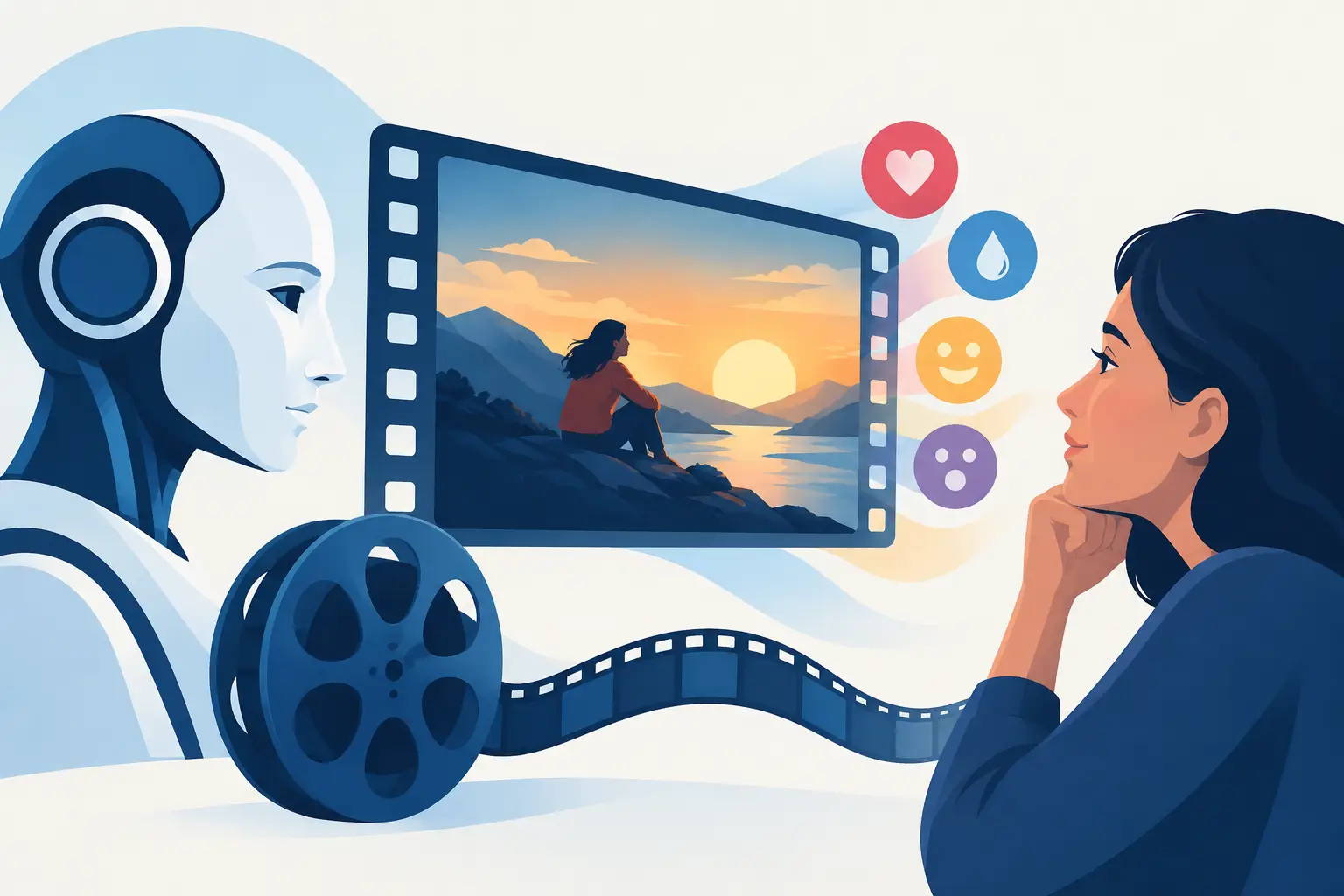
A close-up lasts one beat too long. A synthetic voice catches on a word. A familiar street appears under an impossible sky, and suddenly the image carries the feeling of a memory rather than an effect. Can AI films evoke emotion? They already can. But the emotional force does not come from the model alone. It comes from cinematic intention.
AI cinema is often judged at the wrong moment: the first glance. Viewers ask whether an image looks real, whether a character's hands hold together, whether a transition exposes its construction. Those are valid questions of craft. They are not the final measure of feeling. Cinema has always moved people through selection, rhythm, association, sound, and the charged space between what is shown and what is withheld.
AI changes the materials. It does not remove the language.
Can AI Films Evoke Emotion Without Human Performance?
A human face has long been cinema's most reliable emotional instrument. We read tiny changes in breath, posture, eye line, and hesitation. When an AI-generated character lacks that precision, the result can feel distant. This is one reason some AI films are visually arresting but emotionally flat: they imitate the surface of dramatic cinema without creating an inner life.
Yet performance is larger than an actor standing in front of a camera. A film can create performance through editing, framing, vocal direction, movement, music, and repetition. A figure walking through a changing landscape may become expressive because the film gives that walk a context. A voiceover can turn an abstract image into grief. A cut from an empty chair to an old photograph can create a loss no digital character needs to perform.
The question is not whether a generated face can replace every actor. It cannot, at least not consistently. The question is whether a filmmaker can organize generated material into an experience that lets the audience project, recognize, and feel. The answer depends on the work.
A photorealistic drama built around subtle interpersonal tension demands a high degree of control over continuity and performance. An experimental short about memory, dreams, migration, isolation, or transformation may find emotional power precisely in AI's instability. Faces that shift, places that melt, and time that refuses to behave can become form rather than flaw.
Emotion Comes From a Point of View
The most affecting AI films do not begin with a prompt. They begin with a feeling specific enough to direct every decision.
Consider the difference between "a lonely astronaut on an alien planet" and a film built around the sensation of calling home after everyone you knew has changed. The first is a visual premise. The second is a point of view. It determines the pace of the cuts, the distance of the camera, the texture of the sound, the words left unsaid, and the images that return at the end.
Generative tools are exceptionally capable of producing possibility. They can rapidly create worlds, variations, costumes, weather, faces, gestures, and visual metaphors. Possibility is not emotion. Emotion arrives when the filmmaker rejects most of those options and chooses the few that belong together.
This is where authorship becomes visible. Not as a claim that every pixel was made by hand, but as the presence of judgment. Why this image? Why now? Why hold it for seven seconds instead of two? Why let the sound cut out before the final line? A film earns its feeling through these decisions.
The same principle applies to AI-assisted work and fully generated work. The tools may participate in design, animation, scene construction, voice, compositing, or editorial experimentation. What the audience experiences is not a toolchain. It is a sequence of choices with an emotional center.
Imperfection Can Be Part of the Feeling
For decades, commercial screen culture trained audiences to associate technical polish with authority. AI cinema introduces a different possibility: an image can be unstable and still be precise.
A character whose expression changes slightly between shots may break a conventional scene. In another context, that shifting identity can communicate dissociation, aging, unreliable memory, or the uneasy logic of a dream. A floating object may read as an artifact in one film and as a beautiful refusal of gravity in another. Meaning changes the error.
That does not excuse carelessness. Viewers can tell when a film has no command over its own accidents. Randomness becomes tiring when it never develops into a pattern. The creative challenge is to distinguish productive instability from unattended noise.
A strong AI filmmaker treats anomalies as material. They refine what supports the emotional premise and remove what distracts from it. Sometimes that means chasing a controlled, cinematic realism. Sometimes it means pushing toward collage, surrealism, animation, or visual abstraction. The right approach is the one that makes the film more honest about what it wants to say.
Sound Is Where the Image Learns to Feel
A remarkable AI image can stop a scroll. Sound can make someone stay.
This matters because generated visuals often arrive with a built-in sense of spectacle. They announce themselves. Sound gives them duration, intimacy, and consequence. The scrape of a chair in an empty room, distant traffic under a monologue, a song heard through a wall, or a moment of near-silence can turn visual novelty into emotional space.
Voice is especially consequential. A convincing voice is not necessarily the most polished one. A narrator may need a dry inhale, an imperfect cadence, a pause that feels chosen rather than optimized. If synthetic speech is used, direction and editing matter as much as the voice model. The rhythm of language must belong to the character and the scene.
Music deserves the same restraint. Scoring every image tells the audience what to feel before they have had a chance to feel it. Letting a scene breathe can be more affecting than forcing a climax. In AI cinema, where images can become dense and volatile, sound often provides the emotional handrail.
The Audience Is Not Looking for a Machine With Feelings
A common objection is simple: AI does not feel, so its films cannot truly be emotional. The premise confuses the maker's interior state with the audience's response.
A camera does not feel either. Neither does a lens, an editing system, a paintbrush, or a synthesizer. Artifacts do not need emotions to participate in emotional art. People do. The director, writer, editor, designer, performer, and audience bring human experience to the work.
There is still an ethical dimension. A film should not hide the labor, likenesses, or cultural material it draws from. Consent, attribution, and responsible sourcing are not administrative concerns outside the art. They affect trust. A viewer is more open to emotional risk when the work feels grounded in a clear, respectful creative practice.
Transparency can also deepen the encounter. Knowing that a filmmaker used AI to reconstruct fragments of a lost hometown, visualize recurring nightmares, or build an impossible family archive can give formal choices a human frame. The technology becomes meaningful because someone used it to pursue something that could not be easily expressed otherwise.
AI Cinema Needs Better Questions
"Was this made by AI?" is becoming less useful as a critical question. It identifies a production condition, not an artistic achievement.
More revealing questions are these: What feeling does the film pursue? What visual logic does it invent? Where does it surprise us? Does the form serve the subject? Does its use of AI expand the story's emotional range, or merely decorate it?
Those questions make room for both skepticism and ambition. Not every AI film will move people. Most films made with any method do not. Some will remain demonstrations, built to display a workflow or chase a passing aesthetic. Others will find a language that could not have existed in the same way through conventional production.
That is the territory AI cinema is entering. Not a contest between human feeling and machine feeling, but a new field of human expression shaped through unfamiliar instruments. AICINEO exists for the work that takes that responsibility seriously.
The next time an AI-generated image unsettles, comforts, or stays with you, look past the novelty. Ask what the film allowed you to recognize in yourself. Then ask what a filmmaker might do with that feeling if they had the courage to build an entire world around it.