

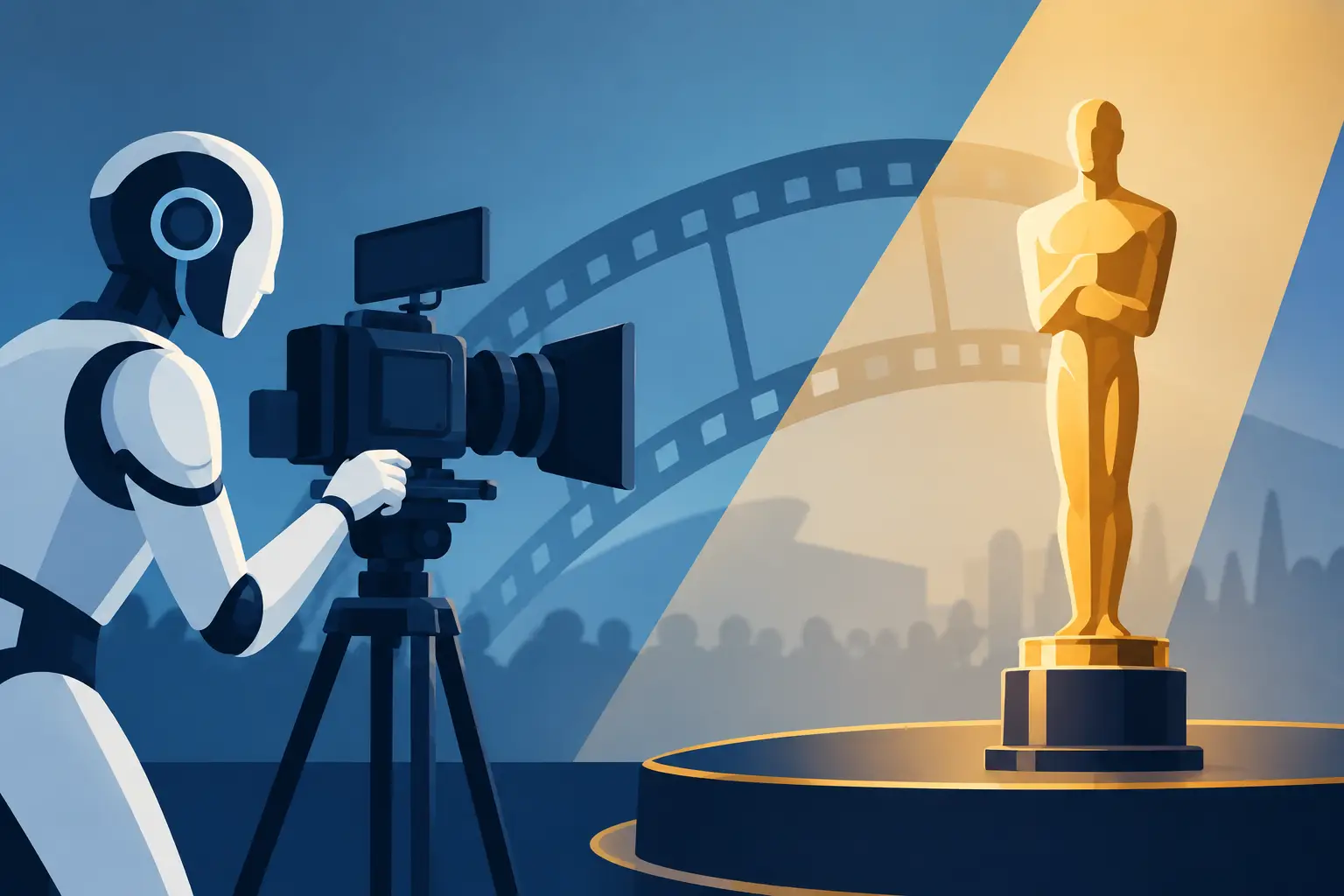
A film enters a festival theater. The image was generated, transformed, composited, and edited with AI. The director shaped every decision that made it matter. Can AI films win awards? Yes. But the answer is not decided by how much AI appears on screen. It is decided by authorship, eligibility, rights, and the standards of the institution holding the prize.
AI Cinema is already asking a useful question of the awards world: what, exactly, are juries honoring? A finished work? A director’s vision? A production process? Most serious awards systems will answer: the work, and the human creative responsibility behind it.
Can AI Films Win Awards Under Current Rules?
Many can, provided they meet the same baseline requirements as any other film. They may need to satisfy running-time rules, premiere requirements, geographic eligibility, submission deadlines, and category definitions. AI use does not automatically disqualify a film from most festivals. It does, however, create extra scrutiny where the rules require human authorship or where the submission includes copyrighted material, performances, or claims of original production.
The central distinction is between AI-assisted filmmaking and a film presented as autonomously made by a machine. A director who develops a concept, builds references, writes or revises a script, directs performances, selects generations, structures scenes, designs sound, and edits the final cut has a strong authorship case. The tool may be generative. The filmmaking is not passive.
That does not mean every award body will treat the work the same way. A forward-looking AI film festival may celebrate the process as part of the form. A traditional animation prize may ask whether the submission meets its production definitions. A screenwriting competition may focus more narrowly on the origin of the text. Eligibility is always category-specific.
The Real Test Is Creative Control
Awards are rarely given for effort alone. They recognize choices: what the camera seems to see, what a cut withholds, how a voice changes a scene, when an image becomes emotionally credible. In AI Cinema, those choices remain visible, even when the material is generated.
A film with thousands of prompts is not necessarily more authored than a film with twenty. Prompt volume is a poor measure of craft. The stronger evidence is intentionality. Did the filmmaker establish a visual language? Do the images evolve with the story? Does the sound design create tension rather than cover inconsistency? Are the artifacts of generation used with purpose, or merely tolerated?
This is where AI films can compete on artistic ground. A jury does not need to be persuaded that AI is novel. It needs to encounter a film that has rhythm, point of view, and consequence. The technology can open a new visual grammar. It cannot substitute for one.
Human Direction Still Carries the Claim
The most defensible AI-film submission identifies the human makers and their roles plainly. Director, writer, editor, composer, production designer, performer, animator, or creative technologist: these credits describe where responsibility lived.
This matters because awards often attach recognition to people, not only projects. If a film wins, who accepts? Who made the decisions? Who can explain the work’s sources and process? A clear answer protects both the filmmaker and the festival.
There is also a cultural reason to be precise. Calling a work “made by AI” can erase the labor of the people who imagined it, iterated it, rejected weak versions, and assembled its final meaning. AI Cinema should not hide its methods, but it should not diminish its artists either.
Disclosure Is Becoming Part of the Submission
As rules mature, disclosure will become more common. Some festivals will ask whether generative AI was used in image creation, voice, script development, music, or post-production. Others will simply require entrants to confirm that they control the rights needed to exhibit the film.
Disclosure is not an admission of lesser status. It is production information, similar to identifying animation techniques, archival footage, virtual production, or documentary reenactments. The practical issue is whether a festival can program the work responsibly and communicate honestly with audiences.
Filmmakers should avoid two opposite mistakes. The first is concealing meaningful AI use because they fear prejudice. If a rule asks, answer directly. The second is treating “made with AI” as the entire artistic statement. A submission should lead with the film’s premise, form, and creative intent. The production method belongs in the notes, not in place of a story.
Rights Can Decide a Film’s Award Future
A beautiful AI short can be rejected long before a jury sees it if the rights are unclear. This is the least glamorous part of the conversation and one of the most important.
A filmmaker needs to consider the terms of the tools used, the source material supplied to those tools, the licenses for music and sound effects, the permission of any recognizable performer, and the use of real brands, artwork, or likenesses. If a synthetic voice is modeled after a living actor, or a character closely resembles a public figure, the risk is not theoretical. A festival may decline the work to avoid a dispute.
Training-data debates make the landscape more complex, but creators should focus first on what they can control. Keep records. Save project files, drafts, prompt histories where useful, licenses, contributor agreements, and proof that you have permission to use supplied assets. A clean chain of documentation will not make a weak film stronger. It may keep a strong one from becoming impossible to screen.
Music, Voices, and Likenesses Need Special Care
These elements carry particular emotional force, which also makes them sensitive. Synthetic vocals, cloned voices, and realistic faces can create a powerful cinematic effect. They can also trigger questions about consent, publicity rights, and audience deception.
If the film uses an AI-generated performer, state that appropriately when a festival requires it. If it uses a real person’s image or voice, obtain the permissions that the project needs. If the film is satire, parody, or experimental work, legal context may differ, but “experimental” is not a blanket exemption from responsibility.
Awards Will Create New Categories, but That Is Not the End Goal
Dedicated AI film awards are valuable. They give emerging artists a fair context, allow jurors with relevant fluency to assess process and craft, and help audiences discover a body of work that might otherwise be scattered across general categories. AICINEO exists within that larger cultural need: AI Cinema deserves a visible home, not a novelty shelf.
Yet the long-term measure of acceptance is not whether AI films only win AI awards. It is whether an AI-assisted drama can win for narrative, an AI animation can win for design, or an AI short can move a jury without its process becoming the headline.
Separate categories can be a useful stage, especially while the medium is developing conventions. They can also become a ceiling if institutions use them to avoid engaging with the work on equal artistic terms. Both outcomes are possible. The better model is expansion: dedicated recognition for the form, plus access to open competition when a film meets the category rules.
What Makes an AI Film Competitive?
The films most likely to earn awards will not be those that imitate expensive live-action production most convincingly. They will be the ones that understand what the medium does differently.
AI can create impossible transitions, unstable memory spaces, compressed worlds, shifting identities, and image systems that feel closer to dreams than documentation. These are not automatic virtues. They become cinematic when tied to theme. If a story concerns grief, surveillance, mythology, migration, desire, or machine perception, the film’s visual transformation should deepen that idea rather than decorate it.
Craft still decides the outcome. Watch the edit without sound. Does the visual progression hold? Listen without picture. Does the audio create its own architecture? Read the synopsis after viewing. Does it name the film you actually made? These simple tests reveal whether the work is coherent beyond its generated moments.
Awards juries also respond to restraint. Not every frame needs to announce the tool. A deliberate still image, a controlled palette, or a single recurring sound can make a short feel more complete than constant escalation. The future-facing film is not necessarily the loudest one. It is the one with a point of view.
The awards question will keep changing because the medium is changing. Rules will tighten in some places, open in others, and eventually become more precise. That is healthy. AI Cinema does not need exemption from standards. It needs standards capable of seeing the artist inside the process. Make the work with that level of care, and let the screen make the case.