

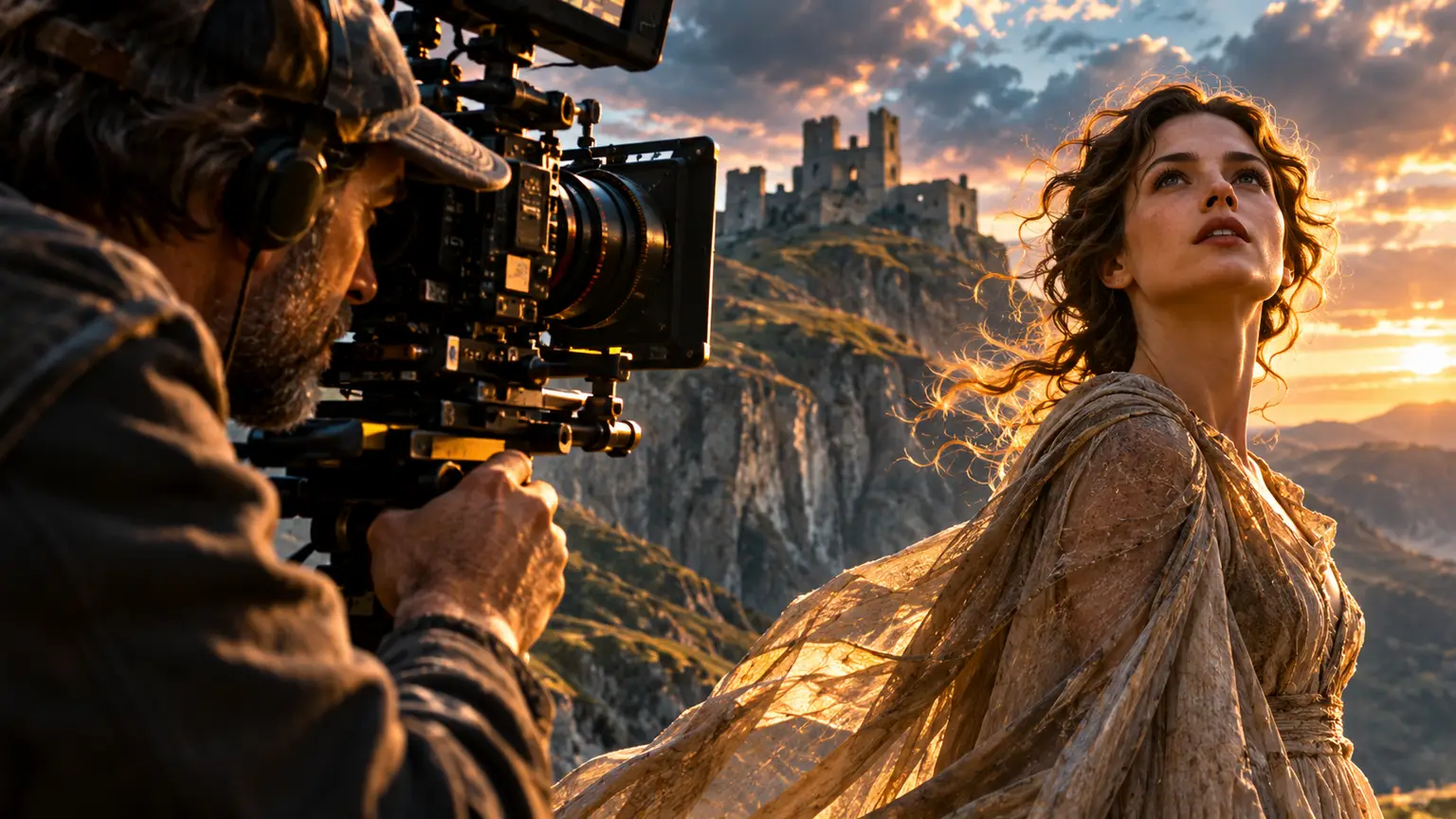
A close-up is not cinematic because the lens was set to 85mm. It becomes cinematic when someone knows what a face is hiding, where the light should fall, and when the camera should hold one second longer. So, can AI replace cinematographers? It can replace parts of the process. It cannot yet replace the full act of seeing.
AI Cinema is changing the production grammar fast. A creator can now generate a mood film, test a camera move, transform a location, or build an impossible shot without renting a crane or assembling a hundred-person unit. That is a real shift in power. But a cinematographer is not simply the person operating the camera. They are the visual author who turns a director's intention into an image system an audience can feel.
https://aicineo.com/create-ai-video
What AI Can Already Do for Cinematography
Generative tools are increasingly capable of producing images that resemble considered cinematography. They can simulate shallow depth of field, motivated practicals, anamorphic flare, fog, grain, golden-hour warmth, and the visual language of almost any era. They can also create previs at a speed that changes how directors and cinematographers prepare.
For a small team, this matters. Instead of describing a scene in references and rough sketches, a director and DP can generate a visual conversation. They can test whether a hallway should feel clinical or haunted, whether the camera belongs across the room or inside the character's breath, and whether a scene needs hard noon light or a soft window source.
AI is especially strong when the task is exploratory, repetitive, or technically constrained. It can generate look references, extend environments, remove unwanted objects, create temp storyboards, and offer variations that would take a traditional department days to mock up. In post-production, it can assist with cleanup, rotoscoping, relighting experiments, and image continuity.
None of that is trivial. It reduces friction between an idea and a visible frame. For emerging filmmakers, it can make visual ambition less dependent on access to expensive equipment.
Why a Cinematographer Is More Than a Shot Generator
A generated image has no set to navigate. A cinematographer does.
On a live-action shoot, the frame emerges from a chain of relationships: director and actor, actor and space, production designer and light, schedule and weather, lens choice and emotional distance. The cinematographer is constantly making decisions inside those relationships. A cloud covers the sun. An actor changes their blocking. A location that looked perfect in scouting suddenly has a white ceiling bouncing light everywhere. The scene is running late, and the emotional center of the shot has moved.
No prompt fully contains that moment.
Cinematography is also a discipline of subtraction. The best decision may be to remove a light, abandon a planned move, let an actor fall into shadow, or accept an imperfection because it gives the scene life. AI can offer options at scale. It does not inherently know which option to refuse, or why a technically beautiful image can still feel false.
That distinction becomes sharper with performance. A cinematographer watches for the instant when a performer stops acting and begins revealing something. The camera may need to drift closer, stay still, or deliberately look away. Those choices are not just visual. They are ethical and emotional. They shape how the audience is allowed to witness another person.
Can AI Replace Cinematographers in AI Cinema?
In fully generated work, the question changes. There may be no physical camera, no lens package, no lighting truck, and no traditional set. Yet the need for cinematographic thinking remains.
Someone still decides the visual point of view. Someone establishes spatial rules, chooses the rhythm of cuts, controls contrast, directs color, and makes the virtual camera feel intentional rather than restless. Someone decides whether a scene should be observed with restraint or pushed into dream logic. That person may not carry the traditional job title of cinematographer, but they are doing cinematographic work.
The emerging role is often a hybrid: director, visual designer, prompt artist, editor, and DP in one. In this context, AI does not eliminate cinematography. It distributes it across a new workflow.
That workflow has its own challenges. Generative video can produce striking individual frames while losing coherence across a sequence. Character scale shifts. Objects mutate. Camera movement can feel like a visual effect rather than a motivated decision. The creator must impose continuity, taste, and dramatic purpose on a system built to generate possibility.
This is where experienced cinematographers have an advantage, not a disadvantage. A DP who understands screen direction, lens psychology, lighting logic, and visual progression can recognize when generated material is merely impressive and when it actually serves the film.
The Real Divide Is Between Images and Intent
AI will continue to absorb technical tasks once treated as specialized labor. That may affect entry-level roles, production budgets, and the number of conventional shoots a project requires. The disruption is real, and romanticizing craft will not change it.
But replacement is not the only story. When cameras became digital, cinematography did not disappear. When nonlinear editing arrived, editors did not become irrelevant. The tools changed the workflow, the economics, and the creative vocabulary. The essential human role became more visible: judgment.
The same is true here. AI can generate a thousand versions of a rain-soaked street. It cannot determine, on its own, why this street matters to this character at this precise point in the story. It cannot earn an actor's trust, read a director's uncertainty, or build a visual language that evolves with a film's moral temperature.
Those are not mystical qualities. They are learned through observation, collaboration, failure, references, and time on set. They are also increasingly relevant to synthetic production, where the volume of available imagery makes discernment more valuable, not less.
A New Collaboration, Not a Clean Handoff
The strongest use of AI is not asking it to impersonate a cinematographer. It is using it to extend cinematographic imagination.
A DP can use generative tools to pre-visualize an impossible transition before finding the practical version. A director can test color worlds early enough to align costume, design, and camera departments. An independent creator can create a proof of concept that earns support for a larger film. A post team can spend less time on repetitive cleanup and more time protecting the image's emotional texture.
There are risks. If every project trains on the same visual shorthand, cinema gets flatter. Familiar prompts produce familiar frames: neon reflections, perfect skin, floating cameras, prestige darkness, spectacle without consequence. The response is not to reject AI Cinema. It is to bring stronger authorship to it.
Cinematographers will need fluency in new systems, just as AI creators need fluency in the visual history of film. Knowing how to generate an image is one skill. Knowing what that image is saying is another.
AICINEO exists in that second space: AI as a filmmaking medium, not a button for instant content. The work worth remembering will not be defined by whether it was shot, simulated, or generated. It will be defined by whether its images carry intention.
The camera may become virtual. The light may begin as a prompt. But the next frame still needs someone who can see what it should mean.