

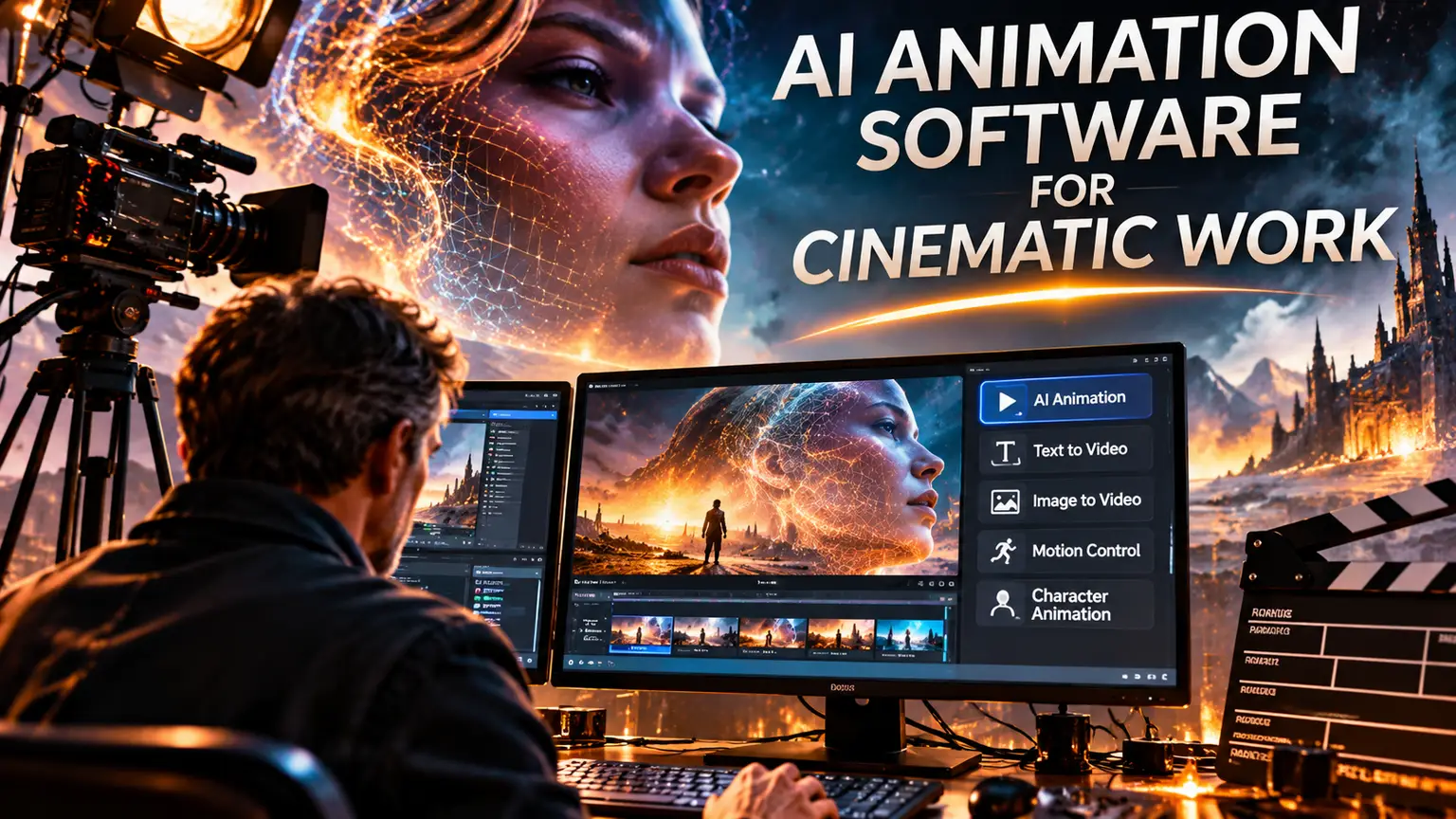
A performer turns toward a window. The shot begins in a real room, then the city outside transforms into a suspended, impossible metropolis. The moment only works if the audience follows the emotion before it notices the technique.
That is the standard when you combine live action AI footage. The goal is not to prove that AI can generate an image. The goal is to make the boundary between captured reality and constructed cinema feel intentional. Sometimes that boundary should disappear. Sometimes it should become the subject of the frame.
For filmmakers, this hybrid form creates real freedom: smaller crews can imagine larger worlds, practical performances can enter environments that would never fit a conventional production budget, and editorial decisions can shape scenes long after the shoot. It also introduces a new discipline. AI does not automatically preserve the visual logic that live-action photography earns through lenses, blocking, light, and time.
https://aicineo.com/create-ai-video?utm_source=chatgpt.com
Start With the Cinematic Reason
Before choosing a workflow, identify why a shot needs AI. “Because it looks cool” may be enough for an experiment, but it is rarely enough for a scene. A stronger reason could be a world that changes with a character’s memory, an architectural scale that reflects a power imbalance, or a transition that turns an ordinary location into a psychological space.
Live action gives AI cinema a human anchor. It supplies a face, a body, a glance held too long, the minor irregularity of movement. AI can then extend, disturb, or reframe that reality. When the two mediums have separate jobs, the film feels designed rather than patched together.
This decision also determines where the cut belongs. If the emotional truth lives in a performer’s eyes, protect that shot as live action. If the scene needs the impossible view outside the window, the collapsing city, or the landscape from a dream no location can provide, use AI where it has a dramatic purpose.
Choose the Right Hybrid Model
There is no single method to combine live action AI footage. The best approach depends on what must remain stable and what is allowed to mutate.
Extend the frame
A live-action plate can hold the actor, foreground props, and essential interaction, while AI creates or replaces the surrounding environment. This is often the most reliable entry point because the performance, camera movement, and physical contact remain grounded. It works especially well for city extensions, distant weather, horizon lines, impossible architecture, and historical or speculative settings.
The trade-off is that the division of labor must be carefully planned. Hair edges, reflective surfaces, fast hand gestures, and transparent objects can expose a weak composite. Give yourself clean separation between subject and background whenever possible.
Transform an existing shot
Image-to-video and video-to-video workflows can reinterpret a filmed plate through a new visual language. A warehouse can become a lunar chapel. A street can become an illustrated memory. This method is powerful when instability is part of the concept.
It is less useful when the audience needs to track exact production details across multiple shots. AI transformation may alter faces, costumes, signage, props, or spatial geometry. For a music video, fashion film, or dream sequence, that fluidity can be an advantage. For a dialogue scene built around continuity, it can become expensive in the edit.
Use AI as an insert language
Not every AI shot needs to carry a full scene. Generated inserts can show an imagined future, a surveillance feed, an abstract interior, a product of a character’s mind, or a view impossible to capture safely. These shots can bring scale and texture without forcing AI to maintain an actor’s identity through a long take.
This model is often the most editorially flexible. It lets live-action coverage carry narrative clarity while AI expands the film’s visual vocabulary.
Build a Visual Bible Before the Shoot
The quickest way to create mismatched hybrid footage is to shoot first and make aesthetic decisions later. Establish the world before production, even if the final imagery will evolve.
Define the camera language: lens character, framing distance, camera height, movement, shutter feel, and depth of field. Define light direction and contrast. Decide whether the world is clean, degraded, soft, metallic, grainy, overexposed, or nocturnal. A few clear references are more useful than a giant mood board full of unrelated images.
Most importantly, define what cannot change. A character’s silhouette, jacket, hairstyle, vehicle, weapon, or signature color may need to persist across live action and generated shots. These anchors give the audience something stable to recognize while the film takes visual risks elsewhere.
A visual bible is not a constraint on experimentation. It is what makes experimentation legible.
Shoot Plates That Give AI Room to Work
Hybrid cinema starts on set. Capture the information your later process will need, even on a lean production.
Record clean plates of the environment without actors. Capture a few seconds before and after the action. Photograph the location, props, wardrobe, and lighting setup from multiple angles. Note the lens, focal length, camera height, exposure, white balance, and movement. If the camera moves, retain tracking markers or usable details in the frame.
Keep lighting motivated. An AI-generated environment may be fantastical, but the light on the actor still needs a believable source. If the final scene contains a bright sunset, monitor glow, or alien skyline, let a practical or off-camera source create a corresponding edge light or color spill during the shoot.
You do not need to pre-solve every pixel. You do need to preserve the physics of the scene. Contact shadows, eyelines, reflections, and the direction of a moving light are the details that make a synthetic world feel inhabited.
Direct for the Edit, Not for the Demo
A striking AI test clip can hide a weak scene. A finished film cannot. When working with hybrid footage, cover the scene with an editor’s needs in mind: a stable wide shot, performance-driven mediums, close-ups that carry emotion, and cutaways that can bridge visual changes.
Shorter generated shots are often easier to control, but brevity should serve rhythm rather than fear. If an AI image shifts slightly during a two-second cutaway, the viewer may read it as atmosphere. If it shifts during a 20-second dialogue take, the illusion may collapse.
Sound is equally decisive. Room tone, footsteps, cloth movement, distant traffic, and a deliberate score can bind unlike images into one cinematic space. A perfect image with generic sound still feels detached. A slightly imperfect image with precise sound can feel present.
Protect Continuity Where It Matters
Continuity is not an administrative chore. It is how a film preserves attention. Viewers may accept a sky that rearranges itself if the character, emotional beat, and spatial logic remain clear. They are less forgiving when a hand changes shape while holding an object central to the action.
Prioritize continuity in faces, hands, hero props, wardrobe, and screen direction. Let less critical areas carry the experimentation: background crowds, distant structures, atmospheric textures, and transitional imagery. This is not a rule against transformation. It is a way to decide where transformation has the most impact.
Color finishing should happen across the sequence, not shot by shot in isolation. Match contrast, black levels, skin tone, grain, and motion texture so that the live-action material and generated material share the same final air. Sometimes the answer is to refine the AI shot. Other times, a subtle treatment on the live-action plate brings the two closer together.
Let the Join Show When the Story Needs It
The obsession with invisibility can limit the medium. A visible shift from live action into AI can become a cinematic event: reality fractures, identity becomes unstable, a remembered place remakes itself in front of us. In those moments, the seam is not a flaw. It is the language of the film.
The question is whether the transition has been authored. A hard cut, match cut, lighting change, whip pan, rack focus, or sound bridge can announce the movement between states with purpose. If the audience senses a decision, it will often follow you into unfamiliar territory.
AICINEO treats this territory as AI cinema, not as a visual-effects substitute. The work is strongest when generative tools expand the grammar of moving images while live action protects the human stakes.
Make the Last Pass a Question of Meaning
Before export, watch the film without thinking about the tools. Ask where the viewer is meant to look, what they are meant to feel, and whether each altered image changes the scene rather than merely decorating it. Remove shots that only demonstrate capability. Keep the images that make the story stranger, clearer, or more alive.
The most memorable hybrid films do not ask audiences to admire the technology. They give audiences a world worth entering, then let the technique disappear into the feeling of the scene.