

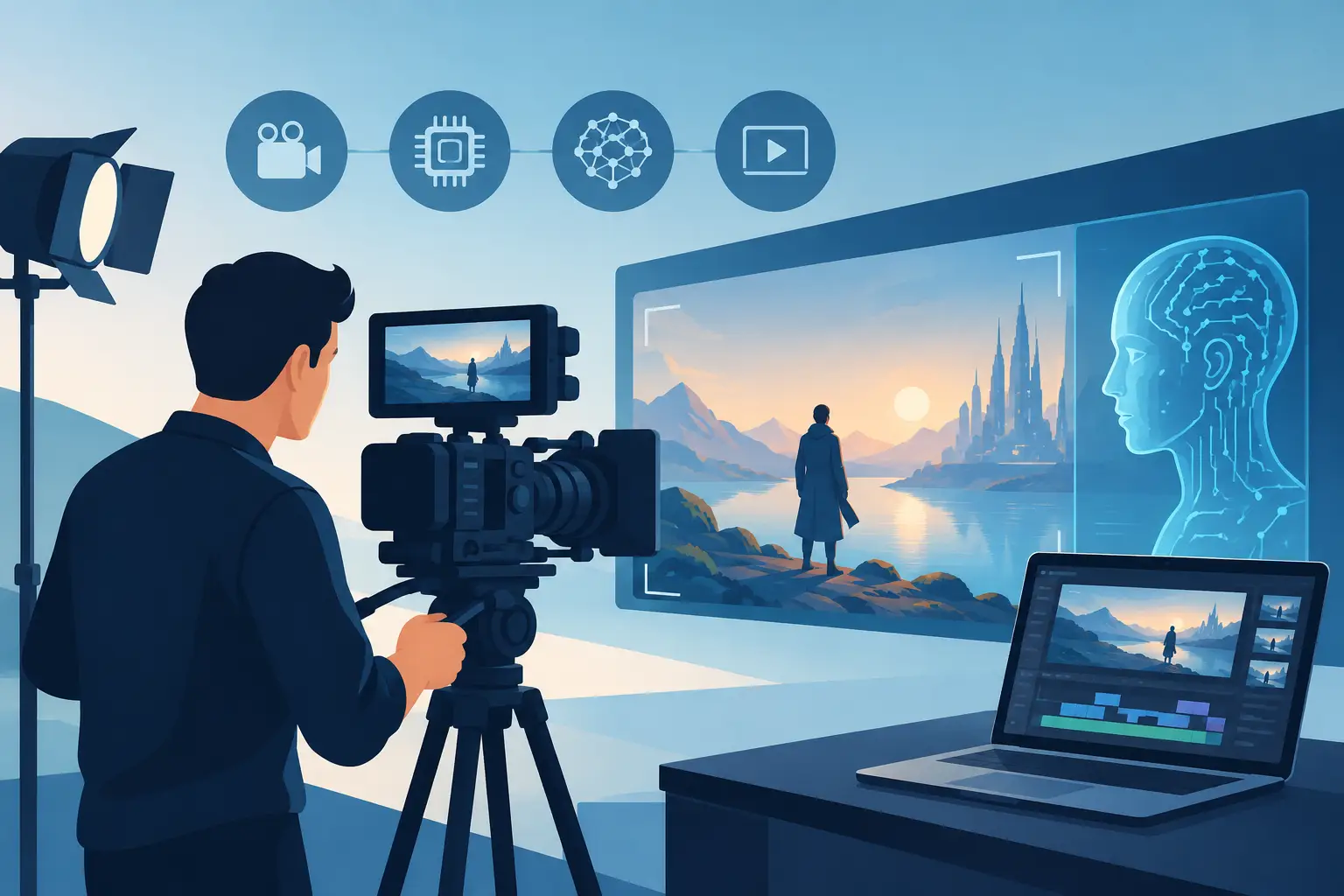
A shot can now begin as a sentence, a sketch, a performance reference, or a rough previs sequence. That change is bigger than a new software category. The filmmaking technology trends defining this moment are changing where a film starts, who can make one, and what kind of images audiences are ready to accept as cinema.
For independent creators, the promise is immediate: scenes once reserved for productions with large art departments, VFX teams, and location budgets are becoming possible at a smaller scale. For directors and producers, the harder question is not whether AI can generate an image. It is whether the image serves a point of view. Technology can widen the frame. It cannot decide what deserves to be in it.
Filmmaking Technology Trends Moving Into the Frame
Generative video is becoming a visual development system
Generative video still attracts attention for its ability to produce striking clips from text prompts. Its more lasting role may be earlier in the process. Directors are using it to test atmosphere, production design, lens language, transitions, and impossible locations before a crew is assembled.
This shifts visual development from a sequence of static references toward moving evidence. A filmmaker can test how a submerged city feels at dusk, how fabric behaves in a zero-gravity dance scene, or whether a character silhouette reads inside a fog-heavy frame. The result is not necessarily final footage. Often, it is a more precise conversation between director, cinematographer, production designer, editor, and client.
The trade-off is consistency. Generative systems can create an arresting moment, then struggle to reproduce the same character, space, or physical logic across a full scene. The strongest workflows treat generation as an iterative department, not a slot machine. References, shot bibles, visual rules, and selective human revision give the work a shared grammar.
Preproduction is becoming more cinematic
Traditional previs can be expensive, specialized, or too abstract to communicate the intended emotional rhythm of a sequence. New image, video, and 3D tools are bringing director-friendly previs closer to the final experience of watching a scene.
A rough animatic can now contain camera movement, lighting direction, sound texture, and a provisional performance. That gives teams a clearer way to debate choices before they become costly. Is the scene stronger as a slow push-in or a locked wide shot? Does the reveal belong in shadow? Should the environment feel built, scanned, or dreamlike?
This does not eliminate planning. It raises the standard for it. When a director can show a near-cinematic intention early, every department needs to know which decisions are fixed and which are still exploratory. Otherwise, a seductive previs can quietly become a constraint rather than a guide.
Virtual production is finding a more practical scale
LED volumes remain visually powerful, especially when a production needs interactive light, controlled reflections, or a horizon that performers can respond to. But the trend is not simply bigger walls and larger stages. It is a broader mix of real-time backgrounds, partial sets, projection, smaller LED setups, and location capture.
For many productions, the smart choice is hybrid. Build the section an actor touches. Use physical foreground elements to anchor the shot. Extend the world digitally where the camera needs it. This can preserve tactile detail while reducing travel, weather risk, and late-stage compositing work.
Virtual production is not automatically cheaper. It demands preparation, technical coordination, and decisions made earlier than some crews are used to making. A poorly prepared virtual set can turn flexibility into delay. A well-prepared one lets performance, camera, and environment meet in the same moment.
Real-time engines are reshaping the director's monitor
Game engines have become part of the filmmaking toolkit because they make world-building responsive. A director can move through a digital set, adjust the time of day, block a shot, and assess scale without waiting for a rendered preview. That immediacy matters most when story worlds are complex or mutable.
The cultural shift is equally significant. The line between cinematics, animation, games, music visuals, and short-form film is becoming less useful as a creative boundary. What remains is the question of cinematic intention: how time, composition, sound, and performance are shaped for an audience.
Real-time tools reward filmmakers who can think spatially. They also reward collaboration. The director who understands a little about assets, lighting, and camera systems can speak more clearly with technical artists. The technical artist who understands dramatic emphasis can help protect the scene from looking like a polished demo.
The New Post-Production Stack
Post-production is becoming less linear. AI-assisted rotoscoping, cleanup, dialogue isolation, transcription, translation, and sound repair can remove hours of repetitive labor. Editors can search interviews by spoken phrase. Sound teams can separate usable dialogue from difficult locations. Small crews can create temporary versions of shots that once required a larger finishing pipeline.
That speed is meaningful, but it is not the same as taste. Automated cleanup can remove the texture that makes an image feel lived-in. Voice processing can make dialogue clear while flattening its emotional grain. A generated insert may solve a continuity problem while introducing a visual lie the audience feels but cannot name.
The best use of automation is selective. Let it reduce mechanical friction, then put the recovered time into pacing, sound design, color, performance, and visual coherence. Those are still the places where a film earns attention.
Synthetic performance requires a clear ethics policy
Digital doubles, voice models, face replacement, and performance-driven character systems will continue to develop. Their creative potential is real. A filmmaker may build a character that exists beyond a single shoot day, create multilingual versions with greater care, or stage a performance inside an impossible world.
But synthetic performance is inseparable from consent, credit, compensation, and disclosure. A face or voice is not raw material simply because it can be modeled. Productions need explicit permissions, defined usage boundaries, and records that survive beyond the immediate edit.
For audiences, transparency does not weaken the illusion. It can strengthen trust. The question is not whether AI was used. The question is whether its use respects the people whose work, likeness, and culture contribute to the final film.
Why the Human Signature Matters More Now
When images become easier to generate, selection becomes more visible. Anyone can produce visual abundance. Fewer creators can build a sequence in which every image belongs to the same emotional universe.
That is where authorship lives in AI cinema. It lives in the references a director rejects, the imperfections they preserve, the rhythm they refuse to accelerate, and the subjects they choose to place at the center of the frame. It also lives in the discipline to stop generating when the shot has found its purpose.
AICINEO exists in that space: not as a showcase for technical tricks, but as a cultural home for films that treat artificial intelligence as a filmmaking medium. The format deserves criticism, programming, audience language, and artistic standards of its own.
The next divide will be coherence, not access
Access to powerful tools is widening quickly. That will produce more work, more experimentation, and plenty of visual noise. The creators who stand apart will not necessarily have the most advanced model or the largest pipeline. They will have a recognizable sensibility and a method for carrying it from first frame to final cut.
Build that method before chasing every release. Keep a visual bible. Define what your camera can and cannot do. Decide how characters move, how light behaves, how sound enters, and what emotional distance the audience should feel. Use new tools to test those rules, not erase them.
The future of filmmaking will not belong to the creators who automate the most. It will belong to those who make technology answer to a stronger cinematic idea.