

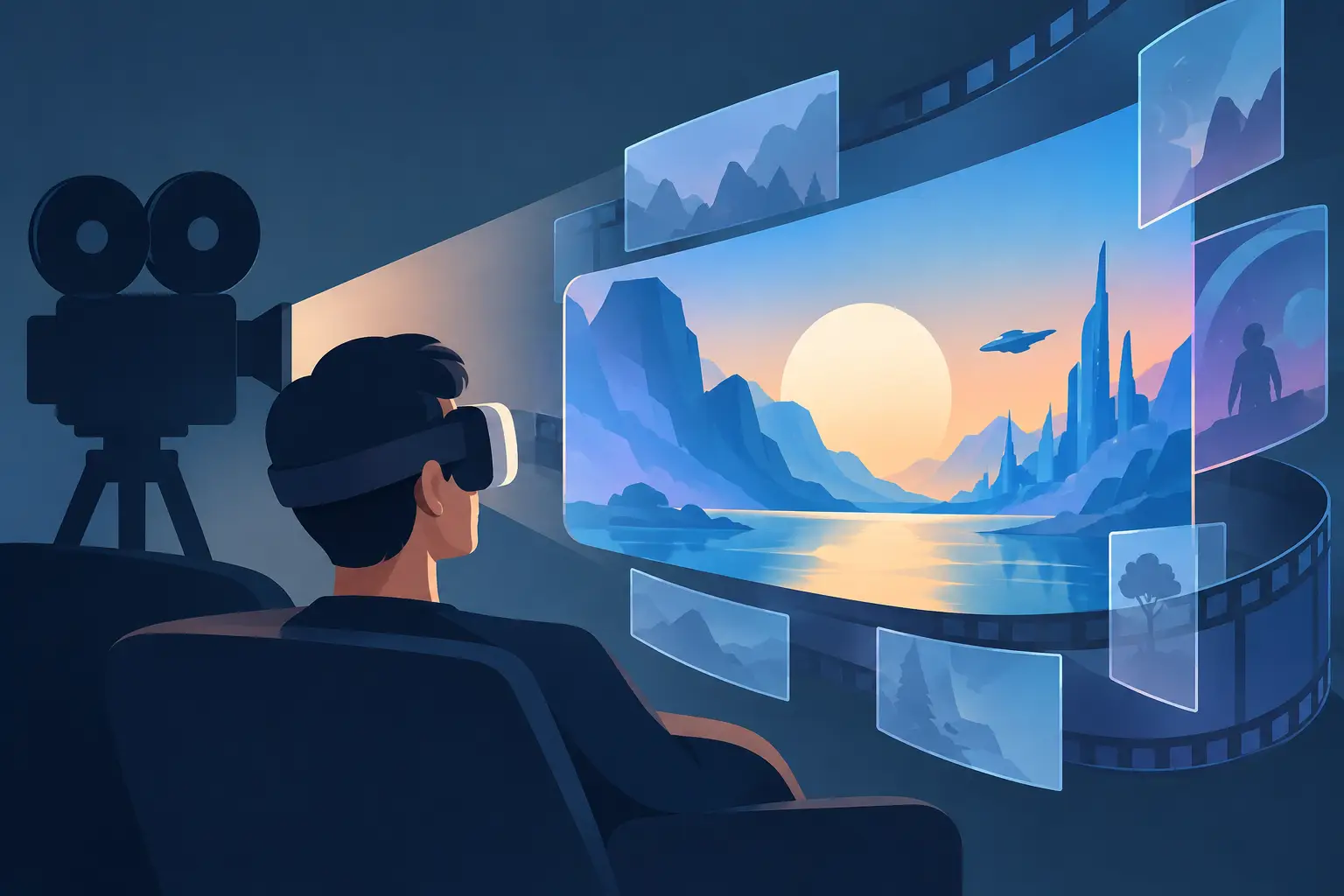
A film begins with a decision about what can be seen. Future cinema expands that decision. A director can now sketch impossible architecture, test a character across decades, animate a still idea, or construct an entire visual language before a traditional shoot is possible. The result is not simply faster production. It is a new relationship between imagination, craft, and the moving image.
The shift matters because cinema has always been shaped by its tools. Editing changed time. Sound changed performance. Digital cameras changed access. Generative systems are changing the distance between a filmmaker's inner picture and the first image on screen. That distance can shrink dramatically. But a shorter path to images does not automatically create a film.
AI cinema earns its place when intention remains visible. The most compelling work does not ask viewers to admire a prompt or inspect a technical trick. It gives them atmosphere, tension, surprise, rhythm, and something worth carrying beyond the final frame.
Future Cinema Is a New Production Culture
The conversation around AI often gets trapped between two shallow positions. One claims that a new tool will replace every discipline. The other treats any machine-assisted image as creatively suspect. Neither view understands how filmmaking actually works.
Cinema is already collaborative, composite, and iterative. A director works through performers, lenses, locations, costume, sound, editing, and visual effects. AI introduces another layer: systems that can generate, transform, extend, and reinterpret visual material at unusual speed. Its role changes from project to project. It may support concept art in one film, create a dream sequence in another, or become the central visual instrument of an entire short.
That flexibility is the point. Future cinema is not one aesthetic and not one production method. It includes meticulously directed generated imagery, hybrid films built from live action and synthetic environments, animation that could not have been financed through conventional pipelines, and personal work made by a single artist with a clear visual voice.
The new production culture is also changing who gets to attempt ambitious ideas. A filmmaker with limited resources can explore scale without first securing access to a soundstage, a large crew, or a visual effects house. That does not erase the value of those resources. It changes which stories can reach a first cut. For independent creators, that is a meaningful opening.
The Tool Is Not the Auteur
There is a temptation to confuse technical novelty with authorship. A generated image can be startling, especially when it depicts something never photographed. Yet novelty fades quickly. Viewers recognize when a film has no point of view, even if every shot is polished.
Authorship in AI cinema appears in the choices surrounding generation: the references selected, the images rejected, the continuity protected, the performances shaped, the pace established, and the emotional logic maintained. It is visible in restraint as much as abundance. A director who can generate anything must become more precise about what not to generate.
This is where traditional cinematic literacy becomes more valuable, not less. Composition still directs attention. Editing still creates meaning between shots. Sound still makes images physical. A character still needs motivation, contradiction, and presence. Generative tools can produce material, but they cannot decide why a scene belongs in the film unless an artist does.
The strongest AI-made work often feels authored because its limitations have been converted into style. A flicker becomes a memory effect. Morphing becomes an expression of unstable identity. Unnatural motion becomes part of a dream logic. These choices do not hide the medium. They make the medium speak.
The Real Change Is Visual Possibility
For decades, certain images belonged mainly to studios with large budgets: worlds collapsing into one another, mythic landscapes, historical transformations, impossible creatures, and vast crowds moving through invented space. Future cinema makes some of those possibilities available to artists working outside that system.
That access should not be mistaken for a mandate to make everything bigger. Spectacle has value, but it is only one register. AI can be equally powerful at the intimate scale: a face shifting through a half-remembered childhood, a room responding to a character's grief, a documentary fragment reimagined through subjective memory. The medium can widen cinema's visual vocabulary without requiring every story to become a synthetic epic.
It also gives filmmakers a way to work before permission arrives. A proof of concept can become a short film. A short film can establish a language for a feature. A visual experiment can reveal a story that was not apparent on the page. This is especially useful for creators whose ideas have been considered too strange, too expensive, or too difficult to pitch in conventional terms.
There is a trade-off. Ease of generation can produce visual excess and sameness. If everyone relies on the same model defaults, reference pools, and trends, the result can flatten into a familiar synthetic look. The answer is not to retreat from the tools. It is to develop stronger taste, deeper references, and a more deliberate relationship with the material.
Cinema Still Needs Friction
A film cannot live on imagery alone. It needs friction: between characters, between sound and picture, between expectation and revelation. It needs time to withhold information. It needs an ending that changes the meaning of what came before.
This is why the future of the medium will not be decided by generation quality alone. It will be decided by filmmakers who understand narrative pressure and by audiences willing to encounter work that does not fit old categories. A technically imperfect film with a distinct emotional center will outlast a flawless sequence that says nothing.
Friction also applies to process. Not every creative problem should be solved instantly. Iteration can be productive, but infinite variation can dilute a decision. Some scenes need research. Some need a performer in a room. Some need the resistance of weather, location, or physical craft. The most mature AI cinema will know when to use synthetic possibility and when to leave space for the unrepeatable real world.
Rights, Consent, and Cultural Trust
The artistic future of AI cinema depends on trust. That means treating likeness, voice, source material, and labor as serious concerns rather than inconvenient footnotes. The medium cannot claim creative progress while ignoring the people whose work, identity, or archives may be implicated in its production.
Responsible practice does not make films less adventurous. It gives experimentation a foundation. Clear consent for performers, transparent use of protected material, and respect for creative attribution help establish conditions in which artists can take bigger risks without normalizing extraction.
Audiences will also develop a more sophisticated vocabulary. They will ask not only whether a film used AI, but how it used it and to what effect. Was it a visual shortcut? Was it integral to the story? Did it create a new kind of performance, perspective, or world? Those questions are signs of a medium becoming culturally legible.
A Screen Needs a Point of View
New forms need more than tools. They need places where work can be discovered, contextualized, debated, and remembered. Without curation, AI cinema can disappear into a feed of disconnected clips, each competing for a few seconds of attention. A film culture requires more than output. It requires standards, programming, criticism, and an audience that returns.
That is the role of a dedicated destination such as AICINEO: to treat AI cinema as cinema. Not as a software demo. Not as a novelty category parked beside conventional entertainment. The work deserves screens and conversations that recognize its emerging language while demanding real artistic ambition.
Curation matters because this field is moving quickly. A creator needs to see what is already possible, but also what has become predictable. A viewer needs a way to find work with purpose amid volume. The best platforms will not merely reward the most technically impressive images. They will make room for singular voices, strange forms, and films that take time to reveal themselves.
What Future Cinema Asks of Creators
The question is no longer whether AI can make moving images. It can. The question is what filmmakers will ask those images to do.
For some, the answer will be to build worlds with a precision that was once inaccessible. For others, it will be to make smaller films with greater visual intimacy. Some artists will merge generated material with documentary, performance, animation, or archival practice. Others will reject photorealism entirely and build styles that could only exist through computational transformation.
The opportunity is not to automate cinema. It is to make cinema less obedient to old production limits. That requires more than access to models. It requires taste, ethics, narrative discipline, and the nerve to develop an image until it belongs to no one else.
Make the film that uses this moment for more than proof. Give the image a reason to exist, give the audience a reason to stay, and let the medium become stranger, sharper, and more alive.