

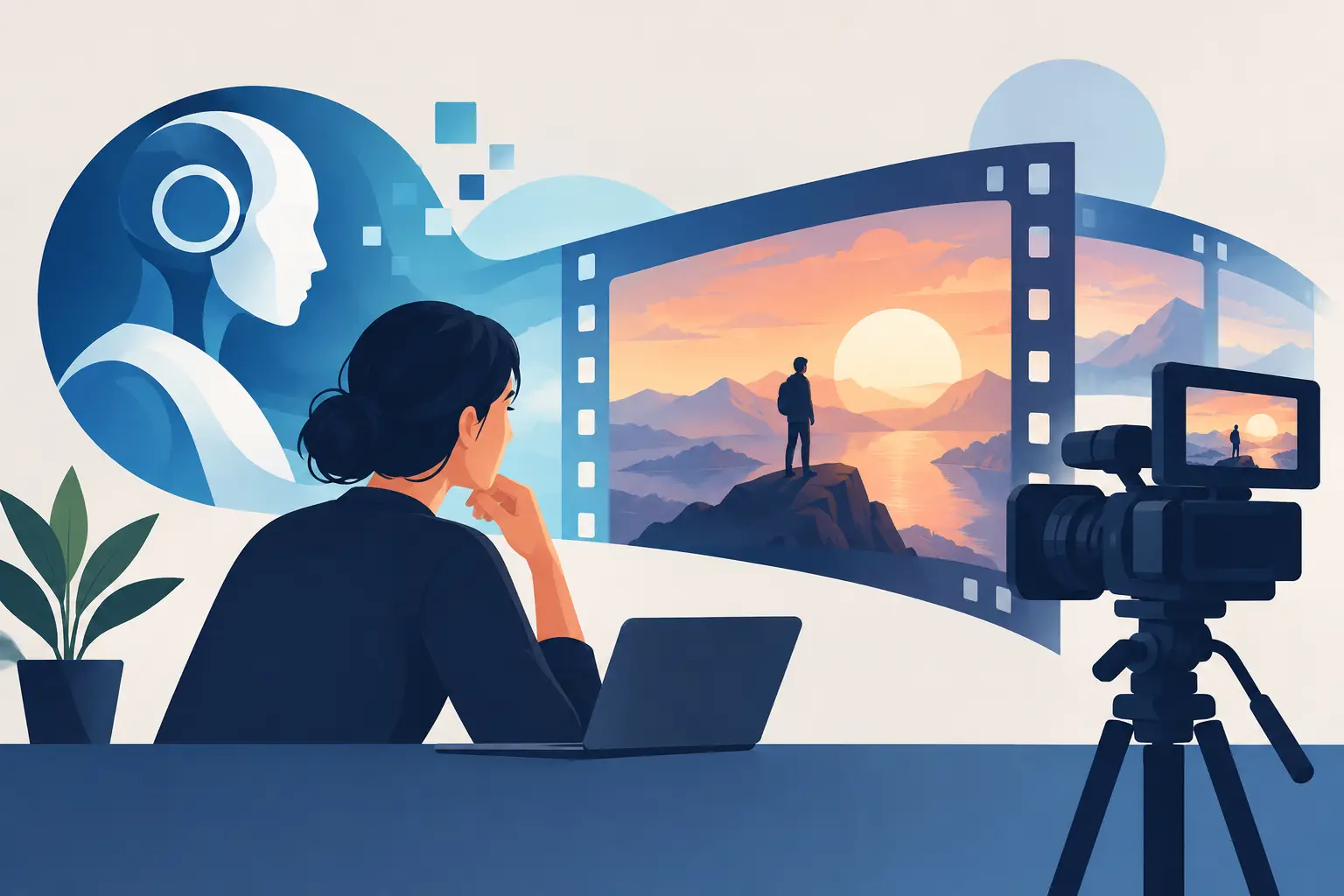
A generated shot can be technically astonishing and still feel empty. A face dissolves into weather. A city rises from a flood of glass. The image earns a pause, then disappears from memory. What makes AI filmmaking artistic is not the presence of artificial intelligence. It is the force of intention behind every image, cut, sound, and omission.
AI Cinema is often judged by its surface: realism, detail, motion, novelty. Those are visible achievements, but they are not the work itself. Cinema becomes art when a creator turns possibility into a point of view. Generative tools expand the field of possibility. They do not choose what deserves to be seen.
What Makes AI Filmmaking Artistic?
Artistic AI filmmaking begins before the first prompt. It begins with a feeling, a question, a tension, or a world the filmmaker needs to make visible. The model may produce a thousand variations. The artist recognizes the one that carries the right emotional temperature, then reshapes it until it belongs to the film.
This is why a beautiful prompt is not the same as a cinematic idea. A prompt can describe a ruined opera house under a red moon. A film asks why this opera house matters, who entered it, what they lost there, and when the red moon should appear. Meaning emerges through selection and relation. One image gains power because of the image before it, the sound beneath it, and the silence after it.
The artistic question is not whether AI made the pixels. The question is whether a maker used those pixels to create an experience that could not be reduced to a technical demonstration.
Authorship Is Direction, Not Total Manual Control
Cinema has never required one person to physically produce every element on screen. Directors work with performers, cinematographers, editors, designers, composers, locations, accidents, and time. AI joins that long history of distributed creation, but with a different kind of collaborator: a system that can propose visual outcomes at enormous speed.
That changes the director's role. The work becomes less about executing a single pre-imagined frame and more about building a language of constraints. The filmmaker establishes character logic, visual rules, recurring objects, camera behavior, color pressure, and emotional boundaries. They reject outputs that are merely impressive. They keep the strange detail that deepens the film's world.
There is a trade-off. More generation can create more options, but it can also weaken conviction. A film assembled from the most spectacular result at every step can feel like a moving mood board. Artistic direction means knowing when to stop searching. It means choosing one imperfect image over ten polished but anonymous ones because the imperfect image contains a human trace.
Taste Gives the Machine a Shape
Generative systems are trained on patterns. Taste is the ability to interrupt patterns.
A filmmaker's taste appears in decisions that may look small from the outside: allowing a frame to stay too long, choosing a less flattering angle, removing explanatory dialogue, using a synthetic voice that sounds slightly unreal, or cutting away before an expected climax. These decisions create tone. They establish a relationship with the audience.
Taste also requires refusal. AI tools frequently offer familiar visual shorthand: symmetrical faces, luxury lighting, monumental landscapes, hyperactive camera movement. These defaults can flatten a film into a stream of borrowed signals. An artist notices when the image is behaving like an advertisement, a game trailer, or a generic fantasy sequence, then pushes it somewhere less automatic.
The strongest AI films do not hide every artifact. They decide which instability belongs. A drifting hand, a fractured transformation, or an impossible shift in scale can become expressive when it serves memory, fear, dream, grief, or desire. When it has no dramatic purpose, it is just a glitch wearing a costume.
Story Is More Than Generated Continuity
Technical continuity matters. A character needs to remain recognizable. A room needs spatial logic. A shot needs motion that does not collapse under attention. But visual consistency alone does not create a story.
Artistic filmmaking organizes attention. It understands what the audience should feel before they understand why. A recurring blue doorway may become a promise. A distorted radio message may become a warning. A figure seen only from behind may carry more mystery than a fully explained protagonist. AI gives filmmakers unusual access to symbolic imagery, but symbols become meaningful only through repetition, variation, and timing.
This is where editing becomes decisive. An AI-generated film can have exceptional frames and weak cinema if each moment simply announces itself. Editing creates movement between meanings. It gives an image consequence. It can turn a surreal transformation into comedy, horror, tenderness, or revelation depending on what follows.
Sound performs the same work. A spare soundscape can anchor impossible visuals in physical sensation. A breath, a room tone, a train in the distance, or a score that arrives thirty seconds late can give generated imagery weight. Many early AI works lean too heavily on visual abundance. Cinema asks for control across the full sensory field.
The Medium Has Its Own Grammar
AI filmmaking becomes more compelling when it stops imitating conventional production at every turn. The goal is not always to make viewers ask whether a shot was filmed with a camera. Sometimes realism is the right aesthetic. Sometimes it is the least interesting one.
AI Cinema can move through impossible architecture, unstable identities, compressed time, and visual metamorphosis with a fluency that live-action production cannot easily match. Those capabilities matter when they are treated as grammar rather than spectacle. A character changing age within one continuous shot might express inheritance. A landscape rewriting itself might express political rupture. A voice speaking from several bodies might express fractured selfhood.
The medium also invites new forms: short films built around visual poems, animated documentary, speculative music cinema, nonlinear narrative, and hybrids that move between recorded footage and generated worlds. Not every story needs feature-length scale. Sometimes a two-minute work with a precise emotional turn has more artistic authority than twenty minutes of imagery searching for a premise.
Artistic Risk Includes Ethics
A film's artistic value cannot be separated entirely from how it was made. AI filmmaking raises questions around training data, consent, likeness, labor, and disclosure. These are not administrative concerns outside the art. They shape what an audience is being asked to accept and believe.
A responsible filmmaker considers whether a recognizable person's identity has been used without permission, whether a voice implies a false performance, and whether generated material obscures authorship in ways that matter. Context changes the ethical stakes. A clearly fictional synthetic character is different from a fabricated documentary claim. An experimental homage is different from a commercial imitation designed to exploit a living artist's style or public image.
Ethical clarity does not limit imagination. It gives imagination a stronger frame. Audiences can engage more deeply when the work is candid about its construction and careful about the people whose labor, likeness, and culture might be implicated in it.
A New Craft Demands Discernment
The craft of AI filmmaking is not one skill. It is visual development, writing, prompt design, image selection, performance direction, animation, compositing, sound, editing, and critique. Some creators will do most of it alone. Others will form small studios with specialized roles. The artistic center remains the same: a coherent sensibility that can make choices across the process.
That sensibility is why platforms such as AICINEO matter. A new medium needs more than tools and feeds. It needs an audience trained to look beyond novelty, creators willing to take formal risks, and a cultural space where AI films can be discussed as films.
The next time a generated sequence catches your eye, stay with it long enough to ask a harder question: what is this work trying to make you feel, and what choices made that feeling possible? That is where the art begins.