

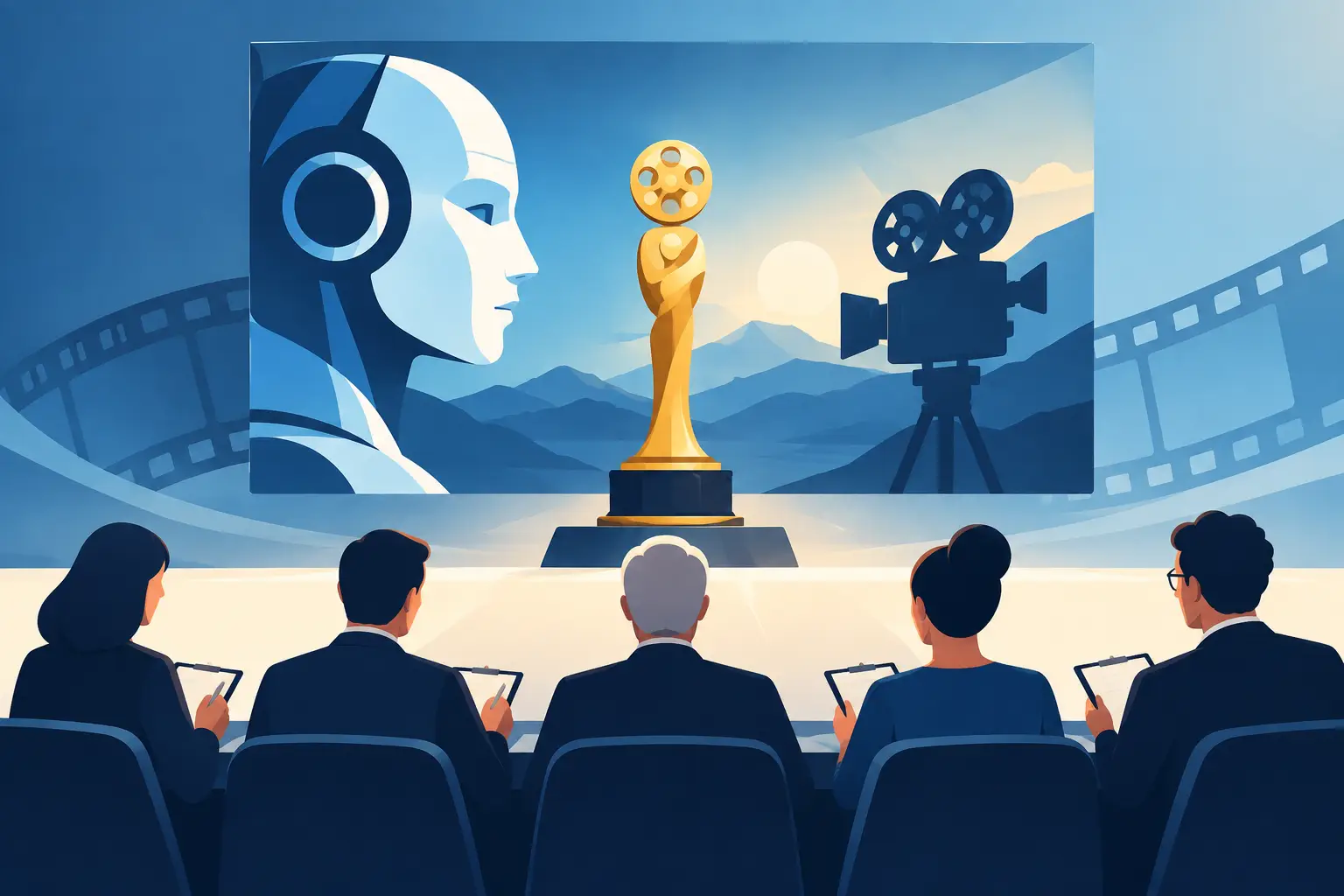
A film arrives with impossible camera movement, faces that seem remembered rather than cast, and a world that could not exist on a physical backlot. The first question should not be, “Which model made this?” AI film awards have a larger job: to determine whether the work belongs in cinema at all - and, when it does, to recognize the people who gave it meaning.
That distinction will shape the medium. Awards do more than distribute trophies. They set taste. They tell creators which risks matter, tell audiences where to look, and tell the wider film culture what it has been missing. For AI cinema, still forming its language in public, the standards established now will carry unusual weight.
AI Film Awards Are Not a Tool Showcase
A production pipeline is not a film. Generative video, image systems, synthetic voices, procedural environments, motion capture, compositing, and conventional editing can all appear in the same project. The presence of AI may be central to the work, or it may be one quiet instrument among many. Neither condition guarantees artistic value.
The weakest awards model turns the ceremony into a software demonstration. It rewards technical novelty, then mistakes visual surprise for cinematic achievement. That approach ages quickly. Tools change monthly. A shot that felt impossible six months ago can become a familiar preset by the next festival cycle.
Cinema lasts for other reasons. It lasts because a filmmaker knows where to withhold information. Because a cut lands at the exact moment an image becomes unbearable. Because sound shifts the meaning of a face. Because a strange invented world reveals something recognizable about grief, desire, labor, memory, or power.
AI film awards should honor that level of intention. The question is not whether a creator used advanced systems. The question is whether they made choices that transformed available systems into a coherent point of view.
The Standard: Authorship, Not Automation
AI cinema has made authorship more visible, not less. A director working with generative tools may be researching references, writing prompts, rejecting hundreds of outputs, designing a visual grammar, building character continuity, directing performances, rebuilding scenes, editing rhythm, and shaping sound. The labor is real, even when it does not resemble a traditional set.
At the same time, “AI-made” cannot become a blanket claim of authorship. If a work is mostly an unaltered output with little dramatic, editorial, or aesthetic intervention, juries should be able to say so. The goal is not to police process for its own sake. It is to distinguish an authored film from an automated artifact.
That requires a more precise vocabulary. A filmmaker does not need to disclose every prompt or node graph to prove legitimacy. But entrants should be clear about how AI participated: visual development, generated footage, animation, performance transformation, voice work, scene construction, or post-production. Transparency gives jurors context without reducing the film to a technical recipe.
The strongest submissions will often be hybrid by nature. They will combine generated material with photography, animation, design, acting, writing, sound, and editorial judgment. A good awards framework should reflect the actual medium rather than forcing films into a false divide between “fully AI” and “not AI enough.”
What Judges Should Look For
The best AI film awards should judge a work with the seriousness applied to any short film, feature, music video, or moving-image artwork. Story, pacing, performance, sound, image, and emotional impact remain fundamental. AI changes the production vocabulary. It does not erase the audience’s ability to feel when a film has no center.
A visual language with a reason to exist
AI can generate beauty at volume. That is precisely why beauty alone is a weak measure. Jurors should ask whether the visual style serves the film’s subject and mood. Does distortion express a fractured memory? Does synthetic texture create distance from a character? Does an unstable face become part of the story, rather than a defect the edit failed to hide?
A compelling AI film does not need to imitate studio realism. In fact, work that embraces its own artificiality can be more memorable than work chasing a flawless simulation of conventional production. The image should feel chosen, not merely received.
Direction across uncertainty
Generative systems introduce variance. A character changes. A room mutates. A gesture arrives with unexpected force. Direction in AI cinema includes the ability to recognize when chance has created something valuable, then build the film around it with discipline.
This is not an excuse for inconsistency. It is a different form of control. The director’s hand may appear in selection, repetition, juxtaposition, and restraint rather than in complete command of every pixel. Judges should be able to recognize both precision and productive instability.
Editorial intelligence
Many AI works are strongest in individual frames and weakest in time. They announce their premise, sustain a mood, then never develop. Awards should favor filmmakers who understand progression: how an opening image creates a question, how scenes alter it, and how an ending leaves a charge after the screen goes dark.
Editing is where AI cinema becomes cinema rather than an image feed. A sharp cut can establish character. A held shot can create dread. Sound can make a synthetic environment feel intimate, comic, violent, or sacred. None of this is secondary craft.
Ethical clarity without moral theater
Rights, consent, training data, likeness, and disclosure are not side issues. They affect artists, performers, and audiences. Yet an awards program should avoid replacing criticism with vague virtue signaling. It needs published eligibility rules that are specific enough to enforce.
At minimum, entrants should confirm they have the rights or permission required for submitted material, disclose meaningful use of synthetic likenesses or voices, and identify whether real people were replicated or materially altered. A jury can then assess the artistic work with a clear record of how it was made.
The point is not to demand purity from an emerging field built from complicated tools. The point is accountability. A film cannot claim radical imagination while treating the people and creative labor behind its inputs as invisible.
Categories Should Reflect a Living Medium
One grand prize is useful, but it cannot carry the full range of AI cinema. An experimental one-minute visual poem should not have to compete by the same logic as a narrative short with a fully developed dramatic arc. Category design can reveal what an institution values.
Narrative, animation, music-driven work, experimental film, and commissioned brand storytelling each have distinct standards. Craft awards can also matter when they identify meaningful contributions such as direction, visual worldbuilding, editing, sound, or hybrid production. The categories should remain selective. Too many awards flatten prestige and make every submission feel pre-approved.
There is also value in a newcomer category. AI cinema is lowering some barriers to production while raising others around taste, process, and access. New voices need a visible path into the conversation. That recognition should be based on the work itself, not on who has the largest audience or the most expensive workflow.
Build Juries That Can See the Whole Film
A credible jury cannot consist only of technologists, nor only of traditional gatekeepers suspicious of the medium. AI film awards need directors, editors, animators, cinematographers, sound artists, critics, curators, and creative technologists in the room. Each sees a different kind of decision.
The filmmaker may recognize dramatic coherence. The artist may see visual authorship. The technologist may understand what was difficult, inventive, or deceptively ordinary. The critic may place the work in a broader cultural conversation. Together, they can resist two predictable errors: rewarding a technical trick simply because it is new, or dismissing a film simply because it was made differently.
Jurors also need enough time with each work. AI imagery can overwhelm on first viewing. A second viewing often reveals whether a film has structure beneath its surface. The best award programs make space for that attention rather than treating moving images as quick content to be scored and sorted.
The Prize Is a Cultural Signal
The future of AI cinema will not be decided by model releases alone. It will be decided by the films audiences remember, the makers peers respect, and the institutions willing to develop real critical standards around the work.
AICINEO sees AI cinema as a medium with its own artists, audiences, and canon in formation. Awards can help give that canon shape, but only if they reward films that take creative risks beyond technical novelty.
The most valuable prize may be simple: a filmmaker leaves with evidence that their experiment was seen as a film, not a demo. That recognition invites the next work to be stranger, sharper, and more human.