

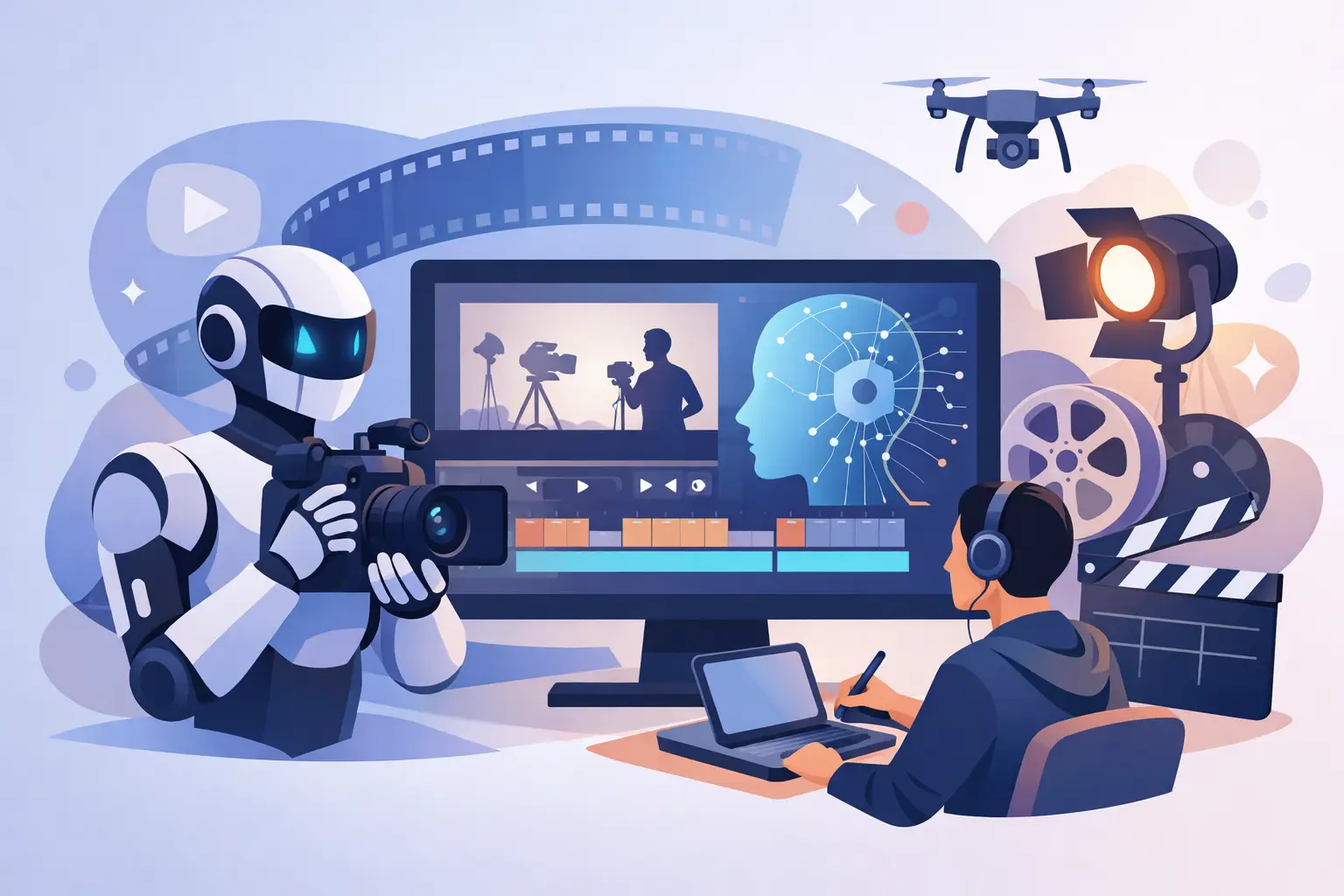
A striking AI image is not a film. Neither is a sequence of beautiful clips cut to music. Cinema begins when an idea survives contact with time: a shot leads to another shot, a character makes a choice, sound changes meaning, and the final frame earns its place. That is the standard worth bringing to ai filmmaking courses online.
The category is expanding quickly. So are the claims around it. Many courses promise command of the latest image, video, voice, and editing systems. Fewer teach the harder discipline: how to direct those systems toward a coherent cinematic result. For artists who want more than a gallery of generated tests, that distinction should guide the search.
What AI filmmaking courses online should teach
A useful course does not treat AI as a button that replaces a film crew. It treats generative tools as part of a production language. The work still requires taste, visual judgment, dramatic intention, and the ability to recognize when a compelling image is doing nothing for the story.
Look for instruction that moves through the full arc of production. Development should cover premise, theme, character, world, references, and script structure. Preproduction should address shot design, style frames, continuity planning, and an achievable workflow. Production should make room for iteration, direction, motion control, voice, performance, and the inevitable surprises produced by generative systems. Postproduction should include editorial rhythm, sound, color, compositing, and delivery.
A course centered only on prompts may be useful as a workshop, especially for a creator who is testing a new tool. It is not, on its own, filmmaking education. Prompts are instructions. Direction is a chain of decisions made before, during, and after generation.
The strongest programs also teach creators to diagnose images. Why does a shot feel flat? Why does a character cease to feel like the same person? Why does a supposedly cinematic sequence feel like an advertisement or a dream fragment with no dramatic pressure? These are filmmaking questions. The software changes. The questions remain.
Choose the course for the film you want to make
There is no single best path because AI cinema contains several distinct practices. A director making a five-minute narrative short needs different guidance than a motion designer producing fashion films, a documentarian reconstructing inaccessible events, or an animator building an original serialized world.
Before enrolling, define the kind of work you want to complete in the next 60 to 90 days. Not the kind of work you admire. The kind you can actually make with your available time, budget, computer, collaborators, and attention.
If narrative is the goal, prioritize courses that teach script-to-screen translation. They should address storyboards, scene geography, recurring characters, coverage, pacing, and revision. Ask whether the instructor shows a complete short film, including the imperfect choices and editorial problem-solving behind it. A polished trailer proves less than a finished scene.
If your work is experimental, seek programs that make space for process. AI can introduce instability, transformation, and visual accident into a film's grammar. That can be the point. But experimentation still benefits from constraints: a duration, a visual rule, a sound strategy, or one emotional question that the piece returns to.
For commercial creators, the practical concern is repeatability. You may need brand consistency, faster approvals, clean asset management, licensing awareness, and workflows that can survive client notes. A course built around one-off visual spectacle may not prepare you for that reality.
The instructor matters more than the tool list
Tool lists age fast. A course may name systems that have changed interfaces, pricing, or capabilities by the time you begin. That is not necessarily a flaw. The real test is whether the instructor teaches transferable judgment.
Watch for evidence of a point of view. An experienced teacher can explain why one reference image is useful and another is merely attractive, when to generate variations instead of forcing a weak result, and when conventional editing is the better solution. They can speak plainly about failure without treating it as a personal shortcoming or a software problem.
A credible instructor also distinguishes personal taste from universal law. Handheld movement is not automatically cinematic. Symmetry is not automatically boring. AI voice is not automatically unusable. Context decides. Good teaching gives you principles, then shows where those principles bend.
Build a curriculum around continuity and sound
The current fascination with AI video often begins with motion. A still image moves. A face turns. A camera appears to travel through an impossible space. Those moments matter, but they are only one layer of screen experience.
Continuity is where many first films break. Characters shift in age, costume, scale, or emotional energy between shots. Locations drift. A prop vanishes. The lighting changes so radically that two adjacent shots seem to belong to separate worlds. Courses worth your time should teach practical methods for controlling those variables: reference packets, character bibles, shot logs, selected seeds or source assets where relevant, and deliberate limits on each scene's visual vocabulary.
Sound deserves equal attention. A weak image can become expressive with the right sound design; an impressive image can lose all force under generic music and unstable dialogue. Learn how to cut with room tone, silence, ambience, effects, and transitions. Learn when dialogue should carry information and when an image can carry it better. If a course treats audio as a final upload step, supplement it elsewhere.
Editing is the final authoring stage. The edit decides what the audience knows, when it knows it, and what it is allowed to feel. Generative footage may arrive with its own momentum, but a filmmaker must still choose duration, contrast, repetition, and release. The ability to remove a gorgeous shot is often more valuable than the ability to generate another one.
Beware the speed trap
AI production can make visual exploration faster. It can also multiply options until a project never reaches a cut. A course should help you build a decision system, not just an infinite prompt archive.
Set creative constraints early. Choose an aspect ratio. Establish a limited palette or lighting logic. Define the emotional temperature of the film. Decide which elements must remain consistent and which may mutate. Then build toward a short, complete work rather than an endless collection of proof-of-concept clips.
Completion creates the feedback that experimentation cannot. Once a film is shown, you learn where viewers become confused, where the rhythm sags, and which images linger after the screen goes dark. That knowledge makes the next project more ambitious for the right reasons.
This is also why peer critique matters. Look for online courses with structured reviews, not just a private library of tutorials. The most useful feedback is specific: the scene loses its objective here; the sound announces an emotion the image has not earned; this cut clarifies the action; this style change becomes meaningful only when repeated. A community that can articulate those observations is a creative asset.
Authorship is part of the craft
AI cinema raises live questions about training data, consent, imitation, labor, disclosure, and attribution. Serious courses should not avoid them. They should give creators a working framework for making choices with care.
That includes understanding the terms attached to the tools you use, avoiding deceptive representations of real people, respecting collaborators, and being honest about the role generative systems played in a project when that context matters. It also means asking a more artistic question: what is yours in the work?
Authorship is not erased because software contributed pixels or motion. It is expressed through selection, framing, sequence, sound, revision, and intent. Still, claiming authorship should not become an excuse to ignore the sources, people, and creative labor surrounding the medium. The most enduring AI films will pair formal ambition with a clear ethical position.
Learn in public, finish with purpose
The field needs more than tool experts. It needs filmmakers with eyes, editors with rhythm, writers with nerve, and audiences willing to demand more from the form. AICINEO exists within that growing cultural frame: AI Cinema as a medium with its own work, conversation, and standards.
Choose a course that gives you a method, then make a small film before the method becomes obsolete. Give it a beginning, a turn, an ending, and a reason to exist. The future of AI cinema will not be defined by the most frictionless generation. It will be defined by the films people remember.