

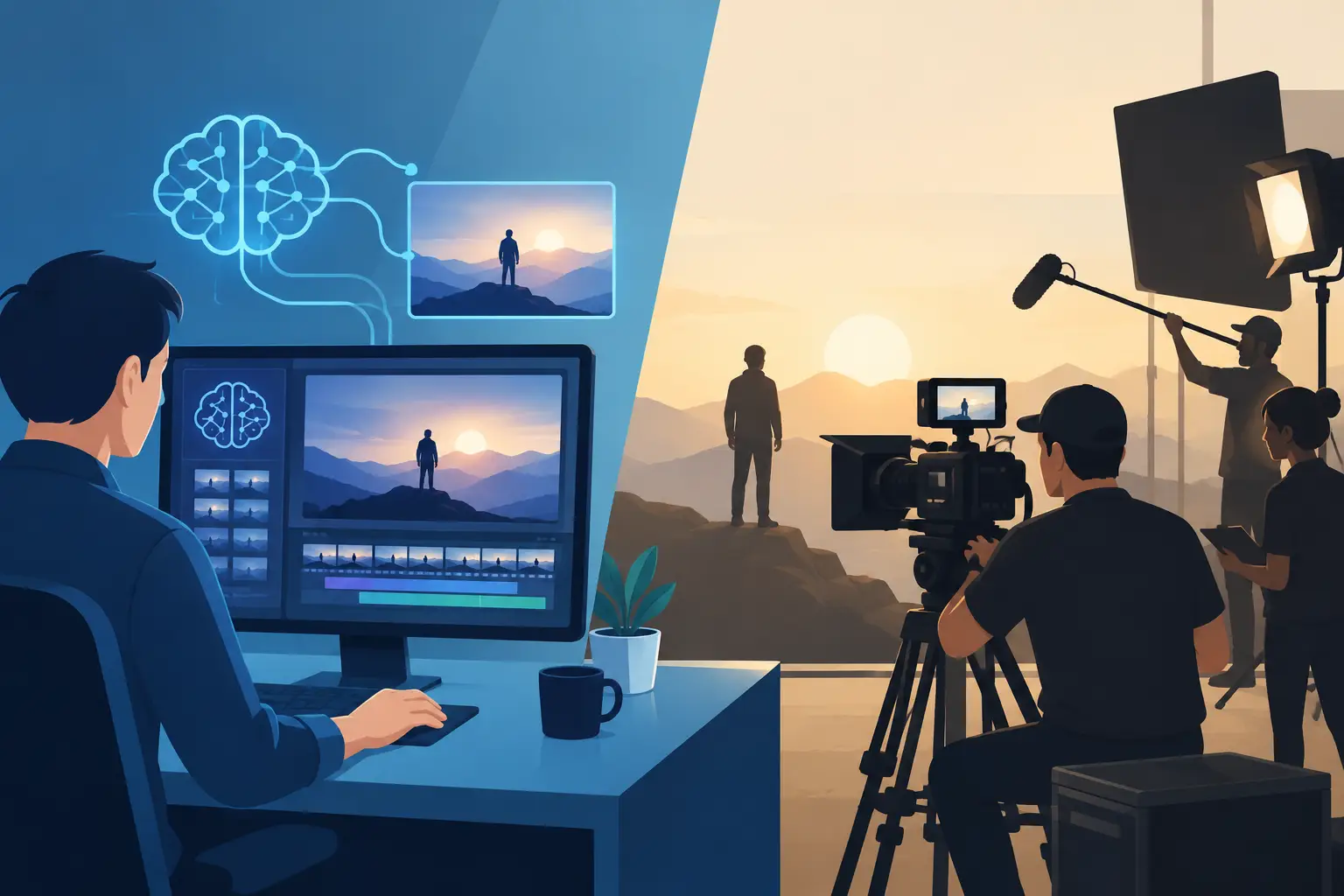
A moonlit city rises from a prompt. A character changes age between shots. A director tests six versions of a final frame before lunch. This is the visible side of AI filmmaking vs traditional production. The deeper question is not whether one replaces the other. It is what kind of cinema each process makes possible, and what each asks of the artist behind it.
AI cinema is not a cheaper imitation of the set. It is a distinct production language. Traditional filmmaking remains a powerful system for capturing performance, place, physical consequence, and human collaboration at scale. AI expands the field around it, making images that would once have required major capital, long schedules, or access to specialized pipelines. Neither path is neutral. Every workflow shapes the film.
AI Filmmaking vs Traditional Production: The Real Difference
Traditional production begins with coordination. Scripts become schedules, schedules become locations, locations become crews, and crews turn intention into footage. The process is built around the camera's encounter with the world. Even on a heavily designed set, light hits real surfaces, performers make choices in real time, and accidents can become the scene's most memorable detail.
AI filmmaking begins with iteration. A creator can move from a written idea to a visual proposition in minutes, then reshape it through prompting, reference images, image-to-video workflows, compositing, sound design, editing, and repeated generation. The camera may be virtual, but the directorial decisions are not. Framing, rhythm, color, motion, continuity, and point of view still determine whether the work feels cinematic.
That distinction matters because AI does not simply accelerate production. It shifts where production happens. In a conventional shoot, many decisions must be locked before the day begins because people, equipment, daylight, and money are already in motion. In AI cinema, visual development and production often overlap. The filmmaker can discover the image while making it.
For independent creators, that can be radical. A concept that would have remained a pitch deck can become a short film, a proof of tone, or an entire imagined world. For established productions, AI can extend previsualization, concept work, inserts, transitions, background creation, and post-production experimentation. The value is not just speed. It is access to cinematic possibility.
The Cost Equation Is More Complicated Than It Looks
AI tools lower some barriers quickly. There is no location permit for a flooded future metropolis. No travel day for a scene set on an invented planet. No need to build every impossible environment before testing whether it belongs in the film. A small team can create work with a scale that previously demanded a large crew and substantial financing.
But lower entry cost does not mean free cinema. Serious AI filmmaking requires time, visual judgment, computing access, tool subscriptions, storage, editing, sound, legal review, and a willingness to discard weak results. A thirty-second sequence may require hundreds of generations, careful selection, cleanup, and reconstruction in post. The first image is often the least useful one.
Traditional production has higher fixed costs because it pays for physical reality: labor, gear, travel, insurance, stages, permits, meals, and contingency. Those costs are real, and they protect real expertise. A good production designer, cinematographer, costume team, editor, sound mixer, and performer do not merely execute a plan. They make the plan better.
The smarter comparison is not cheap versus expensive. It is where a project should spend its resources. AI can concentrate budget on development and finishing instead of logistics. Traditional methods can justify their cost when the film depends on a specific human performance, practical texture, physical stunts, documentary truth, or a location that cannot be convincingly invented.
Control Has a Different Shape in AI Cinema
A director on a traditional set has immediate control over certain fundamentals. They can adjust an actor's intention, move a light, change a lens, wait for a cloud, or stage a body precisely in space. The work is demanding, but cause and effect are legible. Ask the crew for a change, then see that change through the camera.
Generative systems introduce another kind of control: exploratory control. The creator can search through visual directions that might never have existed in a conventional reference library. They can create a creature, architecture, costume, or impossible camera move without first proving that it can be built. This is especially potent for animation, music films, experimental shorts, speculative fiction, and work that moves between dream logic and narrative space.
Yet AI control is not absolute. Models can misread a prompt, drift from a character design, flatten a gesture, or produce motion that feels technically active but emotionally empty. Consistency remains a craft problem. So does taste. A filmmaker cannot treat generation as direction and expect a coherent film to appear.
The strongest AI work usually has a clear authorial system behind it: a visual bible, defined recurring motifs, deliberate shot grammar, controlled references, and an edit that knows what to remove. The artist's role becomes less about accepting outputs and more about building constraints that make the outputs belong to the same film.
Performance, presence, and the human face
This is where traditional production still carries an advantage that matters deeply. Great screen acting is not just an accurate face or a convincing mouth movement. It is timing between people. It is breath, hesitation, resistance, and the tiny shift that changes the meaning of a line. A live performer brings an interiority that no workflow should reduce to surface realism.
AI can create compelling characters and stylized performances. It can also support performers through design, transformation, voice work, and post-production. But when a film's power rests on the unstable, intimate charge between bodies in a room, a conventional set remains difficult to surpass.
That is not a limitation of AI cinema. It is a reason to choose the medium with intention. A film about a haunted machine may need an image no practical production can provide. A two-hander about grief may need the unrepeatable presence of two actors listening to one another.
Crews Do Not Disappear. They Reconfigure.
The lazy story says AI removes the crew. The more accurate story is that it changes the crew's center of gravity. Some projects will be made by fewer people. Others will need hybrid teams that combine directing, writing, animation, compositing, art direction, editing, sound, legal clearance, and technical workflow design.
This shift raises serious labor and authorship questions. Training data, performer likeness, consent, credits, compensation, and provenance cannot be treated as afterthoughts. A future-facing medium needs standards worthy of the artists whose work and identities may enter the pipeline. Fast creation without clear ethical boundaries is not creative freedom. It is exposure.
Traditional departments also carry knowledge AI creators should study rather than bypass. Cinematography teaches how light directs attention. Production design teaches that every object tells the audience where it is. Editing teaches that a beautiful shot can still be the wrong shot. Sound teaches that image alone is rarely enough to make a world believable.
AI filmmaking is strongest when it learns from cinema's existing disciplines, then pushes beyond their old production limits. The medium does not need to reject film history to become new.
What Each Method Does Best
Traditional production excels when material reality is the point. Documentary work relies on the relationship between camera and event. Physical comedy needs bodies and timing. Natural landscapes, practical effects, live action, and ensemble scenes benefit from the shared intelligence of a set.
AI filmmaking excels when imagination is the point of entry. It can move through impossible transformations, compressed world-building, nonhuman perspectives, surreal transitions, and visual systems that resist ordinary production logic. It gives a solo artist or small collective a way to make cinema before permission arrives.
Most of the next generation of work will not sit cleanly on either side. A director may shoot original performances, use AI for visual development, generate dream sequences, build environments in post, record practical sound, and edit everything with the precision of a traditional film. The question will become less about whether a film is AI-made and more about how intelligently it uses each medium.
AICINEO exists for that conversation: AI cinema as a creative territory, not a novelty category. The work deserves to be judged by its images, its ideas, its ethics, and the feeling that stays after the screen goes dark.
For creators, the useful next move is simple: begin with the scene, not the tool. Ask what the audience must see, hear, and feel. Then choose the production method that gives that moment its strongest possible life.