

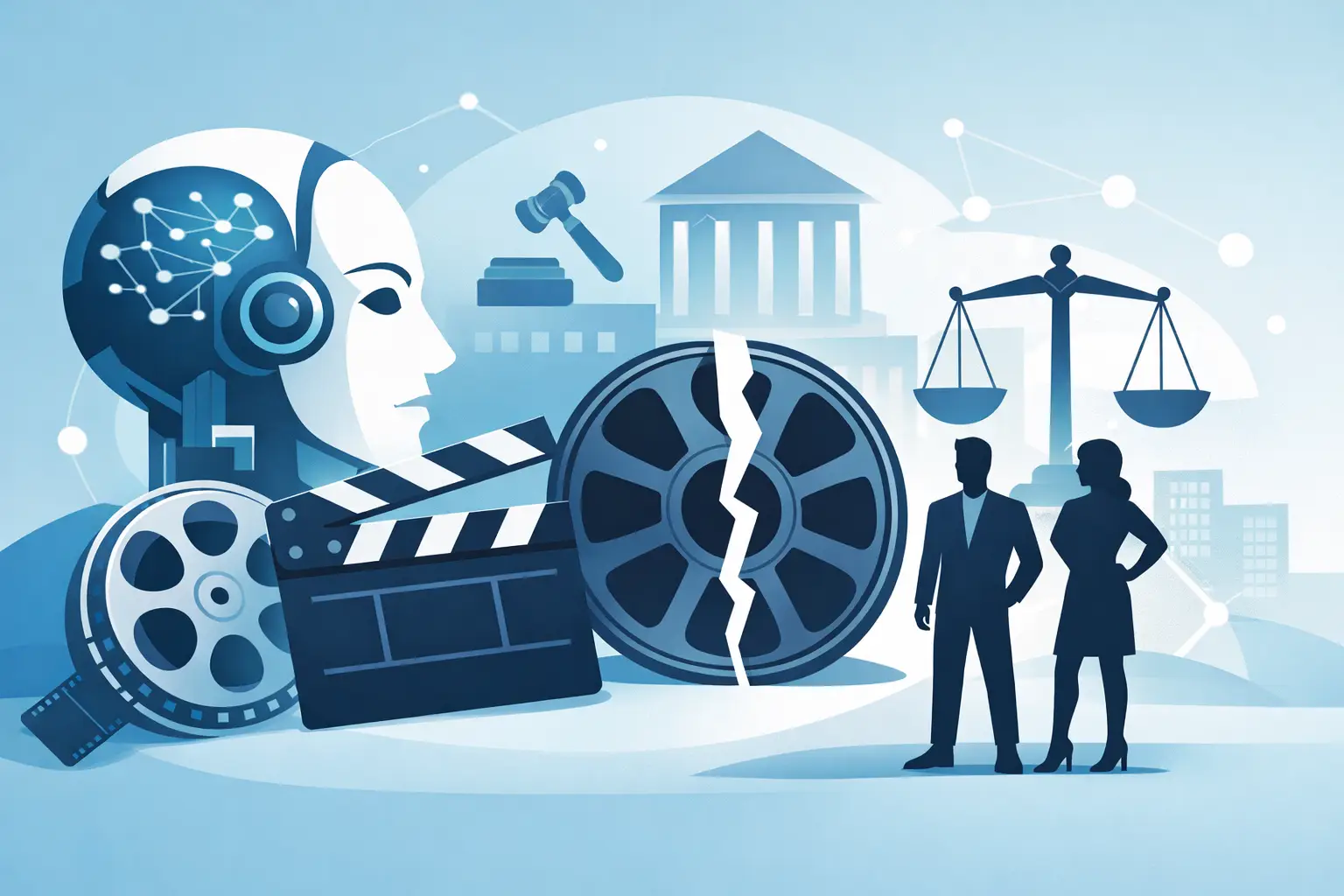
A film can begin with a prompt and still arrive at a hard legal question: who made the work? AI generated film copyright does not turn on whether artificial intelligence appeared in the production. It turns on where human authorship appears in the finished film - and whether a creator can show it.
For AI cinema, that distinction is not a technical footnote. It defines what can be registered, licensed, sold, defended, and credited. A striking sequence may be wholly original in feeling while containing frames that copyright law will not treat as copyrightable authorship. The opportunity is real. So is the need for a cleaner production record.
Copyright protects authorship, not the tool
In the United States, copyright protects original works of authorship fixed in a tangible medium. A camera does not own a shot. An editing system does not own a cut. The same principle applies to generative tools, with one major complication: copyright generally requires human creative control over the protected expression.
That does not mean an AI-assisted film is outside copyright. Far from it. A filmmaker may hold copyright in an original screenplay, shot design, selection of generated material, sequencing, pacing, sound design, score, narration, titles, color work, compositing, and editorial structure. A film is often a layered work. Some layers can be protected even if other material is not.
The harder question is the output itself. If a model produces an image or clip in response to a text prompt and the creator does not exert enough control over the expressive result, the output may be treated as nonhuman-authored material. A detailed prompt alone is not automatically the same thing as directing a camera, drawing a frame, or writing a scene. The law is still being tested at the edges, but the current direction is clear: prompts are instructions, not a guaranteed claim to authorship.
The human cut is where rights take shape
AI cinema is not one workflow. A director who generates a broad field of visual possibilities, then chooses fragments, paints over frames, composites performances, rewrites dialogue, and builds a final scene has a stronger authorship story than someone who exports a single untouched result.
Selection and arrangement can be protectable when they reflect creative judgment. Editing can be protectable when it establishes rhythm, narrative meaning, tension, juxtaposition, and point of view. Human changes to generated material can be protectable when they are sufficiently original. But there is a trade-off: copyright in the human contribution does not necessarily extend to the unaltered AI-generated portion beneath it.
Think of a generated storm sequence. The raw clip may have uncertain protection. Yet the film around it can contain protectable choices: the decision to place the storm after a silent close-up, the custom soundscape, the hand-built composite of a performer in the frame, the altered lighting, the timing of the cut to black. The more precisely a creator can identify those decisions, the clearer the claim.
This is not a reason to make work mechanically just to satisfy a legal theory. It is a reason to recognize craft. AI cinema already has directors, editors, production designers, animators, writers, and sound artists. Their decisions are not erased because part of the image came through a model.
Prompting still matters, just differently
Prompts matter creatively. They establish intent, guide iteration, and shape a visual language. In some workflows, prompting is closer to art direction than casual command entry. But intent is not always enough for copyright. The legal question is whether the human controlled the particular expressive elements that appear in the output.
A long prompt with camera references, lighting terms, and character details can help document a creator's process. It may also support a broader account of authorship when paired with iterative revisions and substantial human modification. On its own, however, it is not a universal substitute for authorship in the final pixels.
AI generated film copyright and registration
Registration is not required for copyright to exist, but it matters if a creator wants to enforce a U.S. copyright in court and access certain remedies. For a film containing generative material, accuracy in the application is part of the strategy.
The U.S. Copyright Office has asked applicants to disclose more-than-de-minimis AI-generated content and to describe the human-authored material being claimed. In practical terms, this means a creator should not present an entire AI-assisted film as though every frame were wholly human-made. Identify the protected work honestly: screenplay, editing, animation, original music, visual effects, compositing, or a creative selection and arrangement.
That disclosure does not weaken a serious project. It narrows the claim to what the filmmaker can stand behind. A clean, specific registration is more useful than an expansive claim that later proves difficult to defend.
The threshold is fact-specific. A minor generative texture in a largely live-action short creates a different registration question from a fully synthetic animated film. When a project's commercial stakes are significant, a copyright attorney with media and emerging-tech experience can help map the authorship before release.
Ownership is not the same as copyright
A platform's terms may say that you own, may use, or receive a license to outputs. That language can be valuable, but it does not create copyright where copyright law finds no protectable human authorship. It answers a different question: what rights does the tool provider contractually give you, and what rights does it retain?
Read the terms for commercial-use permissions, attribution requirements, exclusivity, indemnification, training use, and restrictions on recognizable people or brands. If multiple artists touch a project, use written agreements that clarify who owns the human-made contributions and who can distribute the finished film.
Also separate output ownership from clearance. A platform may permit commercial use of an output that resembles a protected character, incorporates a logo, or depicts a recognizable person. Permission from the platform does not erase potential trademark, publicity, privacy, defamation, music, or underlying-work issues.
The training-data question is not your clearance plan
Public debate often centers on what models were trained on. That debate matters to the future of the medium, and related litigation continues to develop. But a filmmaker should not assume that a model's training history automatically makes every output infringing - or automatically safe.
Copyright infringement is usually assessed through the relationship between a claimed work and the output at issue. Style, by itself, is generally not protected by copyright, yet highly specific resemblance can still create risk when recognizable protected expression appears. The practical standard is artistic as well as legal: do not build a release plan around imitation that depends on an audience recognizing someone else's world.
Build a production record while the film is alive
The strongest evidence is rarely assembled after a dispute begins. It is created during production, while choices are still visible and the timeline still has context.
Keep source files for scripts, storyboards, generated variants, edit timelines, layered project files, matte paintings, sound sessions, and version histories. Save a concise record of what each collaborator made and which tool produced each asset. For a production with extensive generative imagery, maintain an asset log that distinguishes raw outputs from materially edited shots.
This record serves more than lawyers. It protects credits, makes delivery cleaner, and gives future collaborators a trustworthy view of the process. It can also become part of the film's authorship story: not a defense of whether AI was used, but a record of how the work was made.
A new authorship grammar
The old assumption that authorship means solitary creation was never true in cinema. Film has always been collective, technical, and shaped by instruments. Generative systems add a new participant to that production ecology, but they do not replace the central question: whose judgment gave this work its form?
For creators, the practical aim is not to hide AI or overstate it. Make the human decisions legible. Credit the work with precision. License every layer you can control. And let the final cut show the difference between generating images and making cinema.
AICINEO exists in that difference: a medium defined not by the novelty of the machine, but by the filmmakers who turn possibility into a point of view.