

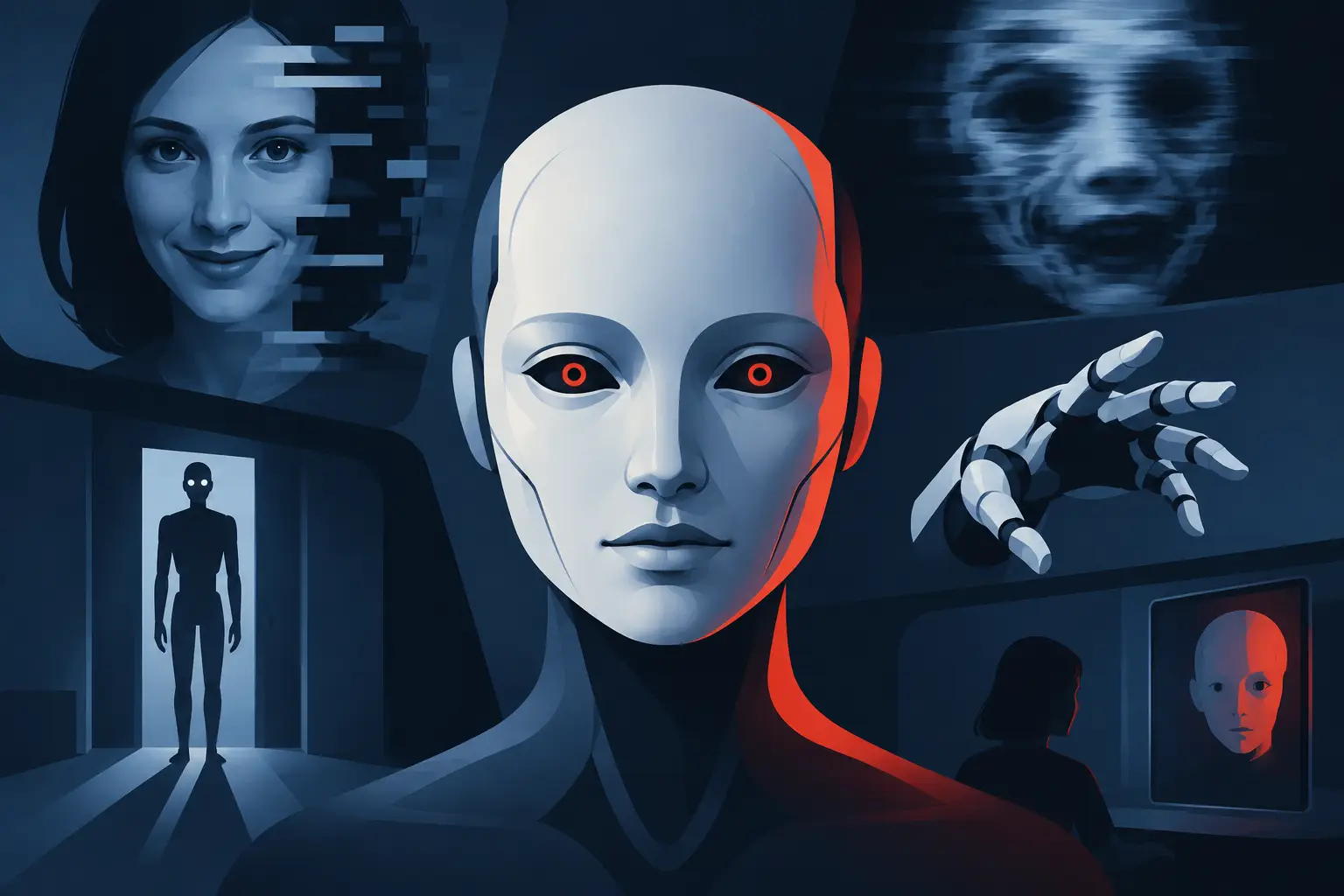
A face changes between frames. Not dramatically. Just enough that the audience questions whether it changed at all. That flicker of doubt is where AI horror examples become more than a visual novelty. Generative cinema can make images feel alive, unstable, and quietly disobedient to the logic of the shot.
For filmmakers, that instability is not a limitation to conceal. It is material. Horror has always used broken perception, altered bodies, and hostile spaces to put viewers off balance. AI gives those old fears a new visual grammar.
Why AI cinema is built for horror
Most screen horror depends on control. A director controls the frame, the reveal, the cut, and what remains unseen. Generative tools introduce another force: variation. A room can subtly rebuild itself between shots. A character can retain their silhouette while losing the consistency of their identity. A landscape can feel generated by a memory that is failing in real time.
The strongest AI horror does not simply show strange images. Strange is easy. It creates a rule, lets the viewer learn it, then lets that rule decay. The unease comes from recognizing that the image is trying to hold itself together and cannot.
This makes AI especially potent for stories about identity, surveillance, grief, dreams, archives, simulation, and the fear that reality has become a bad reconstruction of itself.
12 AI horror examples for the screen
1. The face that will not stay the same
A woman records a video diary every night after hearing footsteps in her apartment. In each new entry, her face has changed slightly, though she never notices. The audience does. Her eyes drift wider, her jawline changes, and eventually her reflection becomes a different person before she does.
The fear is not transformation alone. It is the gap between what the character knows and what the image reveals.
2. The house generated from childhood memory
A man returns to the home where he grew up, but every room combines details from different years of his life. His adult kitchen opens into his childhood bedroom. Family photographs depict events that never happened. The house is not haunted by a ghost. It is haunted by an imperfect memory model of him.
AI imagery can make architecture feel emotionally rather than physically coherent. That is a deeply cinematic form of dread.
3. A missing-person archive that keeps updating
An investigator searches an old public-access TV archive for clues to a disappearance. Each tape shows the same missing person in a different location, speaking in a slightly different voice. When the investigator pauses one frame, the figure appears in the background of footage from decades earlier.
This premise works because archival media already carries a ghostly authority. Generative intervention turns the archive into an active witness that cannot be trusted.
4. The crowd with one shared expression
A commuter walks through a busy station. Everyone appears ordinary until the train arrives. At that moment, every face turns toward the camera with the same faint, unfinished smile.
The scene should not explain itself. A single impossible synchronization can be more disturbing than an elaborate creature reveal. AI can intensify the effect by making individual faces almost, but not fully, distinct.
5. The dream that learns its dreamer
A sleeper uses a device that records dreams as moving images. At first, the footage is fragmentary: wet hallways, distant figures, rooms without exits. Then the dreams begin replaying events from the following day. Eventually, the dream includes the sleeper watching the dream footage.
This is horror built from recursion. The visual language should become clearer as the character loses certainty, reversing the usual logic of waking and dreaming.
6. A dead actor returns in outtakes
A forgotten actor appears in newly discovered behind-the-scenes footage from a film completed years after their death. At first, the discovery seems miraculous. Then the actor begins addressing crew members by name, including people who were not on set until later productions.
The premise touches a real cultural anxiety around synthetic performance without reducing it to a lecture. The terror lies in the image claiming a presence it cannot truly possess.
7. The landscape that watches back
A group documents a remote desert installation. Every wide shot of the terrain contains a facial formation in the rocks, clouds, or shadow lines. The face changes position from scene to scene, always looking closer to the camera.
AI is useful here because it can blur the boundary between pattern recognition and actual presence. Is the landscape alive, or is the audience being trained to see a face everywhere?
8. The family photo that corrects itself
A daughter scans old family photographs after her mother dies. Each time she opens an image, the composition has changed to place her in moments she never lived through. By the final photograph, she is standing beside her mother as a child, while her real childhood self is missing.
This form of horror lands because photographs are evidence. When evidence quietly rewrites a life, the threat becomes intimate.
9. The customer-service voice in the walls
A tenant begins hearing a calm automated voice through the apartment walls. It offers helpful reminders: lock the door, drink water, call your father. Soon it starts making observations no device should know. The voice never raises its volume. It becomes more frightening because it remains polite.
For this idea, restraint matters. Do not turn the voice into a villain too quickly. Let its confidence become the threat.
10. The film that resists being edited
An editor is hired to assemble a documentary from raw material recovered after a ferry disaster. Every time she removes a disturbing shot, it reappears somewhere else in the timeline. Eventually, cuts she has not made begin appearing overnight, revealing that the footage has constructed a version of her death.
This is a natural AI-cinema premise because it places authorship inside the horror. The editor is no longer shaping the film. The film is shaping the editor.
11. The town rendered at low resolution
A driver takes a wrong exit and enters a small town that looks normal from a distance. Up close, surfaces refuse detail. Store signs dissolve into unreadable symbols. People speak clearly, but their mouths move one beat late. The farther the driver walks, the more the town seems to be loading around them.
The concept uses artifacting as atmosphere rather than error. Its power depends on escalation: begin with nearly invisible flaws, then let the world lose its ability to resolve.
12. The monster made from audience memory
At a midnight screening, viewers see a creature only in reflected surfaces: a phone screen, a dark window, a polished theater floor. No two people describe it the same way. By the end, the creature resembles the accumulated fears of everyone watching.
This is AI horror as collective portraiture. The monster is not one stable design. It is an image assembled from the viewer's need to recognize what scares them.
What separates fear from visual noise
AI horror can become empty fast when every shot is warped, grotesque, or visibly trying to impress. If nothing feels normal, nothing can feel wrong. The most effective films establish an ordinary visual baseline and allow only one or two elements to drift from it.
Sound is equally decisive. An unstable face paired with exaggerated glitch audio can feel like a demo reel. The same face held in a quiet room, with the soft hum of a refrigerator and no musical warning, can become unbearable. Let the image carry the break in reality.
Narrative clarity also matters. A film can leave its central mystery unresolved, but the audience still needs emotional orientation. Who wants something? What can they lose? Why does this particular distortion matter to them? A mother seeing an altered family photo is not frightening because pixels moved. It is frightening because her past is being taken from her.
For creators, the practical trade-off is between surprise and continuity. Generative variation can produce accidents worth keeping, but a feature or short film still needs intentional visual rules. Build a small image bible for recurring characters, locations, color behavior, camera distance, and degrees of transformation. Then decide where instability belongs. A character may drift only in mirrors. A house may change only after midnight. A landscape may become sentient only in wide shots.
That discipline gives the audience something to fear: not random change, but a pattern they can sense before the characters do.
AI cinema does not need to imitate traditional horror cleanly. Its most original scares may come from images that seem to remember too much, render too little, or continue dreaming after the filmmaker has called cut. AICINEO exists for work willing to treat that uncertainty as cinema, not a defect.