

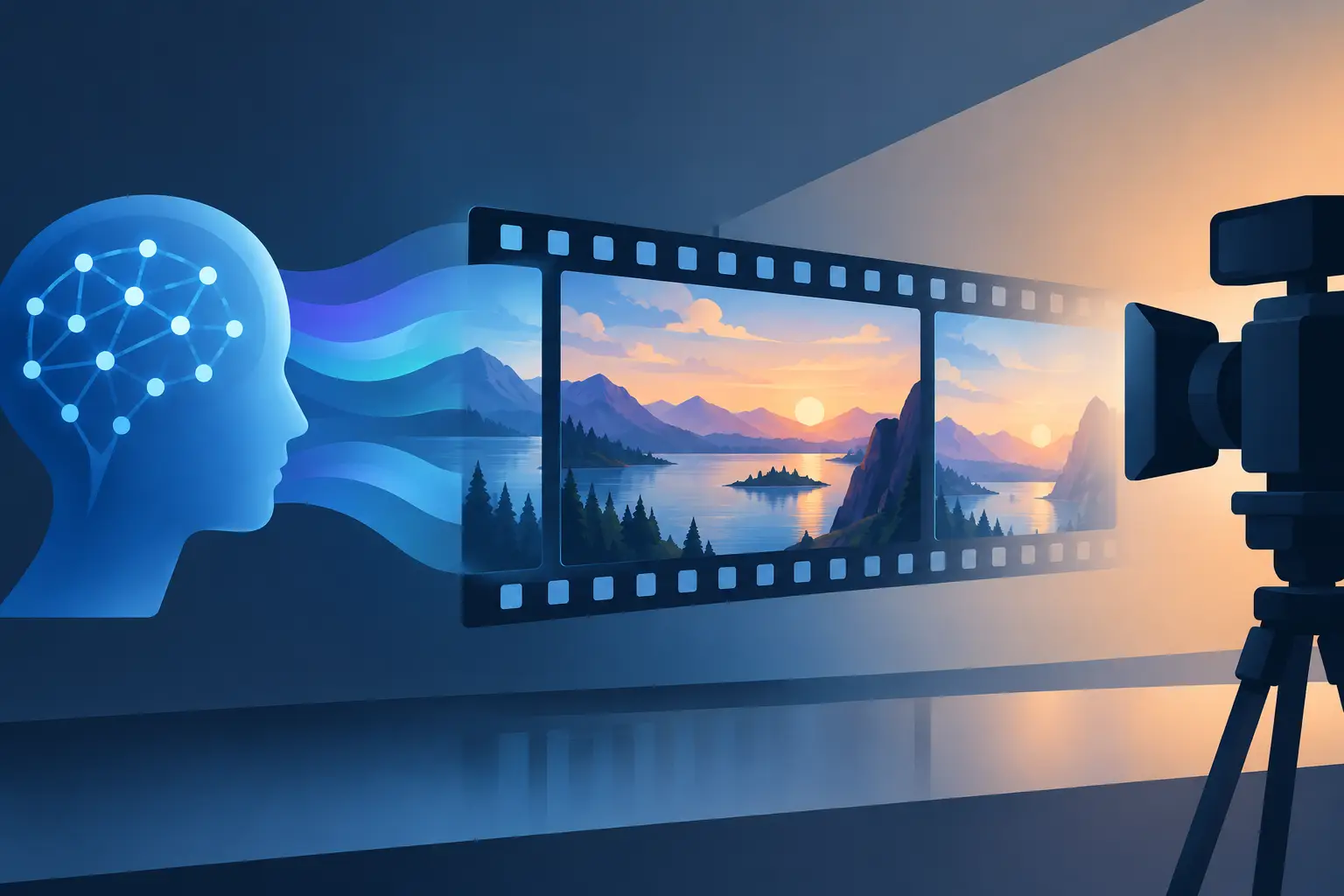
A production designer can spend months defining the texture of a world: the dust on a window, the shade of a motel sign, the particular green of a hospital corridor at 3 a.m. AI image models bring that visual decision-making into a new kind of studio. They do not replace the eye behind the frame. They give that eye another way to sketch, test, distort, and direct.
For cinema, this is the real shift. The conversation is no longer limited to whether an image was generated. The question is whether it belongs to a film. Does it hold a mood? Does it reveal character? Can it carry visual logic from one shot to the next?
AI Image Models Are a Visual Department
AI image models turn language, reference, composition, and iteration into images. At their most basic, they can produce a still from a prompt. In a cinematic workflow, that is only the opening move.
A filmmaker may use a model to find the first image of an unwritten scene: a night ferry moving through black water, a child in a silver raincoat beneath sodium lights, a city where every building looks half-submerged. That image can become a tone reference, a pitch frame, a storyboard panel, a matte painting, a costume study, or the visual DNA for a sequence built across other tools.
This makes the model less like a button for finished pictures and more like a hybrid of concept artist, location scout, production designer, and image laboratory. It can generate volume at extraordinary speed. But volume is not authorship. The filmmaker still decides which frame has tension, which frame is false, and which frame is worth building on.
That distinction matters because cinema is not a gallery of isolated images. A beautiful still can fail the moment it has to cut against another shot. A generated world becomes cinematic when it can sustain perspective, light, geography, character, and emotional consequence.
The Frame Has Become More Negotiable
Traditional production has always involved constraints: locations, weather, budgets, access, crews, physical laws. Constraints can sharpen a film, but they can also narrow what gets attempted. AI image models make certain visual propositions cheaper to explore before a production commits.
A director can test five versions of an impossible environment without building a set. An animator can search for the right abstraction between charcoal drawing and degraded surveillance footage. A cinematographer can use generated studies to discuss lens feeling, color temperature, negative space, and movement long before the camera arrives.
The gain is not simply speed. It is permission to pursue images that once belonged only to large-scale productions or long development cycles. A small team can now establish a visual world with the density of an imagined archive: decades of invented photographs, artifacts, interiors, and landscapes. That changes what independent cinema can attempt.
It also changes pre-production. The old division between a loose idea and a fully financed visual plan is becoming less rigid. A strong filmmaker can make an atmosphere visible early, which helps collaborators understand the film before its conventional machinery exists.
From Prompt to Direction
The myth of generative image-making is that the prompt does all the work. Anyone who has tried to create a specific cinematic image knows otherwise. The first result is often generic, overlit, anatomically unstable, or emotionally vacant. It may resemble a film frame without behaving like one.
Direction begins with specificity. Not just a subject, but a relationship: a figure at the edge of the frame; an empty chair that carries more weight than the character; light that appears to come from a television in the next room. Reference images, compositional controls, masks, inpainting, and repeated revision can guide a model toward an intention.
The most compelling work often comes from resistance rather than obedience. A strange artifact can introduce a useful accident. A distorted hand, duplicated reflection, or implausible hallway may become the premise of a scene instead of an error to erase. Cinema has always made room for accidents. AI expands their vocabulary.
Consistency Is the Real Production Challenge
One extraordinary image is easy to celebrate. Building a coherent film language is harder.
Characters need to remain recognizable across scenes. Wardrobes need internal logic. Architecture must survive changes in angle. A recurring object may need to look worn in exactly the same way three scenes later. If a story moves from dawn to night, the world needs to feel like the same world under different conditions.
This is where AI image models demand craft rather than casual experimentation. Creators need a visual bible: character reference sheets, environment studies, palette decisions, camera rules, material notes, and a clear account of what must remain stable. The more intentional the system around the model, the less the work feels like a sequence of unrelated discoveries.
There is a trade-off. Tight consistency can produce polish while draining the work of surprise. Loose generation can create singular moments while weakening narrative clarity. The right balance depends on the film. A dreamlike short may benefit from unstable faces and shifting rooms. A dramatic feature with recurring characters needs far more discipline.
Continuity is not merely technical cleanup. It is trust. Viewers may accept a world that defies physics, but they still want to sense that the film knows its own rules.
Authorship Is Moving Upstream
As images become easier to generate, taste becomes more visible.
That may sound counterintuitive. If anyone can make a dramatic frame, visual distinction should disappear. In practice, the opposite can happen. When image production is abundant, selection becomes decisive. What do you reject? What do you keep returning to? Which imperfections feel alive? What visual reference is too familiar to use again?
The director's role increasingly extends into the design of a generative process. They establish the source material, the prompt language, the reference set, the degree of intervention, and the editorial standard. The image may arrive through a model, but its place in the film is determined through human judgment.
This does not erase the contributions of artists who made the models possible, or the ethical questions around training data, consent, labor, and credit. Those questions are active and material. A serious AI cinema culture cannot treat them as an afterthought.
Creators should be clear about what tools shaped the work, especially when a film draws on recognizable styles, performers, or archival materials. They should avoid presenting synthetic likenesses as real people or documentary evidence. And they should treat collaborators with the same care they expect for their own work: establish permissions, define roles, and credit meaningful creative contribution.
The medium earns legitimacy through better standards, not louder claims.
The Most Interesting Images May Be the Least Photoreal
Photorealism has become an easy benchmark for AI image models, but it is a narrow one. A frame does not become cinematic because it can be mistaken for a photograph. Cinema has always exceeded realism through miniatures, rear projection, hand-painted backdrops, optical printing, animation, and digital effects.
AI's distinct value may emerge most clearly in forms that do not pretend to be conventional photography. Consider a historical film made from unstable memory-images, a science-fiction story whose city reorganizes itself around a character's fear, or an animated documentary that admits the gaps in its archive. These approaches use generation as a visual language rather than a concealment strategy.
This is where AICINEO sees a real cultural territory taking shape. AI cinema is not defined by a tool appearing in a workflow. It is defined by filmmakers using new systems to make moving images with intention, risk, and a point of view.
The work will not all look alike. Some films will pursue lush realism. Others will be rough, graphic, uncanny, or deliberately synthetic. What matters is that the aesthetic serves the film's inner logic instead of performing technology for its own sake.
Build the Image Before You Need the Shot
For creators beginning with AI image models, a useful first move is not to generate hundreds of final-looking frames. Make ten images that answer one question about your film. What does loneliness look like in this world? How does power appear in its interiors? What kind of light follows the protagonist?
Keep the strongest results and study why they work. Build references from them. Then make variations with purpose: wider, closer, colder, damaged, emptied of people, seen from behind glass. The goal is to develop a vocabulary that can survive motion and editing.
When an image begins to carry narrative pressure, move it into a sequence. Place it beside another shot. Add sound in your head. Ask what happened before it and what must happen after it. A frame becomes cinema when it creates anticipation.
The next great AI-made film may not begin with a model's most impressive output. It may begin with one imperfect image that makes a filmmaker see a world they cannot stop thinking about.