

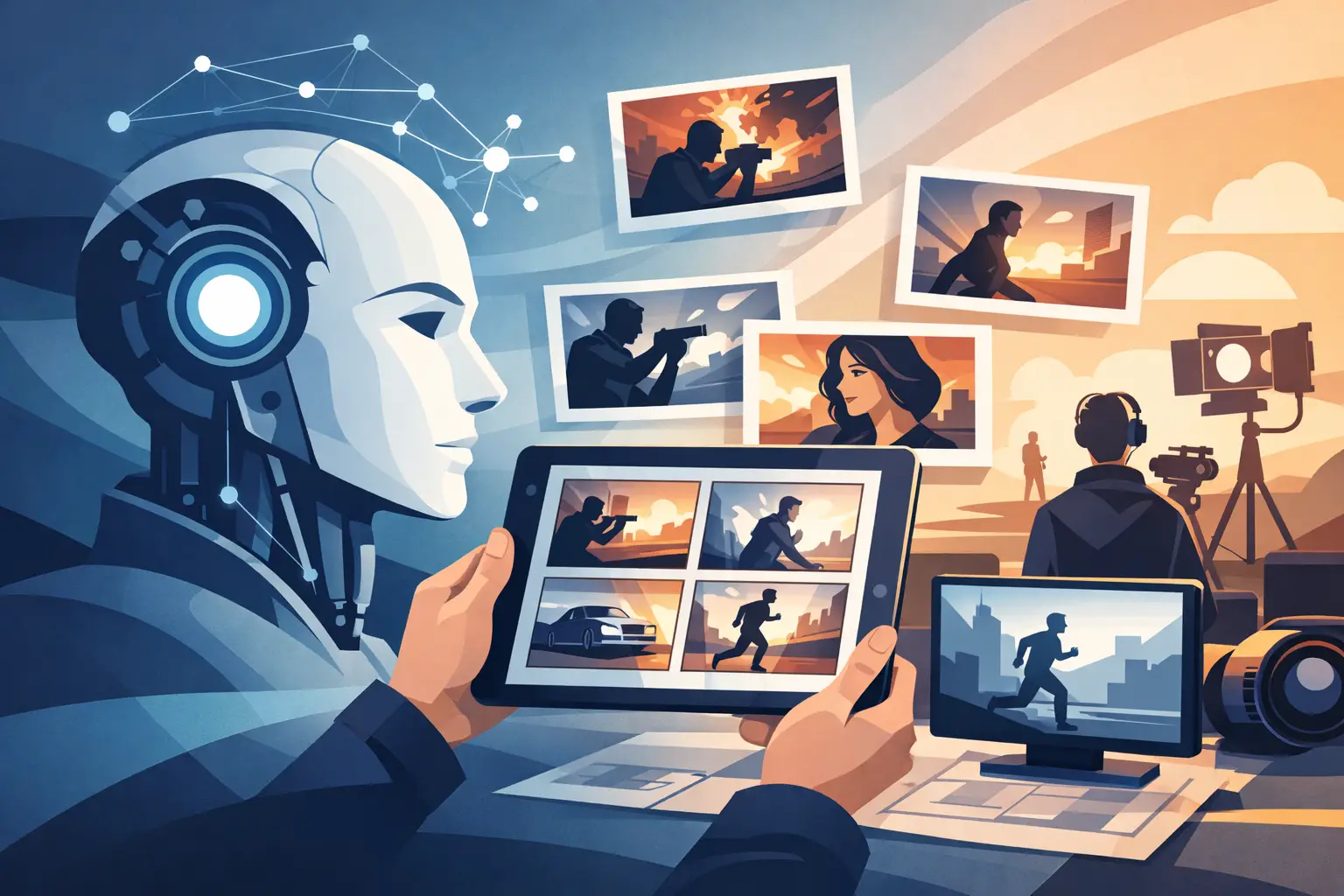
A scene can be clear in a director’s head and still fail to exist for everyone else. The location has not been found. The light has not been designed. The actor’s movement is still a sentence in a script. An AI storyboard generator for film gives that scene a first body - not a finished image, but a visible proposition that the crew can challenge, refine, and build.
That distinction matters. Cinema is not a prompt rendered at scale. It is a chain of decisions about attention, duration, perspective, performance, sound, and consequence. AI can accelerate the moment when an idea becomes discussable. It cannot decide what the audience should feel when the camera waits half a beat too long at a doorway.
For filmmakers working with generative tools, storyboarding is becoming less like drafting a static comic and more like directing an evolving visual system. Used with intention, it can make previsualization faster, stranger, and more precise. Used carelessly, it can produce attractive images that have no shot logic at all.
What an AI Storyboard Generator for Film Actually Does
At its most useful, an AI storyboard generator translates written scene information into a sequence of reference frames. A filmmaker might begin with a screenplay excerpt, a beat sheet, character notes, or a rough shot list. The system then produces visual interpretations: a wide shot of a deserted motel, a low angle on a character at the threshold, a close-up where fluorescent light turns skin slightly green.
The value is not simply speed. The real value is iteration. A director can test whether the motel should feel sun-bleached or nocturnal, whether the scene wants an objective camera or an anxious subjective one, and whether a reveal works better from across the room or behind a character’s shoulder. Those choices once required a sketch artist, a library of references, or a great deal of imagination held privately. Now they can appear early enough to influence the script itself.
But generated frames are only as coherent as the instructions and references behind them. A tool can suggest a composition. It does not automatically understand the geography of a room, the screen direction established three shots earlier, or the narrative reason a lens should feel intimate rather than observational. That work remains filmmaking.
The New Previs Is a Conversation
Traditional boards often arrive after a scene has already settled. Generative storyboards can enter earlier, when the scene is still unstable. That makes them particularly effective for independent productions, music videos, experimental shorts, animation tests, and AI-native films where visual discovery is part of writing.
A filmmaker can use the first pass to expose weak assumptions. Perhaps the script says a character feels trapped, but every generated composition leaves generous negative space around them. Perhaps the supposed climax looks visually identical to the scenes before it. Perhaps a costly crane move is doing less dramatic work than a locked-off medium shot.
This is where the tool becomes useful as a critical surface. It lets a director see the gap between the scene described and the scene implied by images. The board should not settle that gap too quickly. It should make the gap visible.
For cinematographers, the benefit is different. Early frames can establish a shared vocabulary for contrast, framing, lens behavior, texture, color temperature, and movement. They are not a substitute for a lookbook or a technical scout. They are a faster way to locate the questions that need a lookbook and scout.
Start With Beats, Not Prompts
The fastest route to generic output is treating a scene as one large prompt. Break it into changes of dramatic pressure instead. Ask what happens before the character knows something, at the instant they know it, and after they cannot unknow it. Those are likely different shots, even if the setting never changes.
For each beat, define the camera’s relationship to the subject. Is the frame withholding information? Is it observing from a distance? Is it trapped with the character? Include time of day, environment, emotional temperature, wardrobe continuity, and the specific visual detail that cannot be lost.
A prompt such as “cinematic woman in a kitchen, suspenseful” gives the model almost nothing to direct. A more useful instruction identifies intent: “Static medium-wide from the hall, dawn kitchen, character seen through the doorframe, untouched coffee on counter, pale blue practical light, she has just heard a message but has not pressed play.” The latter contains blocking, props, atmosphere, and a dramatic condition.
Consistency Is the Production Problem
A single image can be compelling by accident. A film cannot. The central challenge in AI storyboarding is maintaining continuity across a sequence: the same character, costume, architecture, object placement, visual grammar, and emotional world.
Build a compact reference package before generating dozens of frames. Establish the protagonist from multiple angles, the primary wardrobe, key locations, recurring objects, and the palette of the film. If the platform supports reference images, use them deliberately. If it does not, repeat critical descriptors exactly and keep a written continuity record beside the boards.
The goal is not to freeze every frame into sameness. A story needs variation. The goal is to decide what may change. Lighting can shift as the character moves from safety to exposure. Framing can grow tighter as a lie collapses. The color red might become increasingly present. The character’s face, the geography of the apartment, and the direction of a chase should not drift because the tool lost the thread.
This is also where human drawing, collage, 3D blocking, and photography remain valuable. An AI-generated board does not need to own every panel. A location still, a hand-drawn floor plan, a lens diagram, or a marked-up frame can carry more production truth than a beautiful invented image. Hybrid boards are often the strongest boards.
What to Keep Human
The strongest use of generative storyboards is selective. Give AI the task of producing options, atmosphere studies, coverage variants, and early visual research. Keep authorship with the people responsible for the film.
There are several decisions a director should not outsource. The first is point of view. A model can make a close-up, but it does not know whether the close-up belongs to the character, the audience, or the story’s moral position. The second is rhythm. Boards can suggest sequence, yet they cannot feel the duration of a silence against a performance. The third is meaning. An image may look like cinema while saying nothing particular.
There is a practical reason as well. A board that is too polished can become falsely authoritative. Producers may read it as a production promise. Departments may mistake invented architecture or impossible lighting for a requirement. Label exploratory frames clearly, then distinguish them from decisions that have been approved for the shoot or final generation pipeline.
From Frame Sequence to Film Language
Once a scene has a working board, test it as a sequence rather than admiring panels one by one. Put the frames in edit order. Strip away captions for a moment. Can a viewer understand where people are, what has changed, and where attention is being directed?
Then inspect the transitions. A storyboard is a map of cuts, not a gallery. A wide shot followed by a close-up means something different from a close-up followed by an overhead. Repeated angles can flatten tension. A shot that looks impressive alone may interrupt the scene’s line of action.
For AI cinema, this discipline is especially useful because the final imagery may continue to evolve after boards are made. The board becomes a creative constitution: a record of what the film is trying to preserve while tools, models, and renders change around it. It protects the work from visual drift.
AICINEO sees this shift as part of the medium’s maturation. The question is no longer whether generative images can resemble film. The question is whether creators can shape those images into deliberate cinematic experiences.
Choose the Tool by the Stage of Work
There is no single best system for every production. Some tools are strongest when converting scripts into quick panel sequences. Others offer greater control through reference images, editable compositions, or character consistency. Video-oriented systems can help test movement and pacing, though their output may be less stable than still-image boards.
Choose based on the decision you need to make. If you are finding the tone of a short, breadth may matter more than precision. If you are preparing a live-action shoot, controllable framing, location references, and annotation may matter more than visual spectacle. If you are making a fully generative film, prioritize continuity tools and a workflow that lets you preserve approved visual decisions.
The board does not need to predict every pixel of the final work. It needs to make the next creative decision easier, clearer, and more intentional. Make images early. Question them hard. Then let the film become more specific than the machine’s first idea.