

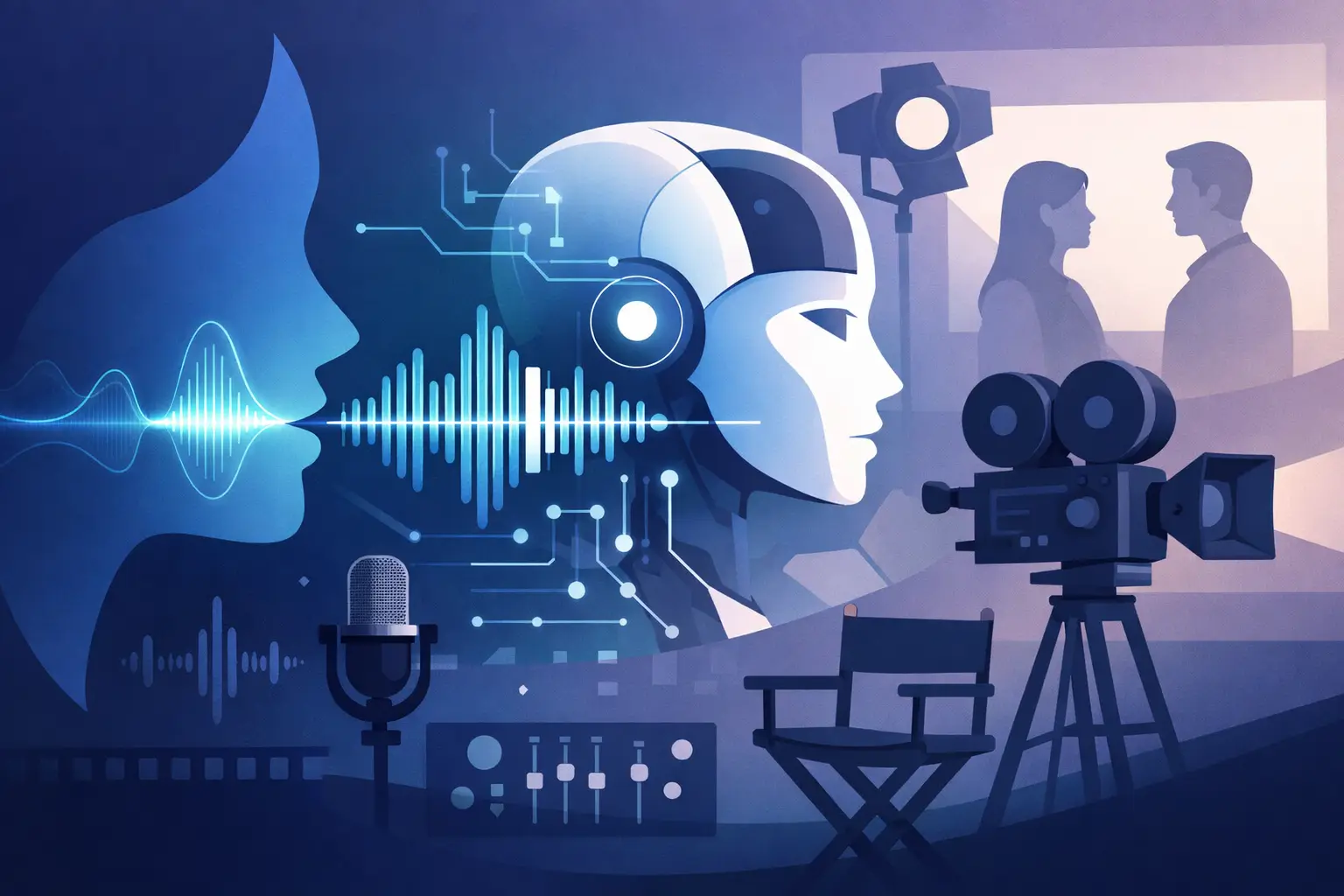
A face turns toward camera. The cut lands. Then the voice arrives one beat too clean, too certain, too unmarked by breath. The scene loses its weather.
That is the real question behind AI voice generation for films: not whether a synthetic voice can speak a line, but whether it can carry the invisible pressure that makes a line cinematic. For AI Cinema, voice is not a post-production convenience. It is performance, rhythm, character, and atmosphere compressed into sound.
AI Voice Generation for Films Is a Creative Decision
Synthetic voice is often discussed as a way to produce dialogue faster or cheaper. That is true, but it is the least interesting part of the story. Its deeper value is its ability to expand what a filmmaker can test, imagine, and construct before a conventional production pipeline would allow it.
An independent director can audition radically different vocal identities for the same character. An animator can find the tempo of a scene before a cast is locked. A creator building a fictional archive, a distant civilization, or a machine consciousness can develop voices that belong to the world rather than imitate a familiar studio sound.
This is especially potent in films made through generative workflows. The image may shift dozens of times during development. Shot length changes. Characters evolve. Languages change. A flexible voice process lets sound keep pace with the moving image instead of becoming the element that freezes experimentation.
But flexibility is not the same as authorship. A generated voice becomes cinema only when it has a point of view. The creator must decide how a character breathes, where they hesitate, what they refuse to say, and whether their vocal texture belongs against the image. The tool can render options. It cannot determine what the scene means.
The Voice Must Belong to the Frame
Film sound works through contrast. A delicate voice over a monumental landscape can create intimacy. A dry, almost documentary delivery over impossible visuals can make fantasy feel credible. A deliberately artificial cadence can give a future world a distinct social texture.
The strongest use of voice generation begins with this relationship between sound and image. Before selecting a voice, define the dramatic job it needs to do. Is it guiding the audience through a fragmented narrative? Is it unsettling them? Is it withholding emotion until the final scene? Those choices matter more than whether a voice sounds perfectly human.
A technically convincing read can still be wrong for the film. Many generated performances default to polished clarity: even pacing, softened consonants, tidy emotional arcs. That may work for an explainer or a temporary edit. In a dramatic scene, it can flatten tension. Human speech is full of interruption. People trail off, change direction, leave meaning in the silence after a word.
Direct the voice accordingly. Write for pauses. Break a sentence where thought changes, not only where grammar says it should. Test a line at different speeds. Remove emotional labels that force every beat into obviousness. If a voice platform offers control over emphasis, pronunciation, pitch, and pacing, use those controls in service of the scene rather than as effects.
Where Synthetic Performance Can Be Most Powerful
AI-generated voice is not a substitute for every actor, nor should it be treated as one. Its most compelling roles often emerge where conventional casting would narrow the imagination or make an experiment impossible.
Narration is a natural territory. Essay films, speculative documentaries, visual poems, and archival fictions can use a synthetic narrator as an artistic presence. The question is not whether the audience can detect it. The question is whether detection is part of the film's language. A slightly unfamiliar voice can create distance, authority, mystery, or unease.
It also has power in nonhuman and borderline-human characters. A ship intelligence, an invented public-service announcer, a recurring dream voice, or a figure seen only through damaged transmissions may gain meaning from controlled artificiality. Do not force these voices to pass as human if their difference can become part of the design.
Temporary dialogue is another serious use case. A convincing scratch track helps filmmakers edit scenes, shape animation, refine camera movement, and discover when dialogue should disappear entirely. The temporary version may later lead to a human performance. That is not a failure of the tool. It is a productive stage in a film's development.
Localized versions can also benefit, provided the process includes cultural and linguistic review. Translation is not merely word replacement. A line's humor, social register, and emotional temperature can change across languages. Synthetic delivery makes fast testing possible, but it does not remove the need for native speakers, writers, and performers to protect the film's intent.
Consent Is Part of the Craft
The creative possibilities are real. So are the ethical lines.
A voice is not just an acoustic asset. It is bound to identity, labor, reputation, and consent. Cloning or closely replicating a recognizable person's voice without explicit permission is not an artistic shortcut. It can cause real harm, and it places the production on unstable legal and cultural ground.
Filmmakers should know where a voice model came from, what rights govern its use, whether commercial distribution is permitted, and how data is handled. If working with a performer to create a digital voice, make the agreement specific. Define the project, the approved uses, duration, compensation, revisions, ownership, and whether future training is allowed. Ambiguity becomes expensive when a film finds an audience.
There is also a creative reason to be transparent inside a production. Editors, sound designers, producers, and performers need to know whether a vocal element is temporary, licensed, generated from a consented performer, or intended for final release. Clear provenance supports better decisions at every stage.
The best standard is simple: treat voice with the same respect you would give a face, a credit, or a performance on set. AI Cinema should widen creative agency, not hide its sources.
A Better Workflow Starts With the Edit
Do not begin by generating hundreds of voice samples. Begin with a scene cut, a sound intention, and a written performance brief. A useful brief identifies the character's relationship to the listener, the emotional turn of the scene, the desired distance from realism, and the sonic qualities the mix will need.
Generate a small range of deliberate options, then place them against picture early. A voice that feels striking in isolation may become brittle under music or disappear beneath environmental sound. Conversely, a restrained read may gain force once room tone, footsteps, and silence create space around it.
Keep the editing process tactile. Cut breaths where needed. Build pauses. Layer subtle location sound. Alter timing by fractions of a second. The goal is not to conceal every synthetic trace. It is to make every trace feel chosen.
For dialogue-heavy work, test scenes with fresh listeners before finalizing. Ask what they understood, where their attention drifted, and whether the voice felt aligned with the character. Avoid asking only whether it sounded real. Realism is one aesthetic among many. Coherence is the higher bar.
The New Voice Department
As AI filmmaking matures, voice will become its own creative department: part casting, part sound design, part writing, part performance direction. The films that stand out will not be the ones with the most lifelike generated dialogue. They will be the ones that understand vocal identity as a cinematic material.
AICINEO exists for that kind of work: films where new tools are not an excuse to reduce craft, but an invitation to rethink it. The voice in an AI film can be intimate, alien, unreliable, documentary, theatrical, or impossible. It only needs to earn its place in the frame.
Give the voice a reason to exist beyond efficiency. Let it carry the grain, silence, and risk that the image alone cannot hold.