

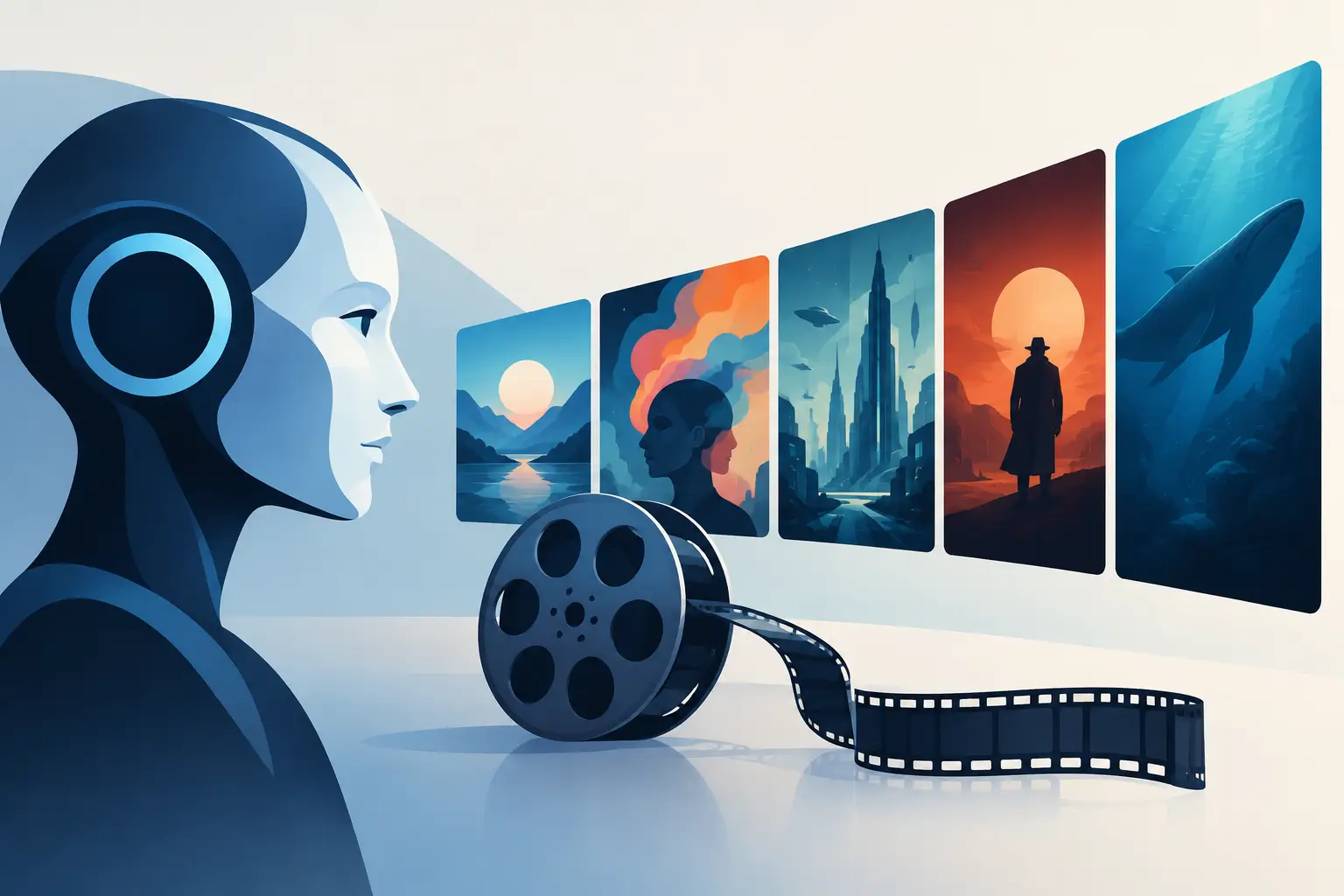
A film collection can make a new medium legible. The best experimental AI film collections do more than place impressive generations side by side. They reveal an emerging cinematic language: images that mutate with intent, worlds built from prompts and performance, and stories shaped by artists who understand that a beautiful frame is only the beginning.
AI cinema is not one genre, one toolset, or one visual style. It includes dream logic, synthetic documentary, animated myth, fashion film, speculative horror, micro-drama, abstract motion, and forms that do not yet have a name. That breadth is precisely why collections matter. A strong program gives the viewer a way to see patterns, contrasts, and real artistic decisions.
What Makes an AI Film Collection Worth Watching
The most memorable collections are curated around a point of view, not merely the fact that AI was used. Generative tools can create abundance. Curation creates consequence. It decides which films belong in conversation and which visual experiments become part of a larger cultural record.
Look for a collection with a clear internal tension. It might place intimate human voices against impossible landscapes. It might bring together short works that use AI to fracture memory, reinvent animation, or question authorship. The films do not need to look alike. In fact, they should not. What they need is a reason to be seen together.
A collection also needs rhythm. Five visually maximal films in a row can flatten into a blur, even when every shot is technically remarkable. Strong programming makes room for scale, silence, story, disruption, and recovery. A one-minute visual rupture can sharpen the impact of a slower, more narrative work that follows it.
The final test is whether the work remains interesting after the initial recognition of its method. If a film's only idea is that it was made with AI, its charge fades quickly. If AI expands a director's sense of time, character, texture, or possibility, the film keeps opening.
Five Kinds of Experimental AI Film Collections
1. The Dream Architecture Collection
This is where AI cinema's visual instability becomes a strength. Films in this collection move through rooms that reorganize themselves, faces that carry multiple identities, and landscapes that behave like memory rather than geography. The aim is not photorealism. It is emotional spatial design.
The best programming in this mode pairs dense, image-led work with films that offer an anchor: a spoken confession, a recurring object, a simple journey. Without that anchor, dream imagery can become decorative. With it, the image becomes dramatic pressure.
For creators, this collection is a lesson in continuity. AI can make transformation effortless, but effective transformation still needs direction. Decide what changes, when it changes, and what the audience should feel as the world turns unfamiliar.
2. The Synthetic Documentary Collection
Experimental AI film becomes especially potent when it brushes against the documentary form. Artists can reconstruct lost places, stage impossible archives, fabricate public information systems, or visualize the gaps inside personal and collective history. The point is not to pass invention off as evidence. The point is to make the construction visible enough that viewers question how all images earn their authority.
This category requires care. A collection should clearly frame fictional, reconstructed, and sourced material. Ambiguity can be an artistic tool; deception is not the same thing. The strongest works use that boundary to create productive discomfort, asking what a record is, who gets represented, and what visual truth can mean when every image is potentially generated.
For a viewer, these films are compelling because they make media literacy cinematic. For a filmmaker, they demand rigor in research, disclosure, voice, and context.
3. The Machine Myth Collection
Myth is a natural territory for generative film. It welcomes transformation, archetype, recurrence, and impossible scale. AI-made worlds can give a contemporary charge to ancient gods, folk creatures, cosmic journeys, and invented cosmologies without requiring a conventional studio pipeline.
Yet spectacle alone is not myth. A worthwhile collection gives each film a distinct symbolic center: a figure crossing a threshold, a ritual with a cost, a landscape that reflects a character's inner conflict. The source material can be global, local, personal, or entirely invented, but the filmmaker should know what the images stand for.
This is also where cultural specificity matters most. Borrowed symbols without knowledge often read as visual extraction. Films become richer when creators work from lived references, credited research, genuine collaboration, or a clearly original mythology instead of a generalized idea of the exotic.
4. The Performance-First Collection
AI cinema is sometimes discussed as though the human body has disappeared. The opposite can be more interesting. Performance-first films use actors, dancers, voice artists, or captured gestures as the emotional engine, then let generative processes alter the surrounding world, costume, identity, or physical rules.
A collection in this mode demonstrates a crucial distinction: AI can generate an image, but it does not automatically generate presence. Presence comes from timing, breath, intention, and the sense that someone is at risk of being changed by what happens in the frame.
These programs are especially useful for directors moving from live action into AI-assisted production. They show where a human performance should remain intact and where transformation can deepen the scene. Sometimes the most advanced choice is restraint. Let the face stay human. Let the impossible happen around it.
5. The Short-Form Cinema Collection
Short-form work is not a lesser version of feature filmmaking. It is one of AI cinema's native forms. A two-minute film can establish a rule, break it, and leave an image behind that continues to work on the viewer long after the screen goes dark.
The strongest short-form collections avoid treating every film as a social clip. They program brevity with cinematic discipline: intentional sound, meaningful cuts, visual escalation, and an ending that feels chosen rather than simply reached. This is where experimental filmmakers can test a new grammar quickly, but testing does not excuse vagueness.
For audiences, short collections are an ideal way to encounter many artistic positions in a single sitting. For artists, they create a compact proving ground for a visual premise before it expands into a larger work.
How to Watch Beyond the Tool
The question is not simply, “Which model made this?” Tool literacy has value, especially for creators, but it is not the whole experience. Ask what the film does with its materials. Does the instability of the image express a character's uncertainty? Does synthetic motion create a new relationship to time? Is the sound design carrying emotional weight, or compensating for images without a story?
Pay attention to recurrence. In experimental work, a repeated color, gesture, voice, or object can perform the work of conventional plot. Notice when a film allows an image to breathe and when it rushes from one invention to the next. Technical novelty often rewards speed. Cinema usually rewards selection.
This is also why collections benefit from artist context, credits, and programming notes. They do not need to explain every frame. They should give the audience enough orientation to meet the work seriously. AICINEO treats that encounter as central: AI film is not a novelty reel, but a field of moving-image practice with its own artists, references, and standards.
The Collection Is Part of the Artwork
A single AI film can be striking. A collection can establish a movement. When films are selected with precision, the sequence itself becomes an argument about what this medium can hold: intimacy beside scale, technical invention beside human intention, and disruption beside craft.
The right collection will not tell viewers that AI cinema has arrived. It will make them feel that it is already changing the grammar of what a film can be.