

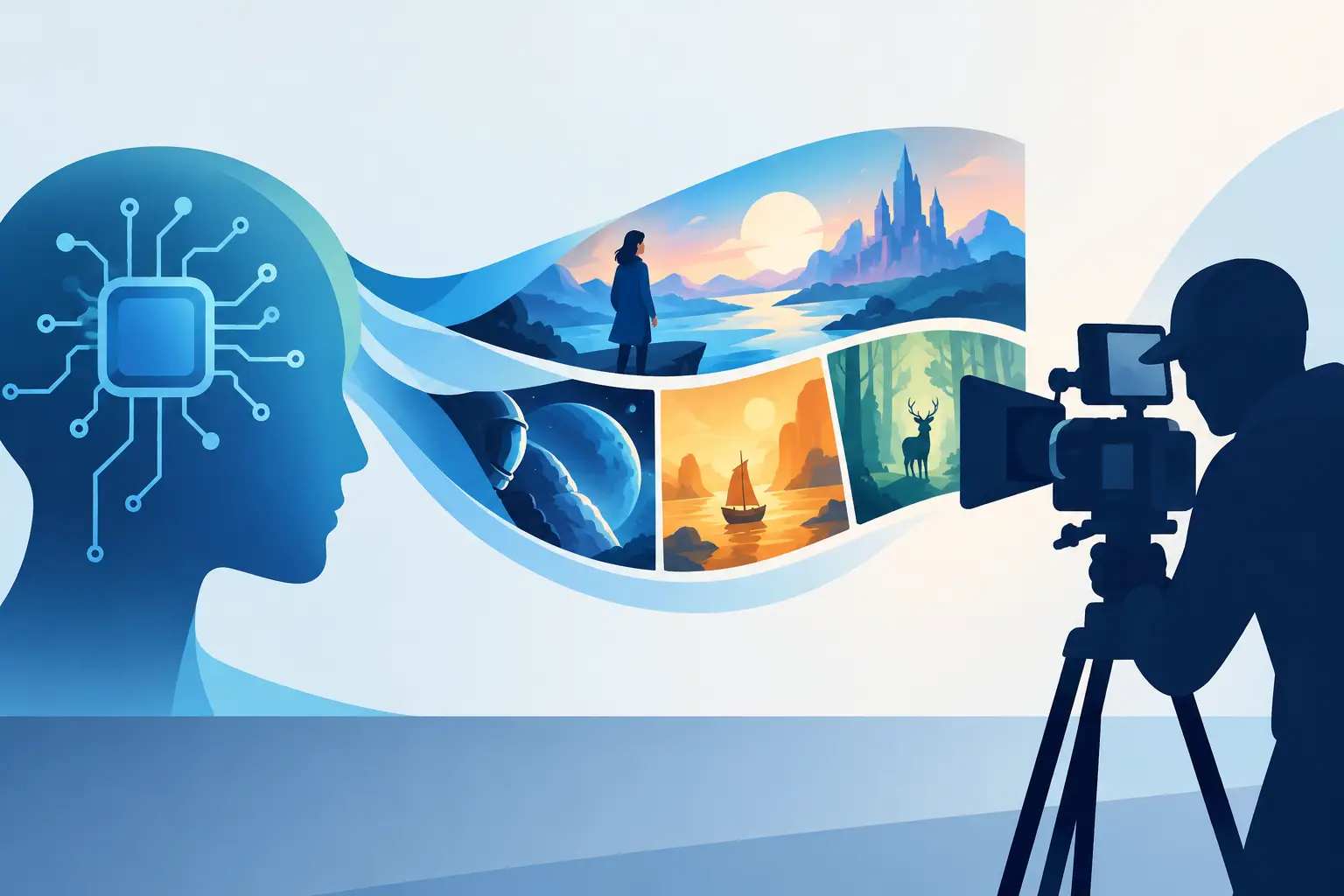
A film can now begin with a sentence, a sketch, a face that never existed, or a fragment of movement captured on a phone. That fact is no longer the story. The real story is what filmmakers do next. Future generative films will be defined less by the presence of AI than by the decisions that turn synthetic possibility into cinematic meaning.
The first wave of AI video made its case through spectacle: impossible transformations, dreamlike camera moves, bodies melting into architecture, worlds appearing in seconds. Spectacle matters. Cinema has always depended on it. But a medium matures when its makers learn what to withhold, repeat, frame, and leave unresolved.
AI cinema is approaching that threshold.
Future Generative Films Will Move Beyond the Prompt
A prompt is not a screenplay, and a generated clip is not a scene. They may be raw material, like a location scout, a test reel, a storyboard, or an improvisation. The filmmaker's work begins in the selection.
Generative systems can produce dozens of visual directions before a conventional production has booked a studio. That changes the economics of experimentation. A director can test whether a story belongs in a flooded suburban America, a hand-painted orbital station, or a city constructed from archival textures. A cinematographer can explore light, lens behavior, scale, and movement before a physical camera is involved.
But abundance creates a harder editorial problem. When every image is available, taste becomes visible. The strongest future generative films will not be those with the most variations. They will be the ones with a precise visual rule set: a reason the characters move as they do, a reason the world glitches or remains stable, a reason one impossible image arrives at exactly that moment.
This is where AI cinema separates itself from the endless feed. The feed rewards instant novelty. Film rewards intention over duration. A strange image is easy to generate. A strange image that changes the emotional temperature of a story is craft.
The Director Becomes a System Builder
Generative filmmaking expands authorship. It does not erase it.
A director working with generative tools may shape the process through references, character bibles, image libraries, performance footage, scripts, motion studies, edit decisions, sound design, and hundreds of rejected outputs. The result can look effortless to an audience. It rarely is.
The role is shifting from command to orchestration. Instead of directing only actors, cameras, sets, and crews, a filmmaker may direct a living production system with human collaborators and machine-generated material moving through it. The director establishes constraints, then recognizes the unexpected moment worth keeping.
That shift has precedent. Editing changed the language of cinema. Sound changed it again. Digital effects altered what could be pictured, while digital cameras changed who could make pictures at all. Generative tools will alter the chain of production, but they will not remove the central question: whose point of view is this?
The answer cannot be “the model.” Models generate patterns from enormous bodies of prior material. Point of view comes from choices. It comes from what the filmmaker is willing to pursue when the tool offers easier, prettier, more familiar alternatives.
Consistency Is Not the Only Goal
Much of the technical conversation around AI film focuses on consistency: the same character, the same wardrobe, the same room, the same light across a sequence. This matters for long-form narrative. Viewers need continuity when continuity carries the story.
Yet inconsistency can also become form. A memory film might let faces drift. A story about surveillance may allow identity to fracture from shot to shot. A music-driven piece may use visual instability as rhythm. The mistake is treating every artifact as either failure or magic. Its value depends on the film's internal logic.
Future generative films will make this distinction clearer. Technical control will improve, but artistic control will remain the larger achievement.
Production Will Become More Flexible, Not Frictionless
Generative cinema promises smaller crews, faster prototyping, and access to images once reserved for large budgets. Those changes are real. An independent filmmaker may build a period world, previsualize an action sequence, or create an animated short without waiting for the resources traditional production requires.
That does not mean filmmaking becomes effortless. Time moves elsewhere.
Hours once spent on physical logistics may move into development, iteration, data organization, sound work, compositing, rights review, and editorial refinement. A production can generate a hundred shots quickly and still struggle to find the ten that belong together. It can make a convincing face and still fail to make an audience care what that face wants.
There are also material limits. Generative output can flatten cultural specificity into a polished global average. It can reproduce visual clichés at machine speed. It can obscure the sources, labor, and creative work embedded in the systems it draws from. Filmmakers and platforms will need clear standards around consent, disclosure, credit, provenance, and the use of likeness.
These are not administrative details outside the art. They affect whether audiences trust the work and whether artists can build sustainable careers inside the medium.
A New Screen Language Is Taking Shape
The most compelling AI cinema may not imitate conventional production perfectly. It may develop formal traits native to generation.
A scene can transform without a cut. A character can cross decades in a single gesture. A landscape can behave like memory rather than geography. Visual motifs can evolve with a character's emotional state, not just decorate it. In the right hands, these possibilities can make interior life visible with an immediacy live action rarely achieves.
There is a trade-off. If every transition is fluid, transformation stops feeling consequential. If every frame is beautiful, beauty loses its pressure. Restraint gives generative imagery weight.
This is why short films, music films, fashion films, experimental documentaries, and hybrid animation are such vital territory. They can test new cinematic grammar without forcing it into the expectations of a two-hour studio feature. They allow artists to discover what a generated image does best: not merely simulate reality, but bend time, identity, material, and scale around feeling.
AICINEO exists for this emerging body of work to be seen as cinema, not as a novelty category beside it. That distinction matters. A medium becomes cultural when its audience learns how to watch it, discuss it, criticize it, and return to it.
Audiences Will Demand More Than Visual Proof
For a while, viewers will ask, “Was this made with AI?” It is a natural question, just as audiences once marveled at early sound, color, digital effects, and computer animation.
Eventually, the better question will be, “Why was AI the right medium for this film?”
That question asks for purpose. Did generation enable a visual language unavailable elsewhere? Did it make a personal project possible? Did it open a new relationship between documentary evidence and imagined reconstruction? Or did it simply add noise to a story that could have been told more clearly with a camera, animation team, or practical set?
Not every project needs generative tools. A quiet performance scene may need the irreducible presence of an actor in a room. A documentary may require strict visual accountability. A handmade animation may gain its power precisely from the trace of human labor. AI cinema becomes stronger when it does not pretend to be the answer to every form.
The future belongs to filmmakers who can make that call without ideology.
The Cultural Work Starts Now
Tools will keep changing. Models will become more controllable, more multimodal, and more integrated into established production pipelines. That trajectory is significant, but it is not the deepest change.
The deeper change is cultural: a new generation of filmmakers is learning to think in images that can be searched, transformed, regenerated, and edited into being. They are building work from dialogue between intention and accident. They are testing where authorship lives when a film's materials are partly synthesized but its meaning is unmistakably directed.
The task now is not to defend generative film as a technical trick or dismiss it as one. The task is to develop standards high enough for the medium to earn its own canon.
Make work that gives the image a reason to exist. Then give the audience a reason to remember it.