

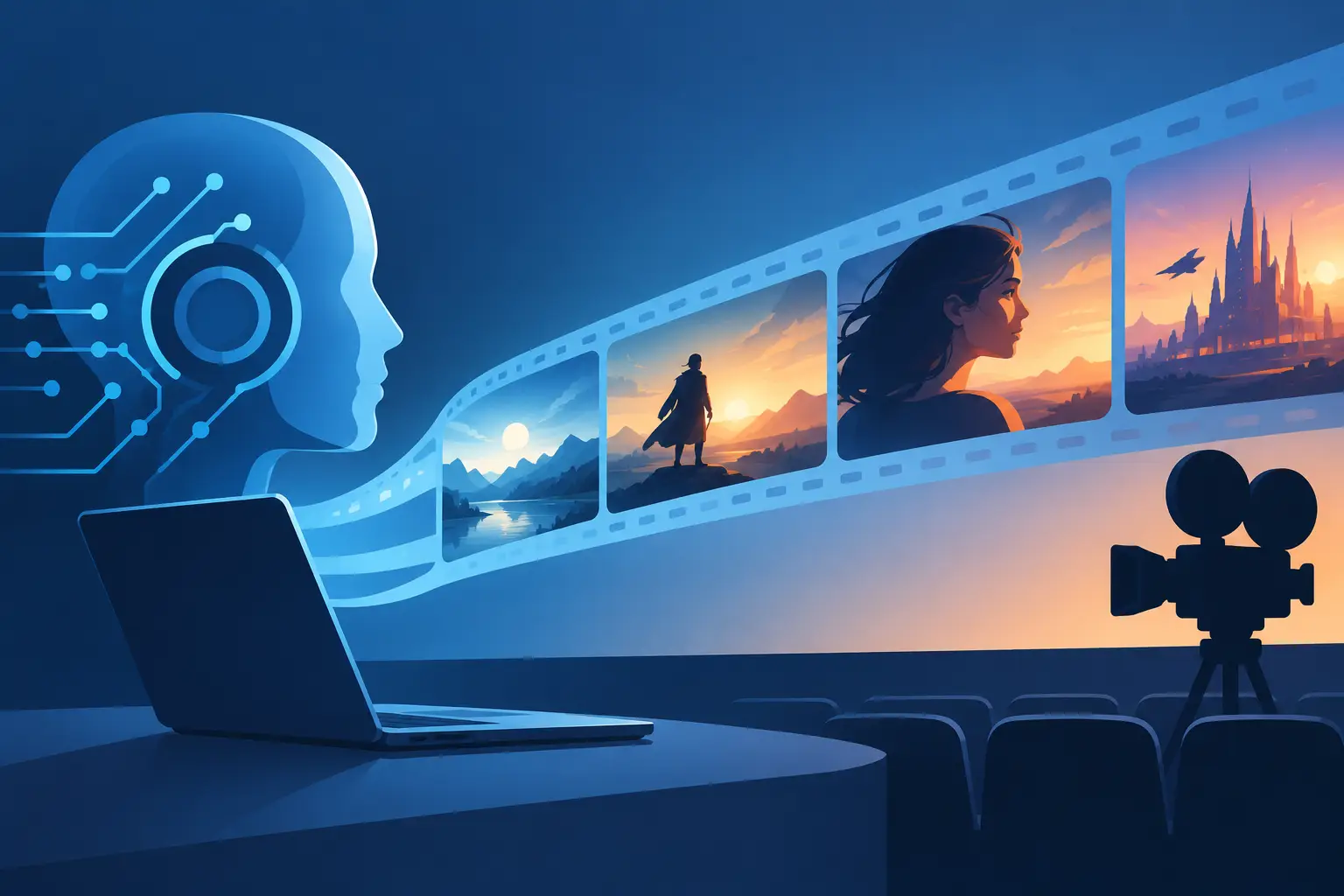
A shot once began with a location, a camera package, a crew call, and a weather report. With generative video models, it can begin with a sentence, a still image, a performance reference, or a fragment of impossible memory. That does not make filmmaking effortless. It changes where the effort lives.
For AI cinema, the real shift is not that software can produce moving images. It is that moving images can now be developed at the speed of thought. A director can test a world before it exists, chase an image that would never survive a conventional budget, or find the visual logic of a film through iteration rather than explanation.
The result is a new production language. It is still forming. Its possibilities are real, and so are its limits.
What generative video models actually do
Generative video models create or transform sequences of moving images from inputs such as text prompts, reference images, video clips, masks, camera directions, and sometimes audio. Rather than recording a scene in the physical world, they predict a sequence of frames that appears to contain motion, light, space, materials, subjects, and camera behavior.
That distinction matters. A model is not a camera. It does not witness an event. It synthesizes a plausible cinematic event from patterns learned during training and instructions supplied during generation.
This makes the technology unusually powerful for visual development. A filmmaker can move from a written idea to a rough moving image without first building sets, traveling to a location, or assembling every production department. The first output may be unstable, strange, or unusable. But it can reveal a tone, an angle, a costume language, or a rhythm worth pursuing.
Generative video also covers more than text-to-video. Image-to-video can animate a concept frame. Video-to-video can restyle footage while preserving a performance or edit. Inpainting can replace a detail within a shot. Extension tools can continue a frame beyond its original edges or duration. Used together, these functions begin to resemble a new kind of virtual production department.
The cinematic opportunity is not automation
The least interesting use of generative video models is automated visual noise: a prompt, a clip, a scroll, a forgettable result. Cinema asks for more. It asks why this image appears now, what the cut withholds, where the sound changes meaning, and what remains after the final frame.
The strongest AI-made work treats generation as material, not a finished answer. A generated shot can be storyboard, location scout, matte painting, dream sequence, visual effect, animated performance, or the image that forces a screenplay to become more specific. Its value depends on the surrounding decisions.
This is why the director's role does not disappear. It becomes more editorial. Prompting is only one gesture among many: selecting references, defining visual constraints, rejecting generic outputs, shaping continuity, directing sound, cutting time, and determining what an audience is meant to feel. A beautiful frame is not yet a scene. A scene is not yet a film.
For independent creators, the economic effect can be significant. Stories once reserved for large effects budgets can enter development earlier. A small team can prototype a historical epic, a cosmic fable, a surreal thriller, or a city that exists nowhere on Earth. That access does not erase the need for resources. It relocates some resources from logistics to taste, compute, iteration, post-production, rights management, and skilled collaborators.
Where the image breaks
Generative video remains a volatile medium. Models can produce striking motion in one moment and lose an object, a face, or the laws of space in the next. Hands, text, reflections, physical contact, and multi-character action often expose weaknesses. A recurring character may drift in age, wardrobe, or identity between shots.
Continuity is the central production problem. A viewer may accept an impossible landscape, but they notice when a protagonist's face changes during an emotional beat or when a glass vanishes between cuts. For a short mood film, this instability can become part of the aesthetic. For a narrative built on performance and dramatic precision, it demands careful planning and cleanup.
The answer is rarely to generate a whole film in one pass. More often, creators work shot by shot, holding reference frames constant, using controlled seeds where available, compositing generated elements, and editing around the strongest seconds. Traditional disciplines remain essential: production design, cinematography, animation, visual effects, sound design, color, and editorial judgment.
There is also a less technical danger: sameness. If creators rely on the model's default visual preferences, the output can converge on familiar glossy lighting, shallow symbolic imagery, and motion that feels impressive but emotionally empty. Distinctive work begins with specific references and a point of view strong enough to resist the average image.
A new relationship between director and performer
Performance is one of the most sensitive frontiers in AI cinema. Models can animate a still portrait, alter an actor's appearance, create a synthetic character, or transform footage into another visual register. These capacities can give filmmakers new forms of casting, puppetry, and character design. They can also create serious questions about consent and control.
A person's face, voice, body, and performance should not become raw material merely because the technology permits it. Clear permission, explicit scope, compensation, and disclosure are creative standards as much as legal ones. A compelling synthetic character is not an excuse for exploiting a real person.
The same applies to artistic influence. Every filmmaker works within a history of images. But there is a meaningful difference between studying a visual tradition and presenting work as if it were made by a living artist who had no role in it. Credit, attribution, and honest framing protect the culture that makes experimentation possible.
For audiences, transparency should be legible without becoming a disclaimer-heavy ritual. Viewers deserve to know when a film uses generated imagery, especially when realism could confuse a work of fiction, a simulation, or documentary evidence. Context is part of the viewing experience.
The craft is moving upstream and downstream
Generative video models compress the middle of production: the distance between imagining a shot and seeing a version of it. In response, more craft moves upstream into development and downstream into finishing.
Upstream, filmmakers need stronger visual bibles. What are the architecture, lens behavior, color world, character silhouettes, movement rules, and emotional temperature of this film? Vague prompts create vague results. A disciplined reference system gives the model something more coherent to interpret.
Downstream, the work needs editorial rigor. Generated footage benefits from selective use, not blind accumulation. Sound can anchor an unstable image. A hard cut can turn a defect into a rupture. Grain, compositing, retiming, and color can bring separate shots into one visual world. Sometimes the right choice is to replace a generated shot with a practical image because the story needs the weight of something real.
This is not a betrayal of the medium. It is the medium. Cinema has always combined processes: performance and construction, accident and control, illusion and evidence. AI cinema extends that lineage with a new set of constraints.
What to watch for next
The next leap will not be measured only in sharper pixels or longer clips. It will be measured in control. Filmmakers need reliable character consistency, editable camera paths, intentional object interaction, stable environments, and tools that preserve decisions across a sequence. They need systems that collaborate with an existing visual plan instead of constantly inventing a new one.
At the same time, the culture around the work has to mature. Generative video will produce far more images than any audience can meaningfully absorb. Curation becomes essential. The question is not whether a model can make a shot. The question is whether the shot belongs to a film, and whether that film has something worth saying.
AICINEO exists for that distinction: not AI as a trick, but AI Cinema as a field of work with artists, audiences, standards, and a memory.
The filmmakers who matter most in this medium will not be the ones who generate the most. They will be the ones who recognize the one image that changes the film, then build everything around it.