

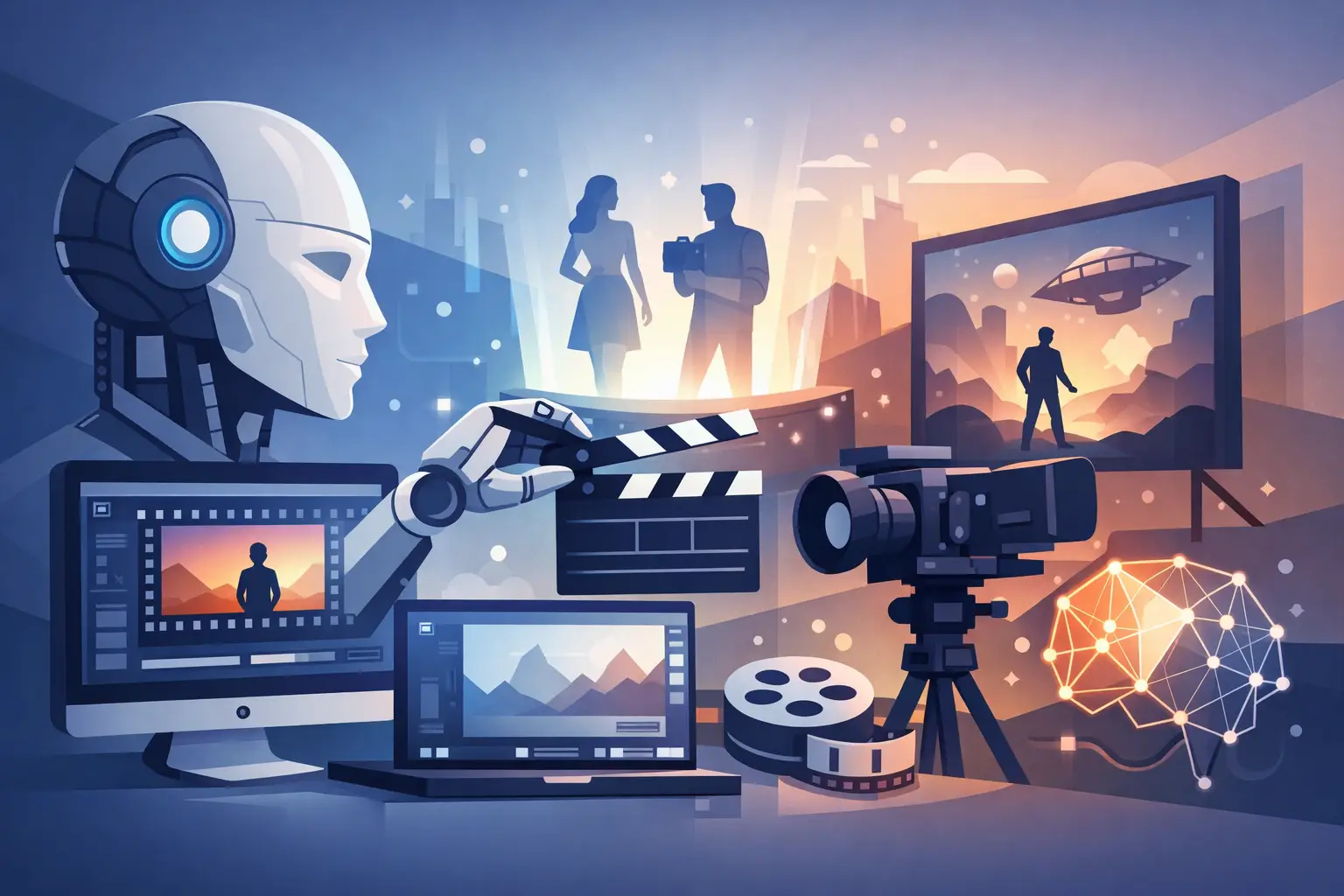
A shot begins as an intention: a face caught in sodium-vapor light, a city that seems to remember its former shape, a character who cannot trust the room around them. So, how are AI films made? Not by pressing a button and receiving a finished movie. They are made through a chain of choices - writing, visual development, generation, selection, performance, sound, and editing - where artificial intelligence becomes part of the filmmaking process.
The result can be fully generated, heavily AI-assisted, or built from a hybrid of live-action footage, 3D assets, animation, and machine-generated images. The label matters less than the creative logic. AI cinema is not defined by whether every pixel came from a model. It is defined by how artists use these systems to create moving-image work that could not exist in quite the same way otherwise.
How Are AI Films Made? Start With the Film, Not the Tool
The strongest AI films usually begin where strong films have always begun: with a premise, a feeling, a dramatic question, or a precise visual idea. A filmmaker may write a conventional screenplay, construct a short treatment, assemble fragments of dialogue, or work from a sequence of images. The planning can be loose, but it needs direction.
Generative tools are exceptionally good at producing possibilities. They are not inherently good at deciding which possibility deserves to become a scene. That decision belongs to the director, writer, editor, or creative team.
For a short AI film, the early development phase often includes a story outline, character descriptions, a tonal reference, and a rough shot list. A creator might establish that a story unfolds over one rain-soaked night, that the camera remains intimate and unstable, or that every location should feel slightly too large for the characters. Those constraints create continuity before generation begins.
This is also where a project finds its point of view. Without one, AI imagery can become an impressive stream of surfaces: beautiful faces, impossible architecture, movement without consequence. Cinema needs more than visual novelty. It needs tension, rhythm, and an idea about what the viewer should feel.
Building the Look of an AI Film
Visual development is often the first visible stage of AI filmmaking. Creators use image-generation systems to explore characters, costumes, environments, lighting, lenses, framing, color, and production design. The process resembles a fast, volatile version of concept art.
A prompt may describe a scene, but experienced creators rarely stop there. They build reference boards, test multiple formulations, generate variations, and identify recurring visual rules. A character may need a particular silhouette, age, wardrobe palette, and emotional presence. A world may require a consistent architecture or weather pattern. The work is less about finding one perfect image than creating a visual language that can survive across many shots.
Consistency remains one of the medium's central challenges. AI models can drift. Faces change, wardrobe details disappear, rooms reshape themselves, and a camera move can alter the identity of a subject. Creators address this through reference images, character sheets, image-to-video workflows, masking, compositing, and repeated generation. Sometimes they accept instability as part of the aesthetic. In a dreamlike or surreal film, controlled mutation may be an advantage. In a grounded drama, it can break the spell.
The trade-off is clear: the more control a project needs, the more deliberate the pipeline becomes. AI can compress certain production tasks, but it does not eliminate craft. It often moves craft upstream into planning and downstream into cleanup.
From Still Frames to Moving Scenes
Once a look is established, filmmakers turn designs into shots. Video-generation models can create motion from text, animate a source image, extend a clip, alter a performance, or reinterpret live-action material. Some creators generate shots directly from a written description. Others begin with storyboards, photography, 3D blocking, or footage they have shot themselves.
A scene is usually constructed shot by shot, not generated as a complete five-minute sequence. The filmmaker decides whether the moment needs a wide establishing frame, an insert of a hand, a reaction, a tracking movement, or a hard cut to another location. This is where conventional cinematic grammar still matters.
Motion generation has its own language. A prompt might specify a slow dolly toward a character, wind lifting fabric, shallow focus, or a handheld documentary feel. Yet the final result depends on the source material, model behavior, timing, and iteration. A request for a subtle glance can produce a dramatic head turn. A quiet walk can become an unnatural glide. The creator reviews, rejects, refines, and generates again.
Many AI filmmakers use live-action performance as an anchor. An actor may perform a scene against a simple background, with AI used later to change the environment, wardrobe, age, or visual treatment. Others use motion capture, pose references, or animated previs to guide body movement. This hybrid approach can preserve human gesture while opening visual territory that would be expensive, dangerous, or physically impossible to shoot.
Performance Still Carries the Scene
AI can generate faces and voices, but performance is more than a face moving in sync with dialogue. It is timing, hesitation, breath, contradiction, and the small choices that make a character feel observed rather than invented.
Some AI films use synthetic voices designed for a specific tone or character. Others work with voice actors, narrators, or performers whose recordings are transformed in post-production. The ethical line is essential here. A person’s likeness or voice should not be used without clear consent, appropriate permission, and a shared understanding of how the work will be distributed.
The same care applies to source material. Creators need to understand the terms of the tools they use, the rights attached to their inputs, and the rules governing music, archival material, brand imagery, and recognizable people. Legal standards and platform policies are still evolving. That does not make responsibility optional. It makes documentation and consent more valuable.
Editing Is Where AI Cinema Becomes a Film
Generation produces footage. Editing creates cinema.
An AI project may produce dozens or hundreds of candidate clips for a sequence that lasts only seconds. The editor chooses the version with the right glance, the right lighting shift, the right accidental detail, or the right cut point. They shape pace, establish geography, hide visual inconsistencies, and decide when the audience needs clarity versus mystery.
Post-production often includes traditional tools and techniques: color correction, compositing, rotoscoping, motion graphics, cleanup, sound design, music editing, dialogue repair, and final mastering. AI may assist with some of these tasks, but the finishing process is still exacting. A poorly mixed AI film feels unfinished no matter how striking its images are.
Sound is especially powerful because it gives generated images physical presence. Footsteps make a corridor feel solid. Room tone gives a close-up air. A distant siren can turn a static city frame into a living place. Music can expand an image, but it can also tell the viewer what to feel too aggressively. The best choice depends on the film. Silence is sometimes the most cinematic layer.
The Director’s Role Has Expanded
AI filmmaking asks directors to think like writers, visual artists, editors, production designers, and system designers at once. They are setting parameters as well as staging scenes. They are curating output as well as capturing it.
That does not mean every creator must be technical. A director can collaborate with prompt artists, editors, animators, sound designers, performers, and AI specialists just as a traditional director collaborates with a crew. The medium is already collaborative. Its production roles are simply still taking shape.
AICINEO treats this emerging practice as AI Cinema: a medium with its own works, audiences, visual traditions, and critical standards. The question is no longer whether AI can make moving images. It can. The more interesting question is what a filmmaker does with that capacity.
What Makes an AI Film Worth Watching?
The answer is not resolution, realism, or the number of tools involved. A memorable AI film has intent. Its visual choices serve a story or a sensation. Its strangeness feels authored. Its edits create meaning rather than merely connecting attractive clips.
AI is most compelling when it gives a filmmaker access to a world, transformation, or visual rhythm that would otherwise remain out of reach. It can let a small team imagine large-scale science fiction, animate inner life, rebuild memory as unstable architecture, or create a new form between live action and illustration.
Make the first shot for the feeling you cannot shake. Then build every tool choice around protecting that feeling all the way to the final cut.