

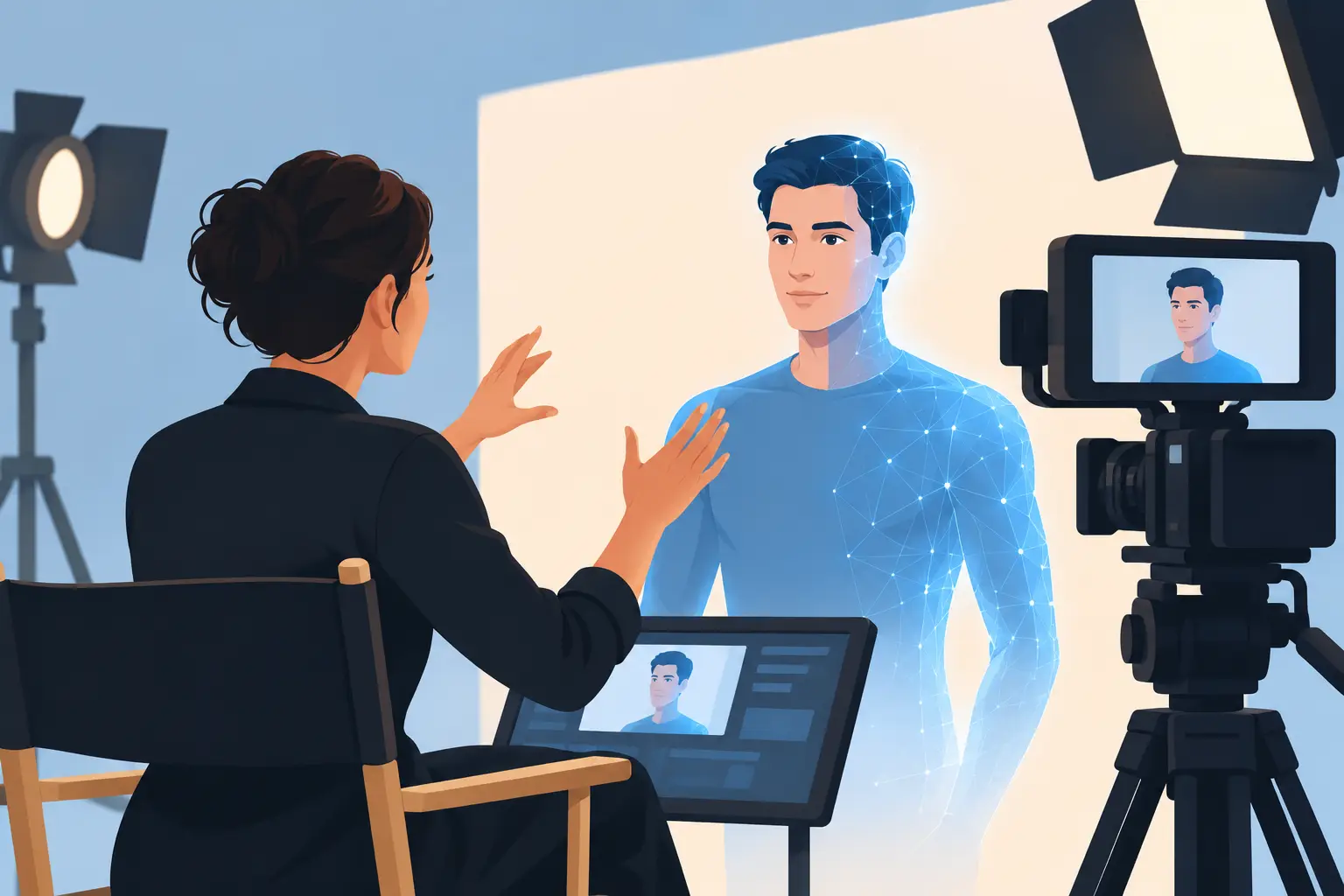
A close-up fails for a reason most prompts cannot name: the face is expressive, but the character has no objective. Learning how to direct generative actors means moving beyond attractive images and toward performance design. The model can render a gaze, a tremor, a withheld smile. The director decides what the gaze wants, why the tremor arrives now, and what the smile costs.
Generative actors are not performers in the human sense. They do not interpret a script, remember a rehearsal note, or protect a character's interior life between takes. But they can become a new kind of cinematic instrument: responsive to language, reference, framing, rhythm, and selection. Directing them is the craft of turning those inputs into intentional screen behavior.
Start With the Character's Pressure
Do not begin by asking for an emotion. “Sad,” “angry,” and “afraid” are broad visual labels. They tend to produce familiar shorthand: tears, clenched jaws, widened eyes. A stronger direction begins with pressure.
What does this person need from the scene? What are they refusing to reveal? What changed one second before the shot begins? A character trying not to cry is different from a character who wants someone to notice their pain. Both may look sad. Their behavior, timing, posture, and relationship to the camera should not be the same.
Write each shot as a playable action rather than a mood. “She listens for the verdict, realizes it is worse than expected, then chooses not to give him the satisfaction of seeing her break” gives the generation a sequence of behavior. It also gives you criteria for judging the output.
This is the first rule of AI cinema performance: direct the change, not the pose. Cinema lives in transitions. A held expression becomes compelling when the audience can feel the thought moving behind it.
Build a Performance Beat Before You Generate
A generative shot benefits from the same preparation as a conventional scene, just compressed into a more precise brief. Define the character, their immediate objective, the emotional turn, physical behavior, camera relationship, and duration. The brief should describe what happens on screen, not merely the atmosphere around it.
For example, instead of prompting for “a devastated astronaut in a cinematic spaceship,” establish the beat: an astronaut receives a transmission from Earth; she recognizes her daughter's voice; she keeps working as if nothing has happened; only her hand gives her away. Now the performance has an arc and a detail that can carry the shot.
The camera relationship matters as much as the face. A frontal close-up asks for scrutiny. A profile can preserve secrecy. A distant frame makes the actor part of the architecture of the scene. If the character is losing control, a locked-off camera may create more tension than frantic movement. If the character is lying, a slow push-in can turn stillness into exposure.
Keep the instruction hierarchy clean. Lead with the dramatic event and the subject’s behavior. Then establish framing, lens language, movement, lighting, period, texture, and other visual conditions. When every detail has equal weight, the performance often becomes generic or unstable.
Give the Model One Main Event
Many failed generations try to stage too much in one clip. A character walks, turns, picks up an object, cries, speaks, remembers, and exits. The result may be technically impressive but dramatically unreadable.
Break the scene into shots with one dominant event each. One shot can be the hand pausing over a door handle. The next can be the decision to enter. The next can reveal the face. This is not a limitation. It is editing logic. Fragmentation lets you control attention, hide artifacts, and create performance through juxtaposition.
Direct Behavior, Not Decorative Emotion
Generative systems respond especially well to visible, specific behavior. A flickering hesitation before an answer. A breath held too long. Fingers tightening around a glass. Eyes tracking someone just outside frame. These are cinematic instructions because they create readable action.
Avoid treating every scene as an emotion poster. Big expressions can work in heightened genres, music-driven work, animation, or surreal cinema. In a naturalistic drama, restraint usually travels farther. Ask for an emotion to be contained, interrupted, masked, redirected, or almost revealed. The word “almost” is often more useful than “extreme.”
Use contradictions. A character can speak softly while preparing to attack. They can smile while refusing eye contact. They can remain physically still while the frame tells us their world is collapsing. Contradiction gives a synthetic performance texture. It prevents the system from resolving the feeling into a single obvious image.
Voice direction follows the same principle. If you use generated dialogue or dubbing, do not settle for a polished reading that explains every word. Give the line an intention: persuade, conceal, provoke, delay, test, seduce, survive. Then control pauses and breaths in the edit. A slightly imperfect voice can feel more alive than one stripped of all friction.
Continuity Is Part of the Direction
A beautiful take is not necessarily a usable take. The audience needs to recognize the same person, costume, emotional state, screen direction, and spatial logic from shot to shot. Generative actors can drift in all of these areas unless continuity is designed from the first frame.
Create a character bible before production. It can be compact, but it should lock the features that matter: age range, silhouette, hair, wardrobe, grooming, facial proportions, posture, color palette, and recurring objects. Include behavioral constants too. Perhaps the character avoids direct eye contact, favors one shoulder after an old injury, or touches a ring before lying. These repeated choices create identity beyond facial consistency.
Reference images and recurring visual anchors help, but they are not a substitute for shot planning. If the character exits frame left in one shot and appears moving right in the next, the scene may feel wrong even if the face is perfect. Preserve eyelines. Map entrances and exits. Decide where the other character stands before generating the reverse angle.
It depends on the project how strict this needs to be. A fever-dream short can use facial drift as part of its language. A narrative scene built around intimacy cannot. The key is authorship: instability should be a decision the film makes, not an accident it tolerates.
Generate Coverage Like a Director, Not a Collector
The temptation is to keep generating until a miraculous clip appears. That can produce isolated moments, but it rarely produces a scene. Directing means gathering coverage with an edit in mind.
For each dramatic beat, generate a small range of purposeful options: the establishing frame that locates the bodies, the medium shot that carries action, the close-up that holds the turn, and the cutaway that gives the edit air. A reaction shot is often more valuable than another hero image. It lets the audience complete the emotion themselves.
Vary one dimension at a time when you iterate. Keep the character, location, and behavior stable while testing camera distance. Or retain the frame while adjusting the degree of restraint in the performance. If every variable changes between generations, you cannot tell what improved the result.
Name and organize takes according to their dramatic function, not just their technical settings. “Mara hears the message - contained” is more useful in the edit than “version 37.” The process becomes legible to collaborators, and your best material remains connected to the scene's intent.
Use Editorial Judgment to Finish the Performance
The final performance is rarely contained in a single generated clip. It emerges in the cut: a look held two frames longer, a reaction placed before the line, an interruption by an empty hallway, a sound arriving before the image changes.
This is where AI cinema becomes cinema rather than demonstration. A generated actor may offer a nearly convincing micro-expression but lose consistency at the end of the take. Cut before the failure. Let sound bridge the transition. Use an insert of a hand, a window, a screen, or another character's response. Conventional filmmaking has always shaped performance through selection and assembly. Generative work simply makes that truth more visible.
Sound is especially powerful here. Footsteps that stop outside a door, a distant machine, fabric moving as someone shifts their weight, an inhale before a confession - these cues give generated bodies mass and intention. Do not ask the image to carry every dimension of the scene.
Keep the Human Stakes Clear
Generative actors raise questions that belong inside the directing process, not after it. Do not use a recognizable person's likeness or voice without clear permission. Be cautious with real identities, especially in intimate, violent, political, or deceptive contexts. If your actor is wholly invented, establish that choice clearly in your production records and creative workflow.
There is also an artistic question. A human actor brings biography, surprise, resistance, and collaboration. A generative actor offers malleability, visual possibility, and a different relationship to iteration. Neither replaces the other across every project. The right choice depends on the story, the resources, the aesthetic, and the kind of authorship you want the audience to feel.
The strongest work does not pretend this new medium has no limits. It composes with them. It writes for the glance, the cut, the silhouette, the unstable memory, the impossible location, and the image that could not have existed any other way.
Direct the generative actor as you would direct any element of cinema: give it a reason to be there, a precise moment to change, and a place in the cut. Then leave room for the image to become stranger than your first instruction.