

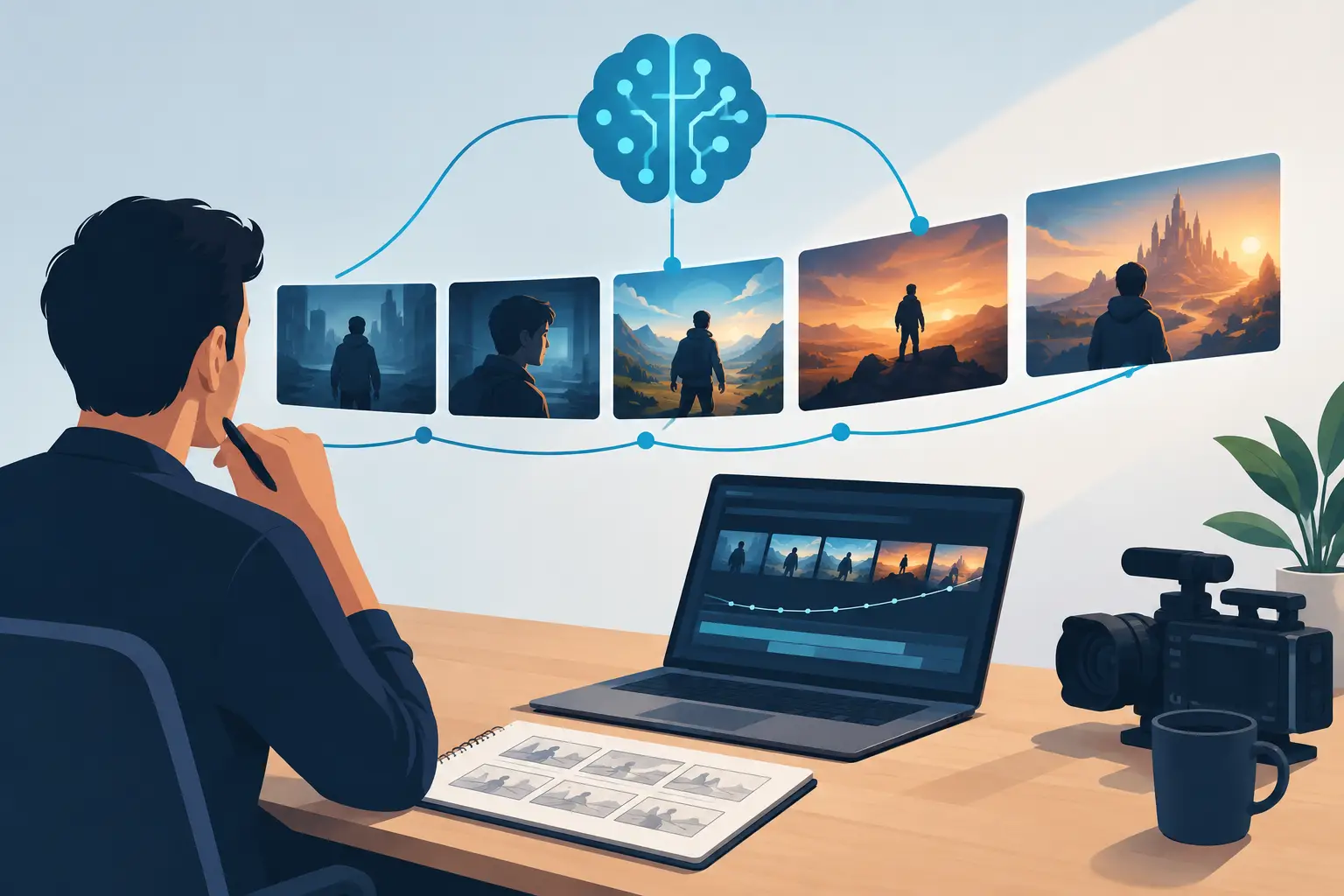
A generated shot can be beautiful and still belong nowhere. That is the central risk of AI cinema: visual possibility arrives faster than dramatic intention. To plan AI visual narrative arcs is to decide how an image, a character, and a world must change before a model generates its first frame.
The goal is not rigid control. AI tools are strongest when they introduce variation, accident, and visual force. The work is giving those forces a destination. A narrative arc turns a sequence of remarkable images into a film with pressure, memory, and consequence.
Start With the Visual Change, Not the Prompt
Every scene should move from one visual state to another. A room becomes less stable. A face becomes less legible. A city shifts from invitation to threat. The audience may not name the change, but they feel it.
Write the arc in a single sentence before building frames. Avoid describing only plot. “A courier enters a forbidden district” gives the action, but not the cinematic movement. “A courier crosses from hard daylight into a city that gradually absorbs her identity” gives the image system something to perform.
This distinction matters because generative video responds to visual language, not dramatic theory alone. A model can render rain, glass, velvet, fog, surveillance cameras, and impossible architecture. It cannot independently determine which of those elements should gain meaning over time. That decision belongs to the filmmaker.
A useful arc statement contains three conditions: the opening image state, the pressure acting on it, and the final image state. For example: a pristine archive is invaded by organic growth until its records become unreadable. That sentence can guide production design, shot selection, sound, color, pacing, and prompt development.
Build Your AI Visual Narrative Arcs in Movements
A feature may carry several arcs at once, but each sequence benefits from a simple progression. Think in movements rather than an inventory of shots. The first movement establishes a rule. The second tests it. The third breaks or transforms it.
Establish a visual contract
Early images teach the viewer how to read the film. If a character appears in formal, centered compositions against clean white interiors, that grammar creates an expectation of order and distance. It also gives later disruption weight.
Choose a limited visual vocabulary for this opening state. Define the palette, lens feeling, texture, light direction, spatial scale, and motion behavior. In AI production, this is also where you establish your reference set and prompt language. Repeating a few precise visual anchors is more valuable than adding ten attractive descriptors to every prompt.
Introduce pressure, not random novelty
The middle of an arc often fails when creators chase escalation through new imagery alone. More creatures, stranger locations, and larger effects can make a film feel like a feed. Pressure is different. It alters the logic of what has already been established.
If the opening world is symmetrical, introduce an off-axis horizon. If a character has been rendered in clear profile, let reflections, occlusion, or unstable identity enter gradually. If the camera has floated calmly, make its movement feel watchful or trapped. The image changes because the story is changing.
This is where AI’s volatility can become a craft advantage. A slight mutation in costume, weather, or architecture may reveal a world losing coherence. But use it selectively. If every shot transforms at maximum intensity, there is no scale left for the climax.
Deliver a visual consequence
The final movement should not merely look bigger. It should show that the initial image can no longer exist in its original form. The archive is overgrown. The white room has become a living membrane. The centered figure is now absent from the frame, or dwarfed by a space that once contained them.
A strong ending can resolve the visual system, reverse it, or leave it permanently altered. What matters is evidence of passage. The final image should carry the opening image inside it, even if only as a trace.
Treat Continuity as Meaning
Traditional production protects continuity because the camera records an existing set, performer, and costume. AI filmmaking has a different problem: the set, performer, and costume may need to be reconstituted for every shot. That makes continuity more than technical cleanup. It becomes a narrative choice.
Not every inconsistency is a failure. In a dream logic film, a character’s changing age or a shifting hallway can create productive unease. In a grounded thriller, the same instability may break tension. The question is not whether an element changes. It is whether the audience understands the change as part of the film’s language.
Create a continuity bible that records only what the audience must recognize. It might include a protagonist’s silhouette, a recurring red instrument panel, the geometry of a hallway, a moon shape, or the grain and contrast of a particular memory state. Keep it visual and concise. An overloaded bible can make experimentation timid.
For every recurring element, decide whether it is fixed, evolving, or unstable. Fixed elements orient the viewer. Evolving elements carry the arc. Unstable elements signal danger, subjectivity, or rupture. This simple classification helps a team make fast decisions when generations produce unexpected material.
Plan Prompts as Scene Direction
A prompt should not be a warehouse of adjectives. It should act like scene direction: specific about what the image must communicate, open enough to allow cinematic discovery.
Instead of asking for “a stunning futuristic woman in a surreal city, cinematic, detailed, dramatic,” direct the moment. Describe the subject’s relation to space, the emotional temperature, the camera’s behavior, and the visible pressure in the frame. The image has somewhere to go.
For a sequence, retain a stable prompt spine and alter only the variables tied to the arc. The stable spine may preserve subject, format, lens character, medium, and world. The changing variables may control weather, time of day, wardrobe condition, camera distance, expression, or environmental distortion.
This approach also makes iteration more intelligible. When a result fails, you can ask whether the problem is identity, staging, lighting, movement, or narrative emphasis. If everything changes at once, no one can diagnose why the image lost its place in the sequence.
Edit for Contrast Between Shots
Narrative arcs do not live inside isolated frames. They appear in the cut.
Place an image beside its predecessor and ask what has shifted. Is the frame tighter? Has the character lost visual control? Is the sound now ahead of the picture? Has the color temperature crossed a threshold? The answer does not need to be dramatic in every cut. Small, accumulating differences often create the deepest sense of change.
This is especially useful when source clips vary in quality or fidelity. Rather than hiding every mismatch, organize contrast. A sudden drop in resolution can mark a memory fracture. Hyper-detailed skin can feel invasive after painterly distance. A flattened, graphic image can arrive when a world is reduced to data. The edit gives these variations purpose.
Still, there is a trade-off. Formal disruption only works after the audience has enough stability to recognize it. If the first thirty seconds establish no visual rules, later violations have little force. Give viewers an image world they can inhabit before you pull its floor away.
Protect the Human Decision
AI can produce dozens of interpretations of a scene. It cannot decide which interpretation makes the film more truthful to itself. That is the director’s work, whether the director is operating alone or inside a distributed creative team.
Hold review sessions around the arc, not around novelty. Ask: Does this image advance the transformation? Does it repeat an earlier beat? Does its strangeness reveal character or only demonstrate the tool? Does the sequence still have room to become more intense?
At AICINEO, AI cinema is not defined by how much of the frame was generated. It is defined by the force of the film that emerges from those choices. A visual arc is where that force becomes visible.
Before the next generation pass, return to the opening and final frame of your sequence. Put them side by side. If the distance between them feels inevitable, strange, and emotionally earned, you have a direction worth following. Let every new image travel that distance.