

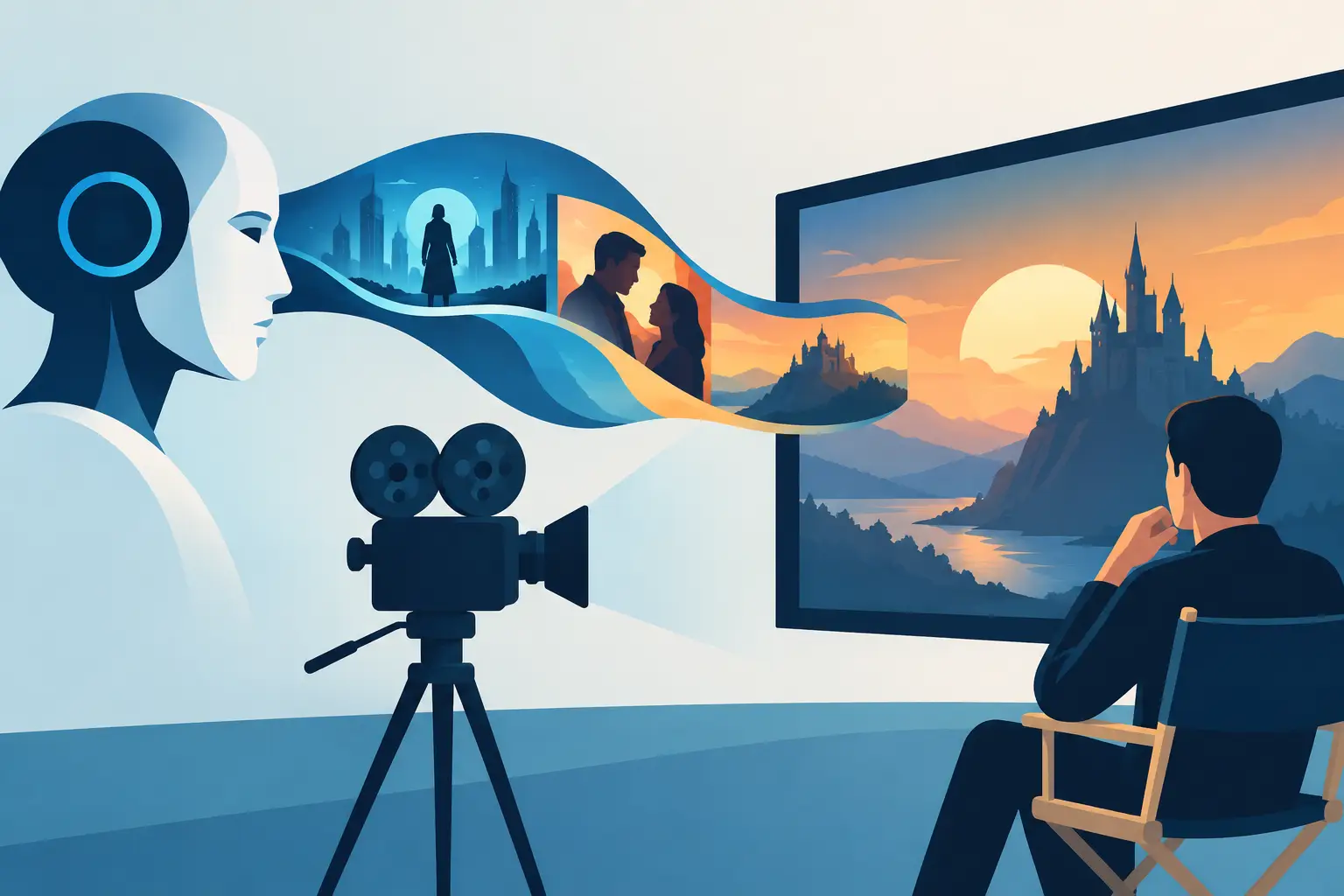
A face appears in rain-soaked neon. The city behind it never existed, yet its mood is precise: exhausted, dangerous, intimate. That image is not a shortcut to a film. It is a question the filmmaker has made visible. Synthetic storytelling begins there, where generated material becomes more than spectacle and starts carrying intention.
For cinema, the shift is not simply that images can now be produced from language, reference, motion, or performance. The shift is that filmmakers can construct a story world at a different speed, scale, and level of instability. A scene can be imagined before a location is found. A creature can be cast before it is modeled. A visual language can be tested before a crew is assembled.
That does not make the work less cinematic. It raises the standard for what must be cinematic about it.
What synthetic storytelling actually means
Synthetic storytelling is the deliberate use of generative systems to create, transform, or extend story elements. Those elements may include images, moving footage, voices, sound, environments, characters, objects, performances, and edits. The word synthetic describes the construction of the material, not the absence of meaning.
A synthetic story can be built from wholly generated shots. It can also combine live-action footage, practical sets, archival textures, animation, virtual production, and AI-assisted post-production. The method is broad because cinema has always been composite. Matte paintings, rear projection, miniatures, CGI, montage, and sound design all changed what a camera could suggest. Generative tools move that compositing power earlier into the creative process and place more of it in the hands of smaller teams.
The distinction matters. A stream of impressive generated images is not necessarily a film. Cinema needs selection, rhythm, point of view, consequence, and emotional continuity. Synthetic storytelling is not defined by how much AI is present. It is defined by whether the work uses synthetic material to make an audience feel, infer, remember, or question something.
The new unit of production is the scene idea
Traditional filmmaking is shaped by physical constraints. A script becomes a schedule. A schedule becomes locations, crew calls, rentals, weather plans, coverage, and compromises. Those constraints can produce discipline and happy accidents, but they also limit what gets attempted.
Synthetic production changes the order of operations. A filmmaker can begin with a visual premise that would once have required a major effects budget: a flooded apartment complex suspended over an ocean, a 1920s desert city run by sentient machinery, a memory replayed through shifting faces. The first task is no longer always, “Can we afford to shoot this?” It may be, “What does this scene need to make the audience believe it?”
That is a meaningful creative freedom. It is also a trap. When every image is possible, taste becomes the scarce resource. The filmmaker has to establish rules for color, lens behavior, production design, movement, texture, and character presence. Without those rules, generated scenes often feel like adjacent dreams rather than parts of one world.
The strongest synthetic films treat generation as a department with direction, not a slot machine for visual surprise. They develop references, test shots, reject attractive mistakes, and return to the same narrative problem until the image serves the scene.
Direction becomes more visible
In a conventional production, directing is distributed across performance, staging, framing, editing, design, and collaboration. In AI cinema, none of those roles disappear. They become more explicit. A director may need to describe not only what a character does, but how an image should fail, drift, breathe, or resist clarity.
This can make authorship feel unusually direct. A filmmaker is often setting the conditions of an image repeatedly, then judging variations with a highly developed internal compass. But prompting alone is not direction. Direction is deciding why this version of a shot belongs before and after the shots around it.
The same is true of editing. Synthetic footage can offer endless alternatives, but more options do not create pacing. A cut still has to control information. It still has to withhold, reveal, interrupt, and land. The audience does not experience a workflow. It experiences time.
Why the medium is changing visual authorship
For independent filmmakers, synthetic storytelling can compress the distance between imagination and screen. A writer with a strong visual sensibility can prototype a feature world. An animator can make a short with a scale that would have been inaccessible. A director can test competing treatments without waiting for a development cycle to approve one.
This does not eliminate collaboration. It changes the collaboration map. Small teams may bring together a filmmaker, a visual development artist, an editor, a sound designer, a performer, and a technical artist rather than building a conventional production hierarchy. The creative advantage comes from a shared language across those disciplines.
It also creates a new expectation: creators should be able to articulate their intent. “Make it cinematic” is not enough. The useful question is more specific. Is the scene meant to feel observed, remembered, recorded, manufactured, or dreamed? Is the camera a witness, a predator, a machine, or an unreliable consciousness? Synthetic tools respond best when the filmmaker has an actual point of view to impose.
AICINEO exists for this emerging language of AI cinema: work where the medium is not an effect added to a familiar format, but part of the film’s artistic logic.
The danger of frictionless images
Generative images can be beautiful before they are meaningful. That is their power and their risk. When novelty arrives quickly, creators can mistake visual density for dramatic depth. A dozen strange transformations will not replace one clear reversal in a character’s desire.
There is also a recognizable aesthetic drift. Left unguided, models may produce polished faces, familiar lighting, floating camera movement, and generic grandeur. The result can look expensive while saying very little. The answer is not to reject polish. It is to introduce specificity: imperfect locations, unusual blocking, regional detail, deliberate silence, awkward pauses, rough textures, and references that come from life rather than from the image feed.
Synthetic storytelling is strongest when it preserves friction. A character should want something that costs them. A world should have limits. An image should sometimes hold still long enough for a viewer to feel its consequences.
Consent, provenance, and the ethics inside the frame
AI cinema cannot treat ethics as a legal disclaimer at the end of production. The choices are part of the work. If a film uses a performer’s likeness, voice, body, writing, or style-adjacent identity, consent and compensation are creative conditions, not paperwork.
Provenance also matters. Audiences may accept synthetic imagery while still wanting clarity about what was generated, transformed, performed, or sourced. The right degree of disclosure depends on the project and its presentation. A fictional short may use ambiguity as part of its language. A documentary, political work, or realistic depiction of public events carries a much higher obligation to distinguish evidence from invention.
The deeper issue is trust. Cinema has always manipulated reality, but it has also developed conventions that help viewers understand the kind of truth a work is claiming. Synthetic storytelling needs its own mature conventions, especially as generated scenes become harder to identify on sight.
Build from a cinematic question
The most productive way to begin is not with a tool. Begin with a question only this medium can help you ask. What would grief look like if a city could rewrite itself around a person? What happens when a character’s memories are visually persuasive but physically impossible? How can an artificial world reveal a real social condition?
Then make a short sequence, not a gallery. Give it a beginning, a turn, and an ending. Use sound early. Let dialogue be sparse if the image can carry the information, but do not assume silence equals depth. Watch the sequence without explaining it. If its emotional movement remains clear, the synthetic material is doing its job.
The future of AI cinema will not be decided by who generates the most footage. It will be shaped by filmmakers who can make synthetic images feel necessary. Start with one scene that has something at stake, and give every impossible frame a reason to exist.